
Tour of Jericho and the Jordan Valley with Combatants for Peace
Translator: Charles K.
ECOME is an ecological commune of Jews, Palestinians and people from abroad located near Almog junction in the Jordan Valley. Members live in tents temporarily, primarily in winter. Today they left.
The tour began in Jericho, led by Osama, and included explanations about the refugee camps Aqbat Jabb’r, Ein el Sultan and a-Nu’eima, which were almost emptied of their residents in 1967 when they became refugees for the second time, in Jordan.
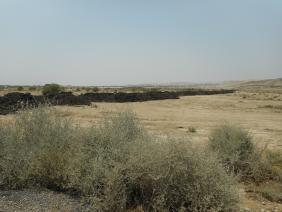
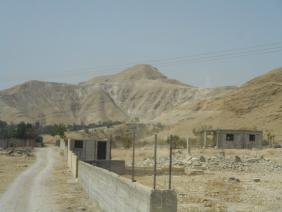
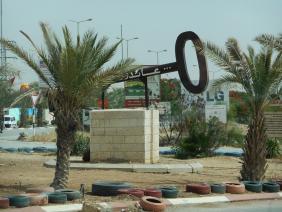
Jericho is a quiet, white and pleasant town. Well taken care of, clean and spacious. Most residents are farmers because it has plentiful water and fertile land. Attempts to develop a tourist industry (casino, pilgrims, etc.) repeatedly fail because of the violent political reality which dissuades tourists from visiting the town and the region. Many residents of Jerusalem buy land because they’re not allowed to build in Jerusalem, so they build homes here.
Osama’s family is from Silwan but they had a house in Jericho which they used during the cold winters. Afraid their house would be taken from them if they weren’t present, his grandfather sent Osama’s father to live in the Jericho house, and when people living in Jerusalem registered themselves as residents of the city, he didn’t and was later unable to return to live there. But they consider themselves Jerusalemites. We went to the eastern part of the town, to Kafr Dyuk which is, unlike Jericho, Area C, under Israeli control. And unlike Jericho with its lovely homes, here we find ruins, homes demolished one after the other every few months, as usual in Area C.
The organizers wanted the tour to focus on ecological aspects, but everything that happens in the Jordan Valley or the rest of the occupied territories is political. One focus of the tour was Israel’s taking over of water resources and preventing access by the local residents: Increased pumping by Mekorot for the sole benefit of the settlers, together with denial of water to Palestinians. We visited the a-Nueima spring in Jericho, the el-Auja spring north of Jericho (which is already, in May, almost dry because of Israel’s four pumping stations), and the Tirza reservoir near the Yafit settlement – a stepped system of three dams channeling all the abundant surface flow, flooding and rain from Wadi Far’a (Tirza) to a huge reservoir supplying water to the Jordan Valley settlements and preventing it from reaching the Jordan Basin and flowing down to the Dead Sea. That’s how the Dead Sea is being dried up and sinkholes are created.
We visited Bardala in the northern Jordan Valley to see how the process operates: In Area B, in the heart of a Palestinian village, are huge Mekorot pumps next to abandoned Palestinian pumps because they’re not allowed to go below 150 meters. We met a Palestinian who took us to Waqf land which the Palestinians are attempting to cultivate and the settlers in the area (Na’aran, Nativ HaGdud) forcibly prevent them, with the army’s backing, even though the landowners have an Israeli court order that they own the land legally. The tour participants found that very troubling. They know the Jordan Valley settlers are leftists, from the Labor Party, kibbutzim, “one of us,” so how can they prevent the landowners from cultivating their lands? They asked repeatedly whether we’re sure the local settlements are the ones interfering with the Palestinians are local settlements, and not more extreme settlers from Samaria… Which goes to show that when the “left” wants to steal land it sheds its presumed leftism and becomes no different than the Samaria hilltop youth.
We talked about firing ranges, nature preserves in the middle of firing ranges, about the process of detaching the valley from the central West Bank, about Palestinian lands included within the immoderate areas of land given to settlers, and about demolition of homes. For lunch we were hosted by the Bisharat family from Makhoul, beneath a solitary tree (all plantings are uprooted by the army).
The participants had difficulty accepting the reality, and repeatedly offered (to Israel) solutions to the problems of water and Palestinian construction, while Osama and I repeated over and over again the most important fact – Israel isn’t interested in solving Palestinians’ problems, because their expulsion is planned, and worsening all the conditions we’ve been discussing is one way to implement it more quickly.
It was particularly hot today and I must note that the guests bravely withstood the terrible heat. In fact, the heat contributed to understanding what it’s like to live in the Jordan Valley, especially without water. At the end of the tour some people told me, “We’re very familiar with what’s happening in the occupied territories, but we never imagined what it’s like in the Jordan Valley.” They had assumed there was reasonable coexistence because the settlers in the Valley are kibbutz members. What they saw and heard was a total surprise for them.
In my opinion the tour was successful, despite the heat, even though it presented a great deal of information. People exposed to this reality for the first time aren’t able to absorb so much, but, on the other hand, I felt there was a great deal more to show and tell them… The cooperation with Osama was excellent and made an important contribution.
Lunch (which we paid for) in Makhoul was very successful. The wonderful residents of Makhoul touched the participants’ hearts, and the account of the demolition of their village two years ago, and the description by Abu Khal’f, who’s 78, of his life there before and after ’67, and sitting and eating together, helped the guests sympathize with the difficulties of the community of shepherds in the Jordan Valley.
V