
Dura-Al Fawwar Junction, Hebron, South Hebron Hills
Today is the fourth of June and in another day 51 years from the Six-Day War. I do not know anymore whether this can be called occupation and not an ongoing apartheid policy.
It is so complex and annoying that people are driven by fear and arrogance and hatred.
There is only a checkpoint on road 60
Al – Fawwar and there is almost no army. Except at the pool opposite Al Fawwar.
In the two pictures below:
Hill 22, Giv’at HaMevaser, a new neighborhood of Kiryat Arba. Already has electricity, infrastructure development work. Four caravans and soldiers guarding it. Another bone in the throat for the Palestinians.
On all the checkpoints the greeting of the army and the authorities wishing people Ramadan Karim. But all this decorations brings no joy to the heart.
The heart is very heavy today in Hebron and a great tension is felt in the air because of the murder of the tractor operator who was involved in the construction of the road. We only talk to a young boy on the street and he sounds frightened. Every moment I can die, he says. Because of Ramadan, we do not go in to talk to people. The soldier we talk to is surrounded by settlers who came to reinforce him. He tells me that the tractor came from Curve 160 and this was clearly with the desire to run someone over. But even in that case they did not have to kill him. But I do not believe the army’s version. Fear prevents them from having any moral considerations. Racism prevents them from seeing Palestinians as people. It is frightening and outrageous what we have become.
The tension in the air conquered us and we left without going up to Tel Rumeida.
Under the house of Rachel and Leah on a road that is forbidden to Palestinian cars to pass, already six cars of the Jewish settlers are parked. Another proof of apartheid.
We returned through Hursa and the divan of the family is open next to the pillbox. The Palestinian live in the shadow of Big Brother all the time.
The Palestinians now have cameras with which they can show what is happening.
And all this is not done in my name, but the spirit resistance is diminishing with the indifference of our surrounings.
It is possible not to know and simply to fear kites.
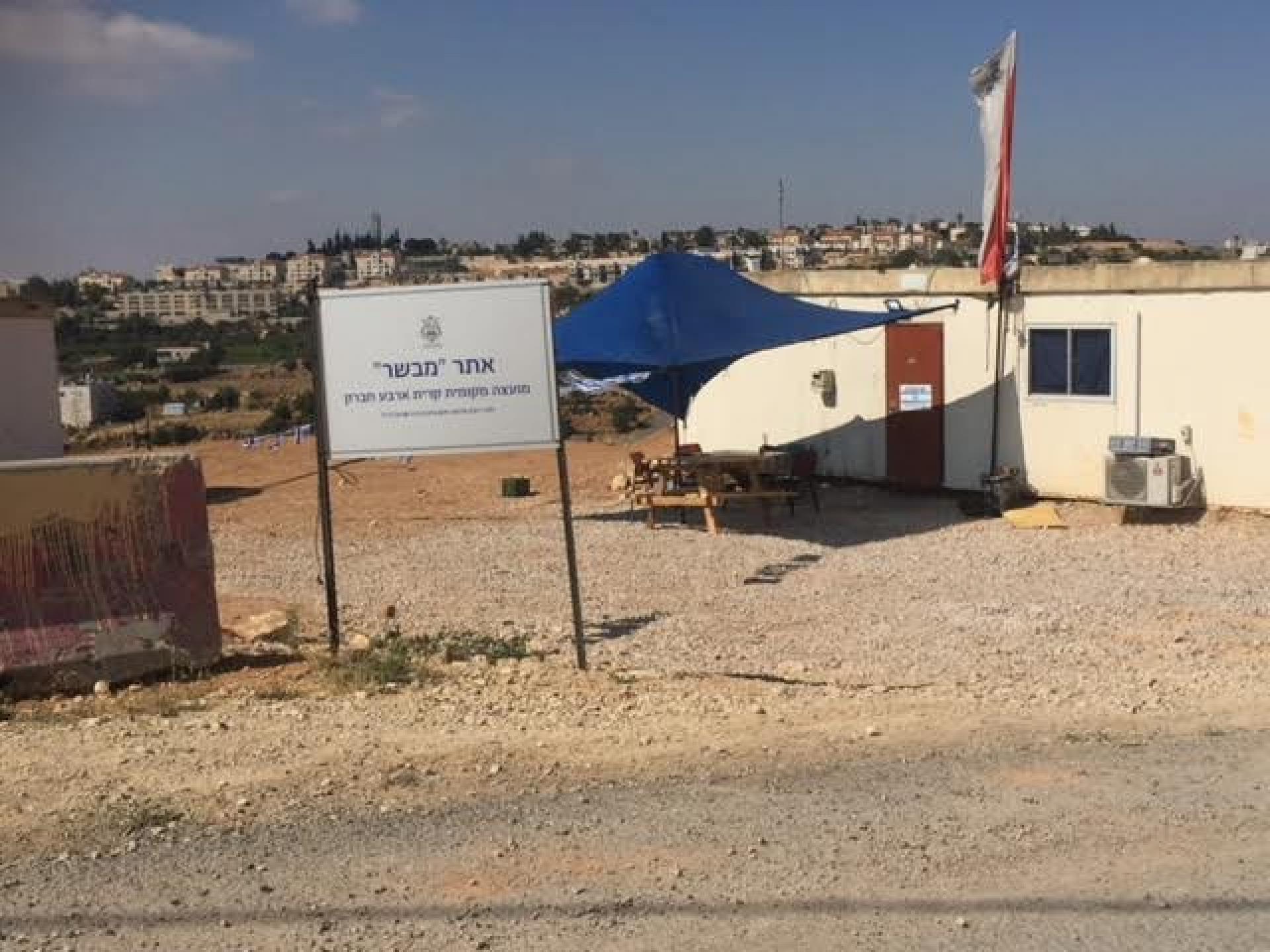
Dura Al-Fawwar Junction
See all reports for this place-
Junction on Route 60: west - the town of El Dura, east - the Al Fawwar refugee camp. There is a manned pillbox at the junction. From time to time the army sets up flying checkpoints at the entrance to El Fawwar and Al Dura. Al-Fawwar is a large refugee camp (7,000 inhabitants in 2007) established in 1949 to accommodate Palestinian refugees from Be'er Sheva and Beit Jubrin and environs. There are many incidents of stone-throwing. In the vicinity of the pillbox there are excellent agricultural areas, Farmers set up stalls adjacent to the plots close to the road. In recent months the civil administration has set up dirt embankments thereby blocking access to the stalls, and making it impossible for the farmers to sell their vegetables. Updated April 2021, Michal T.
-
Hebron
See all reports for this place-
According to Wye Plantation Accords (1997), Hebron is divided in two: H1 is under Palestinian Authority control, H2 is under Israeli control. In Hebron there are 170,000 Palestinian citizens, 60,000 of them in H2. Between the two areas are permanent checkpoints, manned at all hours, preventing Palestinian movement between them and controlling passage of permit holders such as teachers and schoolchildren. Some 800 Jews live in Avraham Avinu Quarter and Tel Rumeida, on Givat HaAvot and in the wholesale market.
Checkpoints observed in H2:
- Bet Hameriva CP- manned with a pillbox
- Kapisha quarter CP (the northern side of Zion axis) - manned with a pillbox
- The 160 turn CP (the southern side of Zion axis) - manned with a pillbox
- Avraham Avinu quarter - watch station
- The pharmacy CP - checking inside a caravan with a magnometer
- Tarpat (1929) CP - checking inside a caravan with a magnometer
- Tel Rumeida CP - guarding station
- Beit Hadassah CP - guarding station
Three checkpoints around the Tomb of the Patriarchs
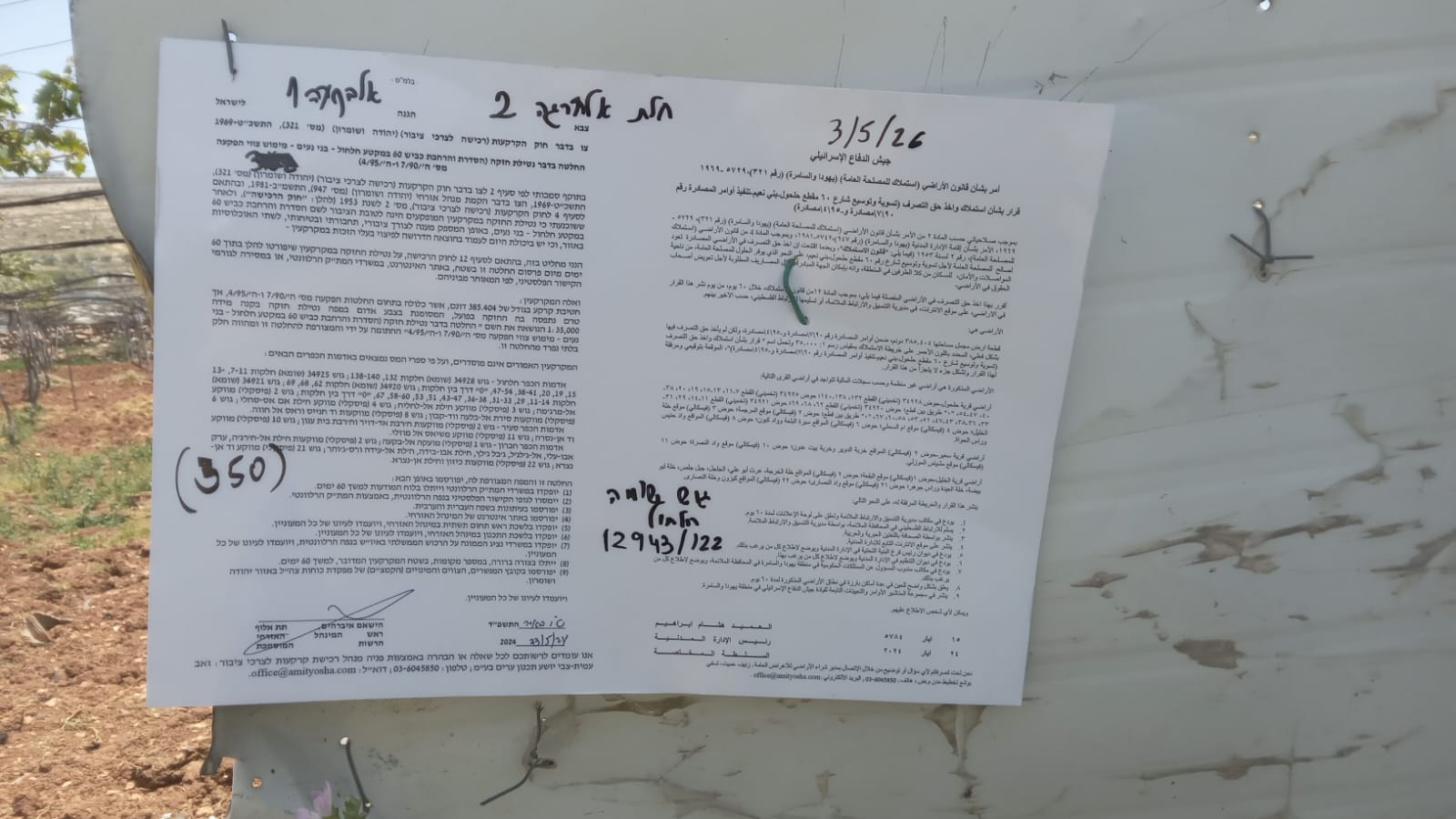 Muhammad D.May-13-2026Hebron - Request for compensation for land expropriation
-
South Hebron Hills
See all reports for this place-
South Hebron Hills
South Hebron Hills is a large area in the West Bank's southern part.
Yatta is a major city in this area: right in the border zone between the fertile region of Hebron and its surroundings and the desert of the Hebron Hills. Yatta has about 64,000 inhabitants.
The surrounding villages are called Masafer Yatta (Yatta's daughter villages). Their inhabitants subsist on livestock and agriculture. Agriculture is possible only in small plots, especially near streams. Most of the area consists of rocky terraces.Since the beginning of the 1980s, many settlements have been established on the agricultural land cultivated by the Palestinians in the South Hebron Hills region: Carmel, Maon, Susia, Masadot Yehuda, Othniel, and more. Since the settlements were established and Palestinians cultivation areas have been reduced; the residents of the South Hebron Hills have been suffering from harassment by the settlers. Attempts to evict and demolish houses have continued, along with withholding water and electricity. The military and police usually refrain from intervening in violent incidents between settlers and Palestinians do not enforce the law when it comes to the investigation of extensive violent Jewish settlers. The harassment in the South Hebron Hills includes attacking and attempting to burn residential tents, harassing dogs, harming herds, and preventing access to pastures.
There are several checkpoints in the South Hebron Hills, on Routes 317 and 60. In most of them, no military presence is apparent, but rather an array of pillboxes monitor the villages. Roadblocks are frequently set up according to the settlers and the army's needs. These are located at the Zif Junction, the Dura-al Fawwar crossing, and the Sheep Junction at the southern entrance to Hebron.
Updated April 2022
 Muhammad D.Sep-8-2026Closed Samu' checkpoint
-
