
Qalandiya
The guests were about three quarters of an hour late, so we arrived at Qalandiya at 06:15. I used the travel time to tell them who we are and what our aim is. At the point where one leaves road number 443 on the way to the checkpoint, many people were marching on their way to work at Atarot.
About 50 trucks were parked on the side of the road, probably since the night before. This is how one saves time in situations of “freedom of movement” which the State of Israel is so proud of. The Checkpoint area was full of people, endless queues and much shouting and shoving. The progress was very slow. The announcements on the loudspeaker were, as ususal, incomprehensible and the frustration of the crowd waiting in the queues didn’t leave any doubt in the minds of the guests about the character of the occupation.
The “humanitarian” gate wasn’t open. When we left at 07:45 there was a slight improvement in the queue, but it still was very long. The “”cages” don’t leave anybody indifferent. What was said by the onlookers, and which is always repeated when we accompany guests to Qalandiya was “that this is like animals, not human, how is it possible and why haven’t we heard of this”.
I invited the group for breakfast at my home and during almost three hours we talked about the occupation. From freedom of movement, to the permits regime, to the military legal courts, to the settlements and up to the high court of justice. I told them about the last testimonies I collected in the framework of the “visit at homes” of “yesh din”, and I said something about the activity of “Ir Amim” (the city of nations). I went into details about what we saw and were seeing during our visits. I talked about the transition from a regime of occupation to a situation of annexation and following it an apartheid regime.
After a long discovery trip these people hadn’t heard or seen anything pertaining to the occupation and they required considerable courage to decide to leave the program in order to listen to our colleagues at “shovrim shtika” (breaking of silence), us and others. The questions raised were matter of fact, considering the stupefaction which befell the group, after they had visited on the previous day at Hebron with shovrim shtika and on the following day with us at Qalandiya. This shows us what the millions of Sheldon Edelson cause, by means of the massive brainwashing of the organisers of the Taglit tours, to the young people who come, mostly for the first time, in order to get to know the country.
It was difficult to part, and even at the door, while waiting for the lift, the conversation continued. I gave the our leaflet and visiting cards and asked them to tell to as many people possible what they had seen and heard, upon their return home.
This is the third tour of Taglit from which participants “fled” in order to hear also about the occupation. Naturally the organisers of the tour do not like these “escapes” and demand from the fugitives to return the cost of their flight tickets to Israel (1000$ from each participant). The group tries to raise the required ten thousand dollars from donations.
It may be assumed that the organisers of these tours fear that the abandonment of the group would become a routine custom of ever growing numbers of the tour participants.
Qalandiya Checkpoint / Atarot Pass (Jerusalem)
See all reports for this place-
Click here to watch a video from Qalandiya checkpoint up to mid 2019 Three kilometers south of Ramallah, in the heart of Palestinian population. Integrates into "Jerusalem Envelope" as part of Wall that separates between northern suburbs that were annexed to Jerusalem in 1967: Kafr Aqab, Semiramis and Qalandiya, and the villages of Ar-Ram and Bir Nabala, also north of Jerusalem, and the city itself. Some residents of Kafr Aqab, Semiramis and Qalandiya have Jerusalem ID cards. A terminal operated by Israel Police has functioned since early 2006. As of August 2006, northbound pedestrians are not checked. Southbound Palestinians must carry Jerusalem IDs; holders of Palestinian Authority IDs cannot pass without special permits. Vehicular traffic from Ramallah to other West Bank areas runs to the north of Qalandiya. In February 2019, the new facility of the checkpoint was inaugurated aiming to make it like a "border crossing". The bars and barbed wire fences were replaced with walls of perforated metal panels. The check is now performed at multiple stations for face recognition and the transfer of an e-card. The rate of passage has improved and its density has generally decreased, but lack of manpower and malfunctions cause periods of stress. The development and paving of the roads has not yet been completed, the traffic of cars and pedestrians is dangerous, and t the entire vicinity of the checkpoint is filthy. In 2020 a huge pedestrian bridge was built over the vehicle crossing with severe mobility restrictions (steep stairs, long and winding route). The pedestrian access from public transport to the checkpoint from the north (Ramallah direction) is unclear, and there have been cases of people, especially people with disabilities, who accidentally reached the vehicle crossing and were shot by the soldiers at the checkpoint. In the summer of 2021, work began on a new, sunken entrance road from Qalandiya that will lead directly to Road 443 towards Jerusalem and Tel Aviv. At the same time, the runways of the old Atarot airport were demolished and infrastructure was prepared for a large bus terminal. (updated October 2021)
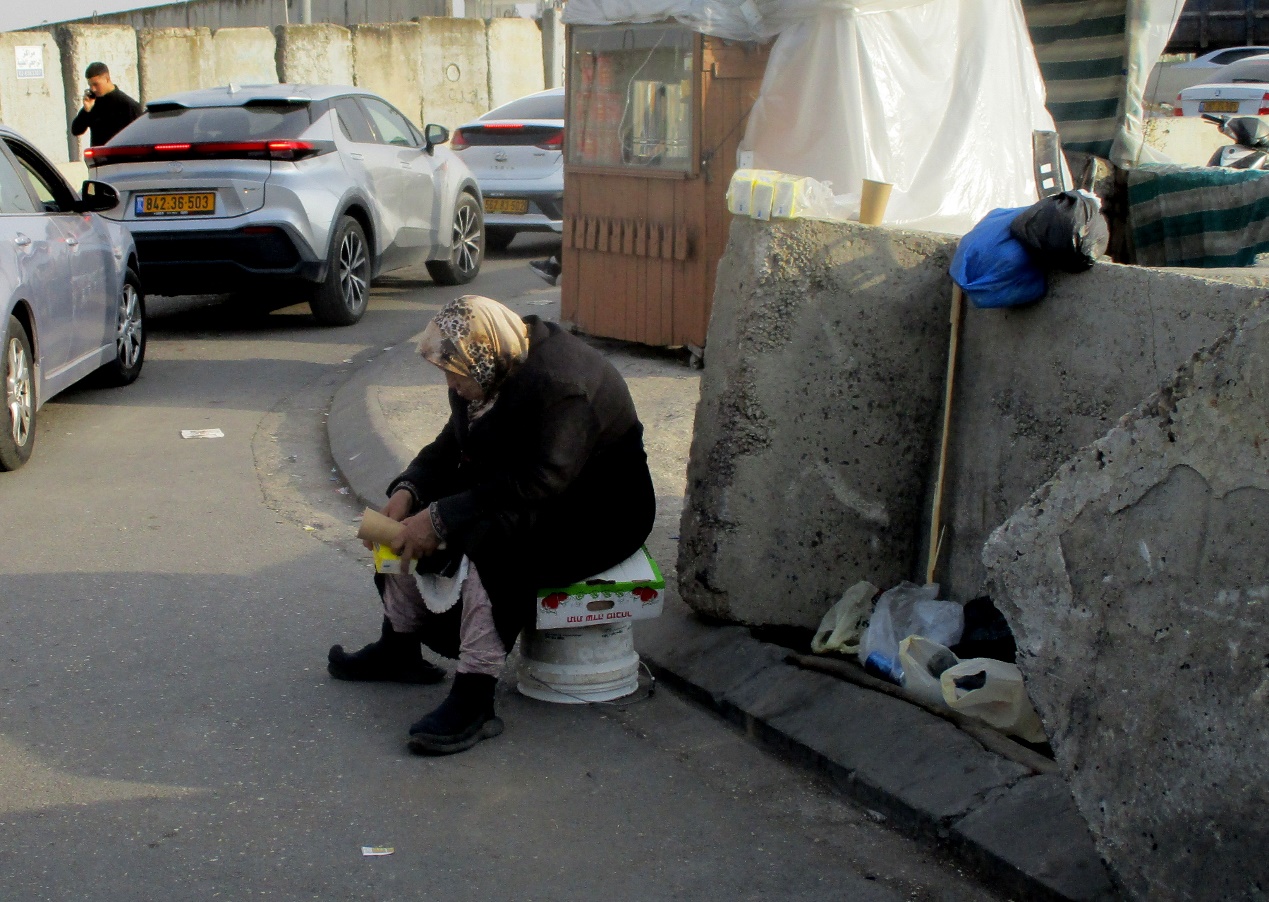 Tamar FleishmanOct-11-2026Qalandiya. Female Beggar
-
