
Qalandiya - long lines. Only some of the checking posts are active
Worse Than the Bad Old Days
As our colleagues noted in their last report, the situation at the Qalandiya Checkpoint is so grim that it resembled the worst of times Palestinians experienced at the old checkpoint. What’s more, it constitutes a major health hazard for everyone who passes through the checkpoint in the early morning hours, which is the majority of those who do. It’s hard for us to figure out what the officers managing the checkpoint are thinking in that they have allowed it to decline to this nadir.
When we arrived at 5:00 a.m., the lines leading into the checkpoint were short and the flow inward was satisfactory. But by 5:30 at least 50 people had built up on each of the three lines (up to the entry into the slaloms—the last stage before entering the building itself—in which they are no longer visible to us). And the more time passed, the longer the lines grew until, at 6:15, we did a rough count of between 150 and 200 people on each line (again, not counting those in the slaloms). Fortunately, the weather was still mild for anyone wearing winter clothing. It’s hard to imagine what things will be like on rainy days, as there is certainly not room for 450-600 people in the covered plaza at the entrance to the checkpoint.
Toward the middle of our shift, at 5:50 a.m., we walked to the end of two of the three lines, chose a person wearing an easily identified article of clothing, and followed him until he entered the slalom for his line. In both cases, it took 22 minutes for the man to advance from the end of the line to the entry into the slalom. At that point, we would know how long it would take for him to completely traverse the checkpoint, that is: to pass through three successive turnstiles and the (automated) security check. However, when we joined one of the lines at 7:30, at which time we were able to enter the slalom directly, it took us 20 to reach the security-check area and complete the procedure. Conclusion: this morning it took a person—let’s say an average of—42 minutes to transit the Qalandia Checkpoint. This brought back to us the traumatic times at its predecessor, which of course lacked all the state-of-the-art technology installed here precisely to avoid such trauma.
This development is not just frustrating. The long wait also constitutes a major health risk. For the more, the lines advance toward the slaloms, and within the slaloms to the first of the three turnstiles, and then inside the building to the second turnstile (which leads into the security-check area), the more the distance between the people on line shortens due to the pressure to get through each turnstile before it closes and one has to wait again. The crowding was also a hallmark of the old checkpoint. But now we are in the midst of a pandemic that calls for social distancing when the emphasis should be on easing conditions to obviate crowding, and here the very opposite is being done.
When we entered the building, we understood the source of the problem. Only half of the positions that regulate the flow of people into the security-check area were manned. Only a third of the machines that check the biometric work permits were operational. And only a third of the stations in which soldiers check and scan documents other than biometric permits were manned. In our colleagues’ last report, they noted that a security guard had explained to them the reason for the long lines being a shortage of soldiers to operate the checkpoint as required. Really, now! If there’s a shortage of soldiers, it’s possible to hire people from security companies to replace them until the shortage is solved. And the most absurd aspect of this situation is that anyone who reads a newspaper or watches television knows that while these Palestinians stand on long, slow-moving, and aggravating lines every morning, countless others are passing through breaches in the Security Barrier to find work in Israel, while the army turns a blind eye. Go figure out the logic of the system.
Qalandiya Checkpoint / Atarot Pass (Jerusalem)
See all reports for this place-
Click here to watch a video from Qalandiya checkpoint up to mid 2019 Three kilometers south of Ramallah, in the heart of Palestinian population. Integrates into "Jerusalem Envelope" as part of Wall that separates between northern suburbs that were annexed to Jerusalem in 1967: Kafr Aqab, Semiramis and Qalandiya, and the villages of Ar-Ram and Bir Nabala, also north of Jerusalem, and the city itself. Some residents of Kafr Aqab, Semiramis and Qalandiya have Jerusalem ID cards. A terminal operated by Israel Police has functioned since early 2006. As of August 2006, northbound pedestrians are not checked. Southbound Palestinians must carry Jerusalem IDs; holders of Palestinian Authority IDs cannot pass without special permits. Vehicular traffic from Ramallah to other West Bank areas runs to the north of Qalandiya. In February 2019, the new facility of the checkpoint was inaugurated aiming to make it like a "border crossing". The bars and barbed wire fences were replaced with walls of perforated metal panels. The check is now performed at multiple stations for face recognition and the transfer of an e-card. The rate of passage has improved and its density has generally decreased, but lack of manpower and malfunctions cause periods of stress. The development and paving of the roads has not yet been completed, the traffic of cars and pedestrians is dangerous, and t the entire vicinity of the checkpoint is filthy. In 2020 a huge pedestrian bridge was built over the vehicle crossing with severe mobility restrictions (steep stairs, long and winding route). The pedestrian access from public transport to the checkpoint from the north (Ramallah direction) is unclear, and there have been cases of people, especially people with disabilities, who accidentally reached the vehicle crossing and were shot by the soldiers at the checkpoint. In the summer of 2021, work began on a new, sunken entrance road from Qalandiya that will lead directly to Road 443 towards Jerusalem and Tel Aviv. At the same time, the runways of the old Atarot airport were demolished and infrastructure was prepared for a large bus terminal. (updated October 2021)
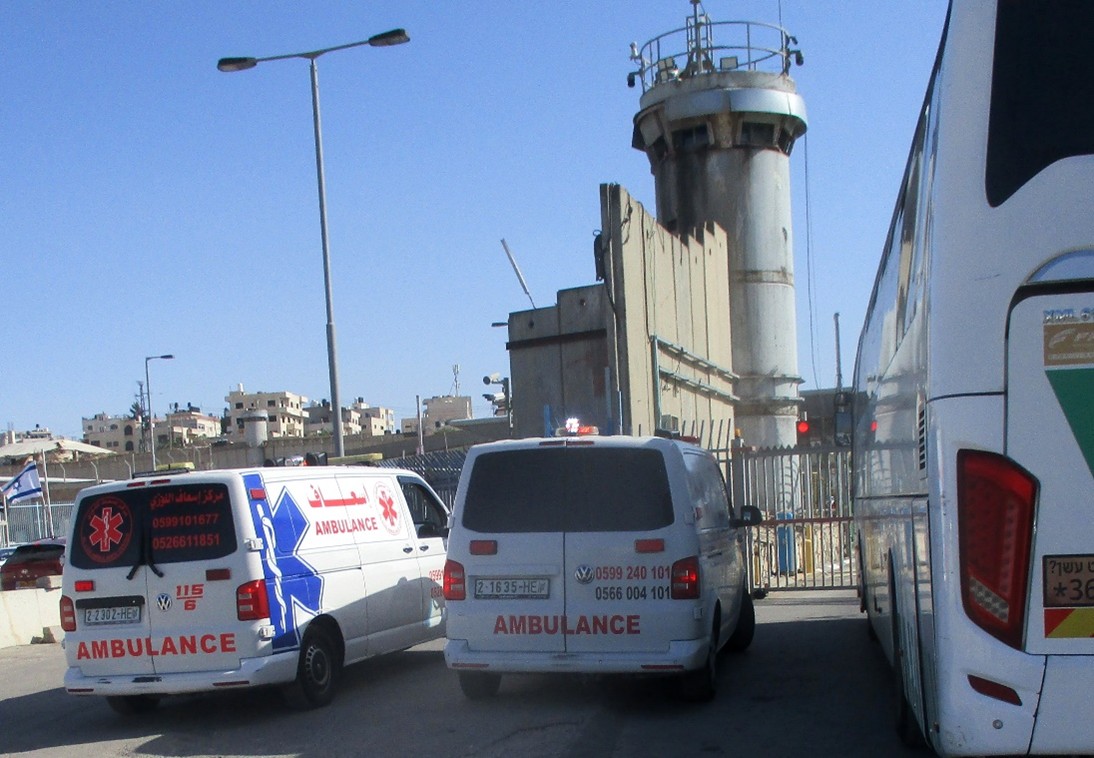 Tamar FleishmanMay-11-2026Qalandiya. Ambulances wait in front of a closed checkpoint
-