
Sansana (Meitar Crossing), South Hebron Hills

Meitar checkpoint – The parking lots are packed to capacity, a little encouraging to think that there is still a demand for Palestinian workers within the state. Also in the breach in the fence, the activity of workers and women who crossed the fence was evident.
We were driving on Route 317 so as to bring a large amount of clothing to Abu Safi.
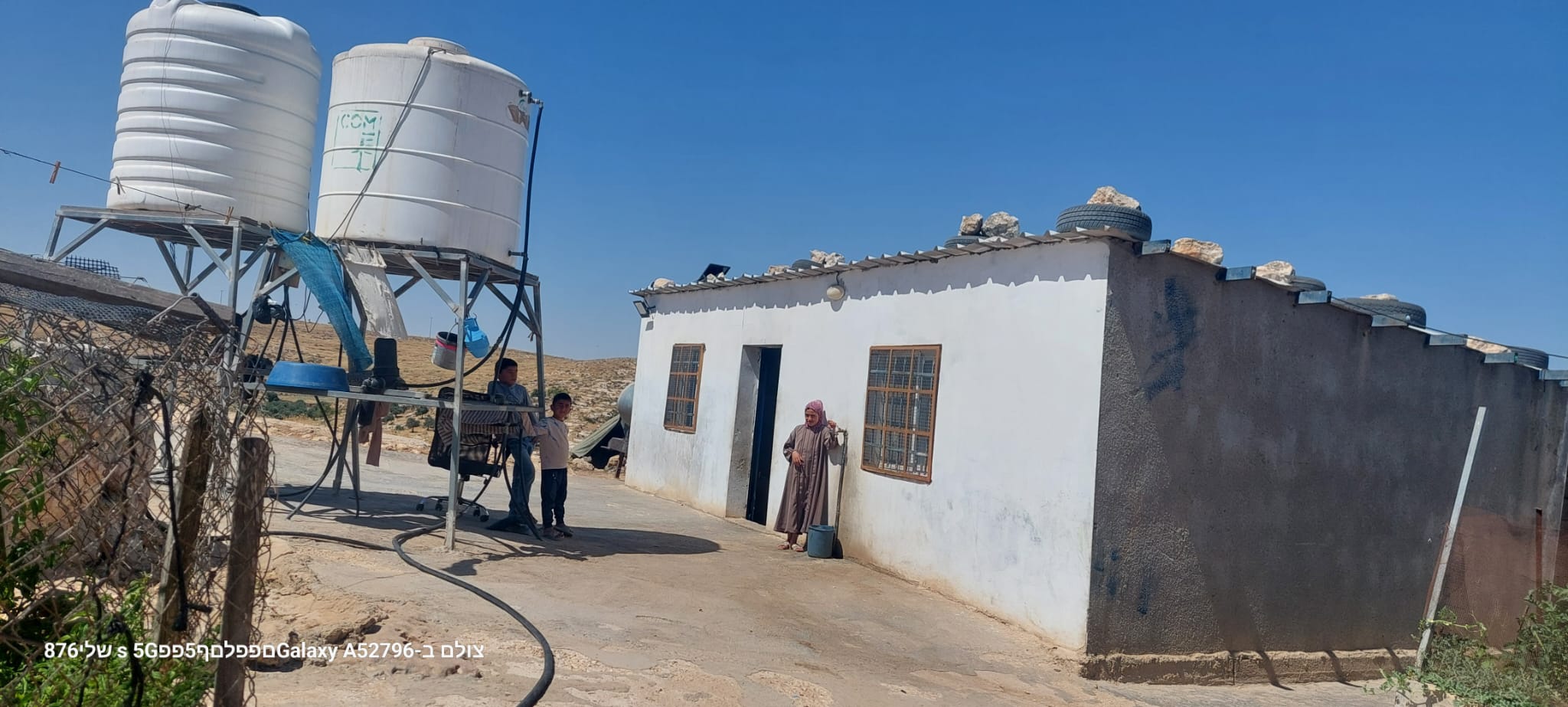
He was not at home but his wife and three of the girls greeted us happily and according to tradition. It’s amazing to see the organization of the house – since March, the kitchen in the cave has been equipped with a “tool cabinet”, a gas hob and several other items, and the walls have been covered with new cheerful paintings by Rania.
Abu Safi’s wife said that the day before, representatives of the settlers, including Kaplan, who live at the top of the mountain in front of them, had approached them. She claimed that they “came in well” meaning the landlord gave them permission to enter and move around. They seem to have come to assess whether they should take over the area.
We returned to the main road and below the Abigail outpost, we saw at the bottom of the wadi Abu Safi with his flock. He explained that the wadi and its two banks have been areas of his family for generations, and that the outpost has bitten into these areas. In 1983 he built a cistern and ditches at the bottom of the wadi to irrigate the flock he brings to the area to eat the wheat extract. This year the wheat did not germinate and the flock ate thorns and thistles.
While we were talking to Abu Safi a military jeep arrived and another jeep as escort, apparently called by the settlers of the outpost. We were interrogated for our actions, and the army did not move from there until we decided to leave and drove away. Back on the same route to Be’er Sheva.
We feel sadness at the end of summer, the herds the fields and also the people , all of whom are thirsty for water and there is only water for the settlers.
Meitar checkpoint / Sansana
See all reports for this place-
Meitar Checkpoint / Sansana The checkpoint is located on the Green Line and serves as a border crossing between Israel and the West Bank. It is managed by the Border Crossing Authority of the Defense Ministry. It is comprised of sections for the transfer of goods as well as a vehicle checkpoint (intended for holders of blue identity cards, foreign nationals or diplomats and international organizations). Passing of Palestinians is prohibited, except for those with entry permits to Israel. Palestinians are permitted to cross on foot only. The crossing has a DCO / DCL / DCL / DCL (District Coordination Office), a customs unit, supervision, and a police unit. In the last year, a breach has been opened in the fence, not far from the crossing. This breach is known to all, including the army. There does not appear to be any interest in blocking it, probably as it permits needed Palestinian workers without the bureaucratic permits to get to work in Israel. Food stalls and a parking area economy have been created, but incidents of violent abuse by border police have also been recorded. Updated April 2022
-
South Hebron Hills
See all reports for this place-
South Hebron Hills
South Hebron Hills is a large area in the West Bank's southern part.
Yatta is a major city in this area: right in the border zone between the fertile region of Hebron and its surroundings and the desert of the Hebron Hills. Yatta has about 64,000 inhabitants.
The surrounding villages are called Masafer Yatta (Yatta's daughter villages). Their inhabitants subsist on livestock and agriculture. Agriculture is possible only in small plots, especially near streams. Most of the area consists of rocky terraces.Since the beginning of the 1980s, many settlements have been established on the agricultural land cultivated by the Palestinians in the South Hebron Hills region: Carmel, Maon, Susia, Masadot Yehuda, Othniel, and more. Since the settlements were established and Palestinians cultivation areas have been reduced; the residents of the South Hebron Hills have been suffering from harassment by the settlers. Attempts to evict and demolish houses have continued, along with withholding water and electricity. The military and police usually refrain from intervening in violent incidents between settlers and Palestinians do not enforce the law when it comes to the investigation of extensive violent Jewish settlers. The harassment in the South Hebron Hills includes attacking and attempting to burn residential tents, harassing dogs, harming herds, and preventing access to pastures.
There are several checkpoints in the South Hebron Hills, on Routes 317 and 60. In most of them, no military presence is apparent, but rather an array of pillboxes monitor the villages. Roadblocks are frequently set up according to the settlers and the army's needs. These are located at the Zif Junction, the Dura-al Fawwar crossing, and the Sheep Junction at the southern entrance to Hebron.
Updated April 2022
 Michal TsadikJun-21-2026Sha'ab al-Butum - the residential complex of the Najjar family
-