
Qalandiya - a very sick woman is being tossed between stretchers and ambulances
The gray was very gray.

Amidst the haze and dust rising with the wild wind, an ill woman waited inside the West Bank ambulance for the arrival of the Jerusalem ambulance.
I do not know the name of the illness/illnesses afflicting this woman, but one mustn’t specialize in medicine to notice and know that her condition was dire.

The woman was only partly conscious, connected to an oxygen tank, and the exposed parts of her body were swollen to the extent that her skin could hardly contain inner pressure.
Mom’s oxygen has fallen dramatically, said her son, and explained that she is being returned to West Jerusalem’s Sha’arei Tzedek hospital where she had been treated until recently.
The woman’s home is in Kufr Akab, she holds a blue (Israeli) ID, is a permanent resident, and on the privilege-hierarchies scale she and her family are placed higher than the millions of Palestinians living between the river and the sea. True, they pay all the taxes levied the by the state and the city, and are free to move, but all of this does not suffice – one needs to be born on the right side of the apartheid wall…
Kufr Akab falls between the chairs. Its inhabitants, although at home only 2 kilometers away from Ramallah, do not receive services from the PA because the neighborhood does not belong to it. However, services are not provided by Israel – the state to which this neighborhood has been annexed and which is committed by law to provide.
The reason for this anomaly is the fear of emergency vehicles from Jerusalem to cross the wall. Moreover, Palestinian ambulances are not allowed to enter Jerusalem.
The result of this complexity was that the woman was not transported from her home directly to the hospital, but had to be tossed from one stretcher to another, among various medical teams and ambulances, and although upon her release the hospital doctors had recommended home medical care, with documents to prove this, the recommendation was not filled and she was abandoned to her family and fate.
***
Not far from there, in a well-hidden corner, in a spot from which retreat was impossible, stood armed hunters waiting for their prey, and detained youngsters returning to Palestine from their day’s work in Jerusalem, thoroughly inspecting their papers, transit permits and personal data. The purpose was to catch whoever came out that morning without a transit permit.

One can hardly understand how in a place defined by the authorities as a ‘security hazard zone’, the hazard lies with those returning rather than those exiting it.
Qalandiya Checkpoint / Atarot Pass (Jerusalem)
See all reports for this place-
Click here to watch a video from Qalandiya checkpoint up to mid 2019 Three kilometers south of Ramallah, in the heart of Palestinian population. Integrates into "Jerusalem Envelope" as part of Wall that separates between northern suburbs that were annexed to Jerusalem in 1967: Kafr Aqab, Semiramis and Qalandiya, and the villages of Ar-Ram and Bir Nabala, also north of Jerusalem, and the city itself. Some residents of Kafr Aqab, Semiramis and Qalandiya have Jerusalem ID cards. A terminal operated by Israel Police has functioned since early 2006. As of August 2006, northbound pedestrians are not checked. Southbound Palestinians must carry Jerusalem IDs; holders of Palestinian Authority IDs cannot pass without special permits. Vehicular traffic from Ramallah to other West Bank areas runs to the north of Qalandiya. In February 2019, the new facility of the checkpoint was inaugurated aiming to make it like a "border crossing". The bars and barbed wire fences were replaced with walls of perforated metal panels. The check is now performed at multiple stations for face recognition and the transfer of an e-card. The rate of passage has improved and its density has generally decreased, but lack of manpower and malfunctions cause periods of stress. The development and paving of the roads has not yet been completed, the traffic of cars and pedestrians is dangerous, and t the entire vicinity of the checkpoint is filthy. In 2020 a huge pedestrian bridge was built over the vehicle crossing with severe mobility restrictions (steep stairs, long and winding route). The pedestrian access from public transport to the checkpoint from the north (Ramallah direction) is unclear, and there have been cases of people, especially people with disabilities, who accidentally reached the vehicle crossing and were shot by the soldiers at the checkpoint. In the summer of 2021, work began on a new, sunken entrance road from Qalandiya that will lead directly to Road 443 towards Jerusalem and Tel Aviv. At the same time, the runways of the old Atarot airport were demolished and infrastructure was prepared for a large bus terminal. (updated October 2021)
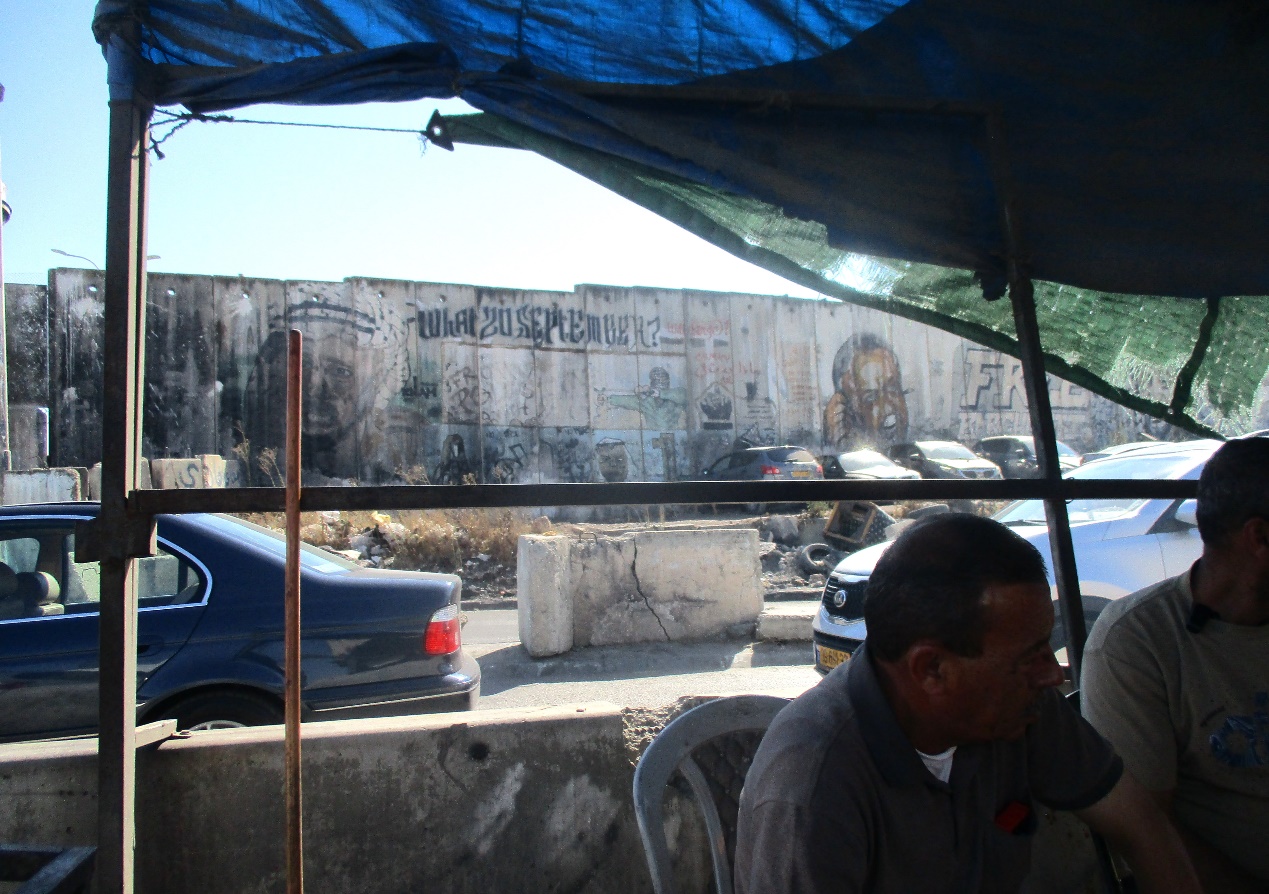 Tamar FleishmanJul-21-2026Qalandiya. Conversation in the shadow of the wall
-
