
Bethlehem 300 checkpoint: how many soldiers are needed to move one Palestinian?

Bethlehem checkpoint and Rachel’s Tomb, Olive checkpoint (via South American Highway and Abu Dis), Anata and Shuafat road (via Apartheid Highway 4370)
7:15 Rachel’s Tomb and the Bethlehem checkpoint
Two children on vacation ride back and forth on bicycles near Rachel’s tomb. Suspicious looks at us indicate that they already know the “nemesis” from a young age. Rachel’s tomb always amazes us with its ugliness – the antithesis of the pastoral image from before 1967. Alejandra was also amazed when we showed her what was there before the dome building of the tomb was covered with rectangular concrete blocks. It’s always full of men, girls and women here. We went to see what was happening in the small settlement that is attached to the yeshiva “Veshavu Banim Ligvulam”. Indeed, there is a new playground and buildings for new tenants. If there were a court for architects who built monsters, they would sentence the architect of the complex to many prison terms and a ban on practicing the profession.
There is not much traffic at checkpoint 300. A long line of men sit and wait for someone offer them work probably in the building trade . It is very depressing. You see men aged 30-40 with an education, who could work in a more suitable profession. They have a 15-day hope (the measure before they despair) of finding an employer.
Inside the checkpoint, only one or two posts are active – the furthest from the opening. It’s not Sunday. Again, it is surprising how many soldiers from different units are needed to man a checkpoint. It seems that there are at least eight here on the Israeli side. And that’s after all the checks… and really, immediately two policemen/police officers jump towards us and want to explain to us why we’re not allowed to stand here. Dangerous. I’m getting angry (because of the trauma of last time) and it’s a shame, because this police officer in charge is a nice man who wants to talk and not to push or threaten, is straight and understanding. He also calms down a female soldier who freaked out and screamed hysterically at two young guys who had already passed by. He talked to them and sent them on their way.
By the way, in Natanya’s mouth, this question turns into a sad joke as we also turn into at the entrance of the Shuafat refugee camp – how many soldiers are needed to block or move Palestinians who live in the territories at the checkpoint? We count a lot of bored soldiers waiting for violent action. Alejandra calls our attention to the drawn guns which we no longer notice.
Descending through Har Homah – where (opposite the light rail that is being lazily built) a new settlement project is also being prepared which will create a continuum between the neighborhood and Givat Hamatos (therefore, from Jerusalem, an updated map of Jerusalem 2022 by Ir Amim). Turn to the new American road and go up the old American road to Abu Dis and the olive checkpoint on the hill. A pedestrian is unable to reach the city of Jerusalem from this main checkpoint; far and steep.
Before nine in the morning we arrived at the olive checkpoint. At such an hour there should not have been any pressing problems. We moved to the Palestinian side. We met a disabled girl and her parents from Jericho on the way to hospitalization in Makassed. We tried to ring the bell to open the humanitarian door to the passage. No reply. There is no one in the booth inside the gate; the shouting didn’t help either.
The overloaded family barely made it through the outdoor carousels. There was a small queue at the checkpoint – about 10 people. Again we tried to ring the bell that should be connected to the loudspeaker at the checkpoint. We also tried the bells in the nearby closed position. We tried to shout. We wanted them to open the door for the disabled girl and her parents carrying the suitcase and bags instead of the turnstile. There is no voice and no answer.
We called the northern army headquarters and asked them to contact the checkpoint soldiers, and give them the request. They said they had nothing to do with the checkpoint. We asked them to call any commander who was located and ask him to go over and see what was going on. They said they couldn’t and that we should call the humanitarian center. We called, even though we know they don’t answer there. And there really was a voice message referring to registering for the application to request permits.
Meanwhile the line grew and grew and became crowded. A woman with a tiny baby was also stuck in it. The super slow pace of the transfer continues. Everything was conducted by yelling from the stand to the subjects, because there is no loudspeaker, and we cannot hear each other.
The disabled girl and her parents again barely passed the narrow carousel because they did not want to wait. We were asked to open the suitcase on the floor in front of the stand. Shouting explanations and instructions again.
In the end, we also passed by and saw a young and nervous female examiner, and next to her was a guy sitting with his phone. Not involved, nothing moves him, just his phone. We argued and said that it is impossible to continue working shouting without a connecting speaker, and it’s a shame that disabled and sick people are transported like this.
Suddenly one of the responsible police officers appeared out of nowhere. In one second he connected the plug of the speaker, and decided to open another position. He explained that some soldiers were sick and that someone had taken a break without notice. He said that we ruined the day for the female soldier in the post and she is angry. We were sorry, but we said she ruined the days of the Palestinians and there was not a shred of empathy in her behaviour.
We asked for the phone number of the checkpoint commander, or at least his second in command. But of course were answered in the negative. So will things continue like this?
We asked to file a complaint and emphasized that the Olive checkpoint had once been an example of efficient and empathetic conduct. Now, when the medical center is also closed, it looks neglected and in poor operation. We again asked for the phone number of someone senior who can be called if there are problems.
From there we went to Anata and the Shuafat refugee camp. Kamal, the driver, confirmed to us what his wife relayed on WhatsApp – that there were riots and violence two days ago during the high school graduation celebrations. Soldiers entered in large numbers, sprayed gas and arrested young people who shot fireworks and explosives. The morning is quiet. There are no traffic jams. The shops are closed for the time being and the main road is completely destroyed – under the responsibility of the Jerusalem Municipality?
Bethlehem (300)
See all reports for this place-
Located adjacent to the Separation Wall ("Jerusalem Wrap") at the north entrance to Bethlehem, this checkpoint cuts off Bethlehem and the entire West Bank from East Jerusalem, with all the serious implications for health services, trade, education, work and the fabric of life. The checkpoint is manned by the Border police and private security companies. It is an extensive infrastructure barrier and is designated as a border terminal, open 24 hours a day for foreign tourists. Israeli passport holders are not allowed to pass to Bethlehem, and Palestinian residents are not allowed to enter Jerusalem, except those with entry permits to Israel and East Jerusalem residents. Israeli buses are allowed to travel to Bethlehem only through this checkpoint.The checkpoint, which demonstrated harsh conditions of crowding and extreme passage delays for years, started employing advanced electronic identification posts and has upgraded its gates' system as of the middle of 2019 - and conditions improved.Adjacent to the checkpoint, in an enclosure between high walls and another passage, is the historic Rachel's Tomb, which is now embedded within a concrete fortified building. It contains prayer and study complexes for Jews only, as well as a residential complex. updated November 2019 .
-
Checkpoint Shu'afat camp / Anata-Shu'afat (Jerusalem)
See all reports for this place-
The Shu’afat checkpoint is located in the northern part of East Jerusalem at the exit from the village of Anata and the Shu’afat refugee camp, which are located in the area annexed to Jerusalem in 1967. The refugee camp borders the Shu’afat neighborhood to the west, Pisgat Ze’ev to the north, the French Hill neighborhood to the south and the planned expansion of Ma’aleh Adumim to E-1 in the east. It was established in 1966 for 1948 refugees from the West Bank and was populated after the Six Day War by persons who had been expelled from the Jewish Quarter. Today its population comprises some 25,000 people holding blue ID cards and some 15,000 people with Palestinian ID cards. The camp lacks adequate infrastructure and services, and suffers from poverty, neglect and overcrowding. All its buildings are connected to the public electricity and water infrastructure, but not all are connected to the sewer system. The camp’s services are provided by UNRWA, except for those such as health clinics and transportation of pupils to schools in Jerusalem. In 2005, the Israeli High Court of Justice rejected a suit by the residents requesting that the route of the separation fence be drawn such that the camp would remain on the Israeli side, but conditioned its approval of the route on the establishment of a convenient and rapid crossing facility for the inhabitants of the neighborhood, most of whom are residents of Jerusalem.
A temporary checkpoint operated there until December, 2011. It was extremely congested during rush hours, and dangerous for pedestrians (especially children) because of inadequate safety provisions. The new checkpoint was inaugurated south of the old one, for public and private transportation and for pedestrians, intended solely for the residents of the camp – holders of blue ID cards, and those with Palestinian ID cards who possess appropriate permits. There are five vehicle inspection stations at the checkpoint, and two for pedestrians (one of which is currently closed) where scanners have been installed but are not yet operating. According to the army, representatives of government agencies will also be present to provide services to residents of the neighbourhood. The pedestrian lanes are very long, located far from the small parking lots, and accessible through only a single revolving gate.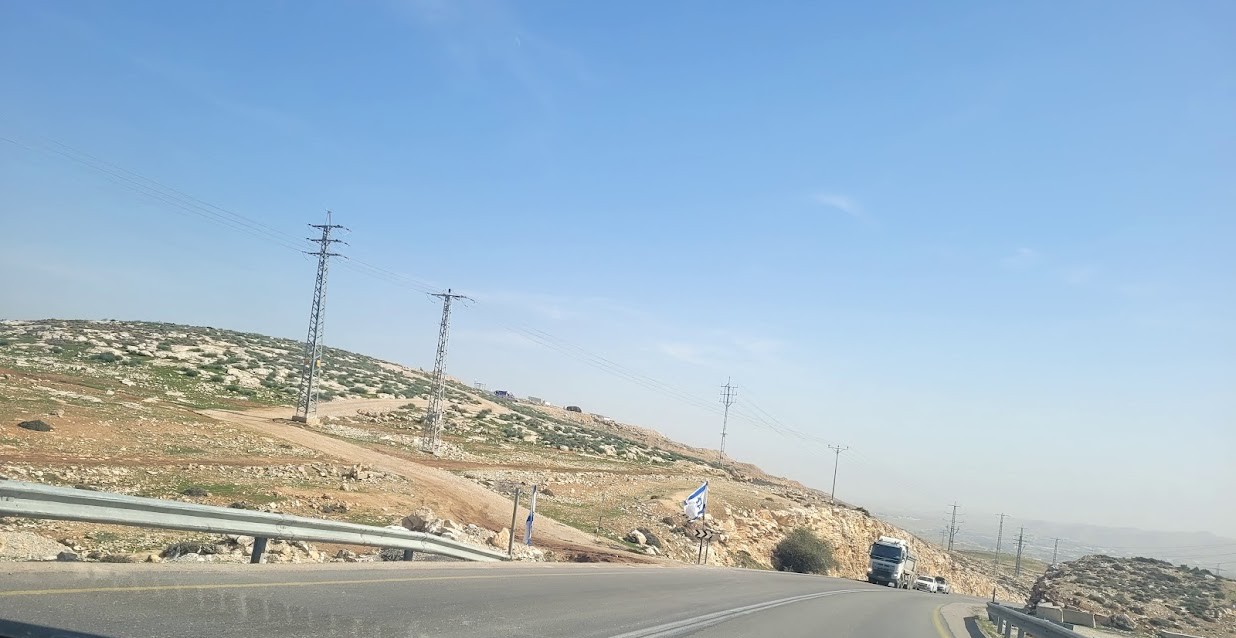 Anat TuegJan-25-2026Anata: A new outpost has been built south of the junction
-
Ras Abu Sbitan (Olive Terminal)
See all reports for this place-
A large checkpoint/crossing to the area of a-Tur, Abu Dis and the Old City; only for pedestrians. Located on Jerusalem’s municipal boundary.
One of the major crossings in Jerusalem’s central sector. It is located on the separation fence between the northern portion of the al-Ezariya neighborhood and the neighborhood of a-Tur and the rest of East Jerusalem. It is manned by Border Police soldiers and private security companies and operates 24 hours a day. Palestinians are forbidden to go through, other than permanent residents of East Jerusalem (holders of blue ID cards) and holders of work and commercial permits who are allowed through only on foot.
-