
Shu'afat checkpoint and camp, Wadi Nar (container checkpoint)
It’s a hard morning in the Shu’afat refugee camp. A 4-story house was demolished, and the pupils’ school buses belonging to the Jerusalem municipality did not arrive. The multitude of schoolchildren finally returned home after trying to cross the pedestrian checkpoint. It is not clear whether this is associated with the protest and riots taking place the previous evening following the death of an administrative detainee Islamic Jihad prisoner. There was no answer from the Civil Administration, the person in charge of the checkpoint said he cannot do anything, and has no direct contact with the Administration (!). No doubt the spirit of the now-responsible ministers inspires the conduct on the ground. Hanna Barag will lodge a complaint.
On our way to the Container Checkpoint, we observed the wooded hills that are about to change as a new Palestinians-only road is to be paved, distancing them from Ma’ale Adumim colony and from the E-1 area. We also saw the other side of the Separation Wall that halves Azariyah and Abu Dis.

Sho’afat refugee camp checkpoint: We met Kamal at the French Hill neighborhood, and he told us he had seen a bulldozer and many police vans crossing the Anatot Checkpoint through an open gate leading to Anata (which is usually closed because the Palestinians drive only underneath, along an apartheid road). We drove to the Shu’afat refugee camp through its main entrance from Road 1 to Jericho.
The traffic outgoing to the Jerusalem exit was heavy. Unusually, in the large car-park used for transports of school children holding a blue (Israeli) ID who go to school in Jerusalem, hundreds of pupils were crowded, all ages from kindergarten to high school – and only 2 buses and a minibus were there. We found out that most of the buses financed by the Jerusalem municipality did not come today. A group of curious boys crowded around us, and when they saw our MW tags, they spoke with us. They did not know why the buses were not coming. They said the municipality-paid ‘ushers’ “ran away”, and no one knows what to do. Some of them began to try the pedestrian passage to Jerusalem, in an attempt to catch some bus or transport outside the camp. On principle this is possible, but the track which contains only one turnstile, a metal detector and one inspection booth, was filled to bursting with people. Some of the pupils stood in line, tightly holding on to little siblings. Most of them have up and turned back. We tried to contact the local DCO but there was no answer. We called Hannah, who said all the phones were changed and there was no longer any answer, but she would try to report it somehow.
A youngster told us that last night (Tuesday), there were riots in the camp in memory of Khader Adnan, the prisoner who died in Israel’s Nitzan Prison that morning, after 86 days of his hunger strike. According to the speakers, there were mainly stones thrown and tear gas canisters hurled in retaliation. We are not sure this was the reason for the buses’ absence.
We decided to approach the checkpoint and speak with the person in charge through the empty track designated for the absent transports, as we held our tags high. He did come, and said he sees the terrible pressure on the pedestrian inspection booth, but cannot do anything about it. We suggested he add personnel from the numerous people standing there, and pass school children, as well as try to find out with the Civil Administration what was going on with the school and kindergarten transports, and what to do about it. To our surprise, he said he has no contact with the Administration (!).
At this point, we took our leave of the children (who applauded us, to our surprise), and went back to our waiting car. We joined the long lines of girls, boys and little children who were headed home from their no-school day.

Demolition of a 4-story house in the Peace Neighborhood of the refugee camp – Kamal had inquired in the meantime and led us through the alleys of the neighborhood in the camp (whose inhabitants hold blue IDs) to the demolition site. Special police force prevented our passage there, as a bulldozer began to move towards a house further down the alley. The people watching said the house had 4 floors, and no construction permit, but already inhabited. They asked: why do the authorities wait until the house is fully built and inhabited before they punish and demolish it? Such heartache and loss of property and money for the inhabitants’ families! Indeed, turning back we saw women sitting in a car, weeping. We did not stop, not knowing what to say.

Driving to the Wadi Nar (Container) Checkpoint through Azariyah: As we drove to Azariyah we looked at the beautiful wooded hills between Azariyah and the A-Za’im Checkpoint. Last week we heard of the approved plan for a Palestinians-only road that would be paved and wind through them and certainly flatten certain parts there. The road is meant to connect the northern and southern parts of the West Bank, forbidding the entry of Palestinian traffic into the E1 area and Ma’ale Adumim colony (we wrote about it in our information page about Jerusalem on our website – https://machsomwatch.org/en/content/jerusalem-forbidden-city).
This time we drove along the wall on its eastern side. We photographed the spot where the old road to Jericho ceases, the backside of Cliff Hotel surrounded with walls, and were pleased to see that the Azariyah and Abu Dis neighborhoods on the Palestinian side looked peaceful and well-cared for.
At the Container Checkpoint traffic flowed. We stood at the roundabout and did not go closer in order not to have the traffic stopped on our behalf. We met a lecturer from Al Quds University who said that heavy traffic jams make life difficult for those crossing to work in the direction of Jerusalem in the early morning hours, and especially back to the West Bank from Jerusalem as the workers from the southern parts of the West Bank head home. In the old grocery near the roundabout, there is now a nice coffee house for those stopping by. Its location at the end of a steep ascent is not ideal. The way back to Azariyah drags through unreasonably heavy traffic inside Azariyah, because the colonists of Keidar refuse and are even violent about enabling approach through the broad and direct and rather distant road from Keidar, that gets directly to the roundabout between Azariyah and the Ma’ale Adumim colony. Why should the ‘lords of the land’ share even one or two kilometers of a good road with Palestinians? Let the latter drive at least another half-hour around and patiently wait out the traffic jams…
Checkpoint Shu'afat camp / Anata-Shu'afat (Jerusalem)
See all reports for this place-
The Shu’afat checkpoint is located in the northern part of East Jerusalem at the exit from the village of Anata and the Shu’afat refugee camp, which are located in the area annexed to Jerusalem in 1967. The refugee camp borders the Shu’afat neighborhood to the west, Pisgat Ze’ev to the north, the French Hill neighborhood to the south and the planned expansion of Ma’aleh Adumim to E-1 in the east. It was established in 1966 for 1948 refugees from the West Bank and was populated after the Six Day War by persons who had been expelled from the Jewish Quarter. Today its population comprises some 25,000 people holding blue ID cards and some 15,000 people with Palestinian ID cards. The camp lacks adequate infrastructure and services, and suffers from poverty, neglect and overcrowding. All its buildings are connected to the public electricity and water infrastructure, but not all are connected to the sewer system. The camp’s services are provided by UNRWA, except for those such as health clinics and transportation of pupils to schools in Jerusalem. In 2005, the Israeli High Court of Justice rejected a suit by the residents requesting that the route of the separation fence be drawn such that the camp would remain on the Israeli side, but conditioned its approval of the route on the establishment of a convenient and rapid crossing facility for the inhabitants of the neighborhood, most of whom are residents of Jerusalem.
A temporary checkpoint operated there until December, 2011. It was extremely congested during rush hours, and dangerous for pedestrians (especially children) because of inadequate safety provisions. The new checkpoint was inaugurated south of the old one, for public and private transportation and for pedestrians, intended solely for the residents of the camp – holders of blue ID cards, and those with Palestinian ID cards who possess appropriate permits. There are five vehicle inspection stations at the checkpoint, and two for pedestrians (one of which is currently closed) where scanners have been installed but are not yet operating. According to the army, representatives of government agencies will also be present to provide services to residents of the neighbourhood. The pedestrian lanes are very long, located far from the small parking lots, and accessible through only a single revolving gate.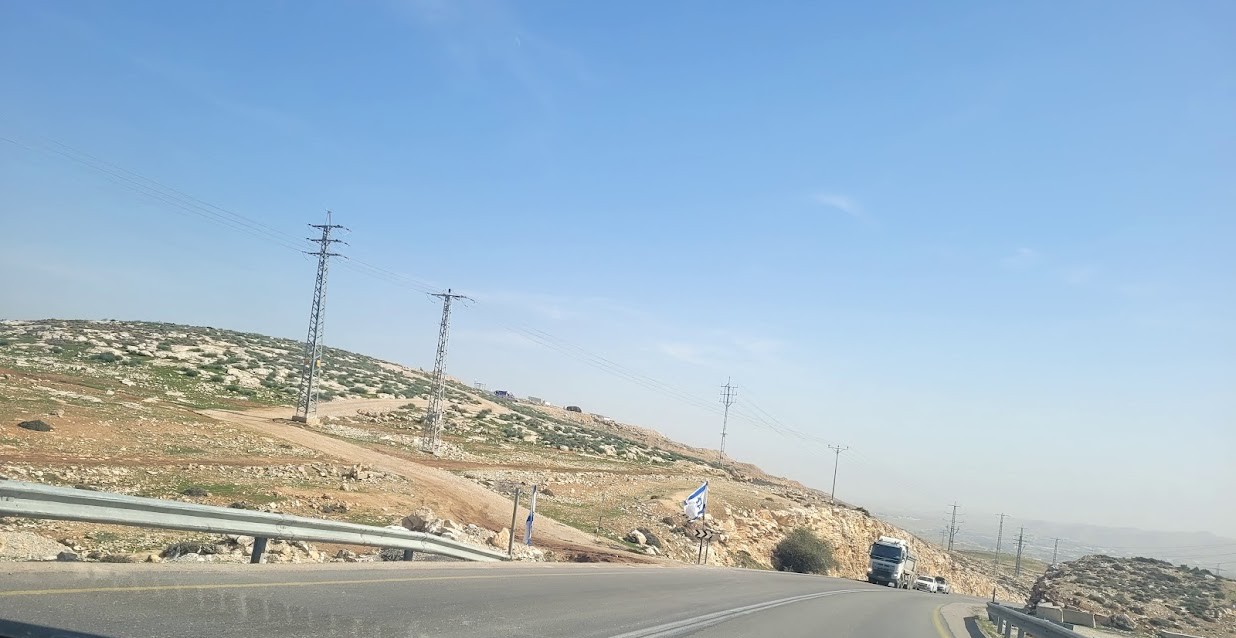 Anat TuegJan-25-2026Anata: A new outpost has been built south of the junction
-
Container (Wadi Nar)
See all reports for this place-
Wadi Nar Checkpoint ("Container", "The Kiosk") - a barrier for vehicles in Area B that is regularly manned - east of Abu Dis between Sawahra A Sharqiya and Bethlehem and its daughters. Controls Palestinian movement between the north and south West-Bank. Includes driving routes, access roads, spikes, traffic lights and signs. There is no pedestrian crossing. Open 24 hours a day with random checks enhanced on security alerts. The checkpoint is in Palestinian territory, allowing for separation between the north and the south Palestinian areas when necessary.
In 2015, the leading road from Azaria to Bethlehem was renovated, as well as the steep and narrow ascent to the Wadi Nar checkpoint, which was dangerously travelled in both directions! The temporary checkpoint was renovated and expanded, and pedestrian traffic was banned. From 2016, traffic travelling from the south bank to Azaria was directed to a one-way road near the Southern Keydar Jewish settlement.
Machsomwatch shifts visit this far-fetched checkpoint only occasionally.
(updated to July 2019)
-
