
Visiting Sheikh Said, the amputee in Al-Arqiz
Shift purposes:
1. Delivering donations by Sylvia and her friends;
2. Buying supplies in Nabil’s grocery store at Zif Junction and visiting Sheikh Said at Al Rakeez.
Our way
We crossed the terribly stinking, deserted Meitar Checkpoint, remembering how bustling it used to be, to the point that no parking was to be found.
Road 60 – Eshtamo’a colony is expanding. The road from Ramadeen to Dhahariya is closed since the inhabitants of Tene Omarim do not enable Ramadeen inhabitants to use the road. They don’t like seeing them… The approach to Dhahariya is through Siniya (opposite Samu’a, west of the road).
Adorayim colony is expanding: outside the original fortress there are now caravans. A soldier is on observation duty, pointing his rifle from his post toward the spring, out of bounds for Palestinians.
In order to get from Dura/Al Fawwar Junction to Al Fawwar town, they must walk a winding dirt track. In order to enter Dura with a vehicle, one must drive along a winding dirt track – Al Hijra.
Qalqis is blocked, goods are passed back-to-back.
Road 356 – Zif Junction is open.
At Nabil’s grocery store we delivered the donated money from Sylvia and her friends for Ziyad Hushiya. We bought basic products and vegetables for Sheikh Said’s family at Al Rakeez.
North of Carmel colony west of the road, a new colonist vineyard is planted, fenced in, and they are also building a winery. Further on the road, opposite Havat Maon outpost, the area they took over in the past is flourishing in its bright green color – there’s money and water. The colonists draw Zionist landscape – Jews as bringing civilization to the wild rocky land. Naturally, opposite A Tawane one can see that when it is impossible to remove the Palestinians from their lands, their territories also flourish.
At Sheikh Said’s in Al Rakeez, on the dirt track east of A Tawane
We stop at the place where the track is blocked by a large stone (photo), so close to the exit to the road near Avigail outpost. Beyond the blockage, colonist vehicles are seen on the road paved on Palestinian land.
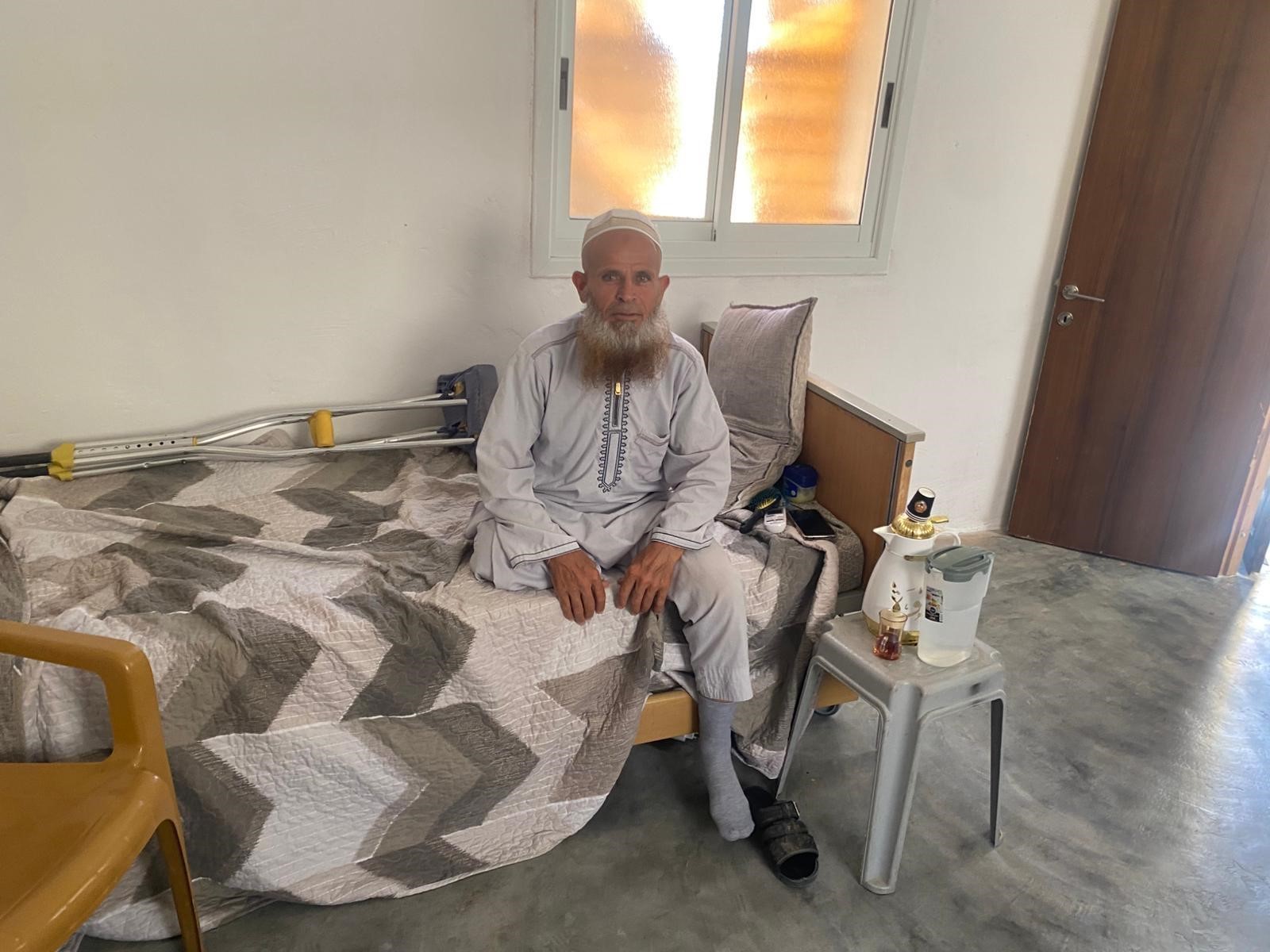
We enter the house. Mohammad explains that the entire house was built by Sheikh Said manually, and the yard floored in model precision. He had worked for years in construction at various sites in Israel. He has 10 children – 6 sons and 4 daughters – of two wives. One lives with him and her children while the other has left and lives elsewhere with her children. The house owner welcomed us warmly in a room suited for his special needs, including an adjustable bed, bought with the help of the A Tawane local council.
Sheikh Said told us how on April 17th, four colonists including the Avigail security official invaded his land, adjacent to his yard. The security official (whose conduct has gotten more violent since the proliferation of violent youths in the entire area) took a compressor and began to dig up Sheikh Said’s land. His 16-year-old son went out and began filming them. The colonists forced the boy down to the ground. When the father tried to help his son, they shot two bullets in the air and one at the father’s leg. The boy was arrested but the camera with the video documenting the invasion and attack managed to be thrown by the boy to his sister. Thus, a filmed documentation remained. However, the code to open the cellular phone was possessed only by the boy so one could only use the documentation after the boy was let go on a bail of 5000 shekels, aided by Attorney Qamar Masharqi.
Sheikh Said lay on the ground, his wounded leg bleeding, for an hour while the colonists tried to prevent his being taken to hospital by Israeli ambulance. Finally, he was taken to Soroka Hospital in Beer Sheva, unconscious due to losing blood. He received 4 blood portions. The doctors at the Intensive Care Unit said that after he regained consciousness 3 days later there was no other choice but to amputate his leg.
Being transferred to the ward, he was shackled to the bed in both hands above his head and with his other leg. 2 soldiers guarded him and visits were forbidden. When he was brought food, his left hand was released. When he said he could not use his left hand that was not considered usable (he is not accustomed to it for Muslims eat only with their right hand, their left used for fecal purposes and therefore unclean). When he shouted, he was told to shut up, this is a hospital! He reacted that for him this was prison. Still, he tried to eat but dirtied his shirt and the nurse looked at him critically. When the shift ended, soldiers freed his right hand. Sheikh Said favorably mentioned the humaneness of the soldiers on the new shift. Unlike this, the nurse tried to rummage his bag in order to give over documents to the colonists who planned to press false charges, as if they were only protecting themselves saying he was the one who presumably attacked them… When he was released 4 days later, Ehud Krinis managed somehow to bring him a change of clothes. These clothes, too, underwent close inspection. An ambulance was requested that would bring him home, but this was not approved and he was taken home in the infamous narrow, irony prisoner vehicle, and the fresh stump beat against the iron frames and hurt immensely. Finally, an ambulance took him to a Hebron hospital.
The video containing the fact that the family was attacked in its own yard proves who the assailants were and who their victims. Sheikh Said is not giving up on pressing legal charges against the assailants while waiting for his stump to heal so he could use a prosthesis.
In the meantime, colonists continue to harass the family daily, cutting down the fence.
Complaints to the Israel police are useless. Volunteers from abroad are deported.
On our way back from Al Rakeez on Road 317 we passed by Zanuta. Its land have been taken over by the lords of the land who planted rows of grapevines there. The water pipes water the fields. Usually, vineyards and sheep and cattle flocks are the main takeover means in this area. We look at what used to be the home-castle of Abu Safi, taken over by the colonist Israel Kaplan. Mohammad identified the buckets of the late Abu Safi that are used by the colonists who robbed his fields.
Location Description
South Hebron Hills
See all reports for this place-
South Hebron Hills
South Hebron Hills is a large area in the West Bank's southern part.
Yatta is a major city in this area: right in the border zone between the fertile region of Hebron and its surroundings and the desert of the Hebron Hills. Yatta has about 64,000 inhabitants.
The surrounding villages are called Masafer Yatta (Yatta's daughter villages). Their inhabitants subsist on livestock and agriculture. Agriculture is possible only in small plots, especially near streams. Most of the area consists of rocky terraces.Since the beginning of the 1980s, many settlements have been established on the agricultural land cultivated by the Palestinians in the South Hebron Hills region: Carmel, Maon, Susia, Masadot Yehuda, Othniel, and more. Since the settlements were established and Palestinians cultivation areas have been reduced; the residents of the South Hebron Hills have been suffering from harassment by the settlers. Attempts to evict and demolish houses have continued, along with withholding water and electricity. The military and police usually refrain from intervening in violent incidents between settlers and Palestinians do not enforce the law when it comes to the investigation of extensive violent Jewish settlers. The harassment in the South Hebron Hills includes attacking and attempting to burn residential tents, harassing dogs, harming herds, and preventing access to pastures.
There are several checkpoints in the South Hebron Hills, on Routes 317 and 60. In most of them, no military presence is apparent, but rather an array of pillboxes monitor the villages. Roadblocks are frequently set up according to the settlers and the army's needs. These are located at the Zif Junction, the Dura-al Fawwar crossing, and the Sheep Junction at the southern entrance to Hebron.
Updated April 2022
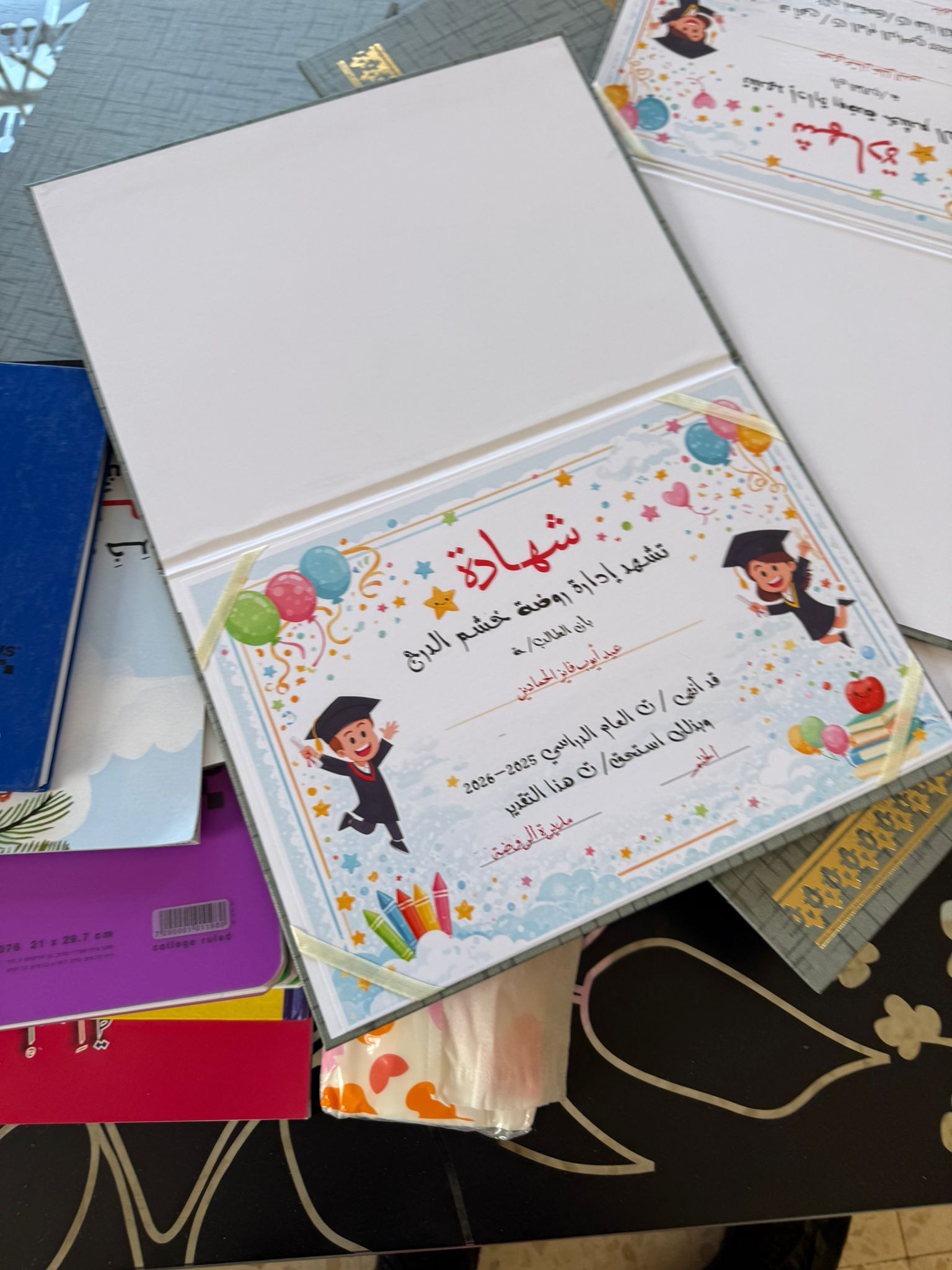 Smadar BeckerMay-10-2026A personal certificate for every child who finishes the year at Huda's kindergarten, Hashem Al-Daraj
-