
חברון, מחסום מיתר, כביש 60, בית ספר קורדובה, 1.11.2011
Translator: Charles K.
Difficult is the road…
We wanted to visit the Cordova school, to hear that, as promised, after a week had passed the teachers are allowed to pass through the gate rather than the scanner.
We wanted to, but that’s not how it turned out. But first things first.
Nothing out of the ordinary at the Meitar checkpoint and on Route 60.
We arrived at the entrance to Kiryat Arba. The guard, like his colleagues who’ve taken upon themselves, and received, policing authority, feels free to ask us where we’re coming from and where we’re heading.
And immediately reports to “big brother.” We didn’t realize this was a sign that things would get even more annoying later.
We tried to get closer to Mitzpeh Avichai because at least six new buildings had been erected, and the floor of another was under construction, to see what was happening on the way there and whether their neighbors were having problems, as we’d been told last week. We dared – you have to be daring, since a car suddenly appeared from the settlement to find out who we were. [The chance of an encounter with settlers is always frightening]
We ignored it, but one of the Kiryat Arba “security” people appeared opposite us, cutting us off and demanding to see ID. We refused, unless they showed us documents identifying them as police officers. They don’t have any, of course, nor do they have the authority to check us, but the Israeli police apparently finds it convenient to be “present absentees” there, and the thugs from Kiryat Arba fill the vacuum.
So the guy, who’s gone out on a limb and doesn’t know how to get down, continues to detain us. We insist on driving on, but not before reminding him that we’re Israeli citizens just like him, and have the same right as he to go anywhere we please. “You see we’re not terrorists, so why are you holding us?”, we ask. “I’m the security coordinator, and you didn’t respond when I honked.” “Do you think that if you came to Omer we wouldn’t let you enter without stopping you and checking your documents?”, we ask.
A few more mutterings about security obligations and the guy retreats.
The Israeli police evades its responsibilities there and allows citizens to “protect themselves” as they see fit. That’s how the thugs in the settlements become increasingly powerful.
Paratroopers on a morning run along Shuhada Street in Hebron.
The occupation routine continues.
The Cordova school
At the Tarpat checkpoint, and on the street below the Cordova school, soldiers and civilians told us it was again operating normally. “How do the teachers go through?”, we asked. They make a wide detour through Tel Rumeida [so they won’t have to pass through the scanner].
So we went to see how they were. They were very happy to see us. The principal said they’re willing to make a 45 minute detour to avoid going through the checkpoint. The authorities will let them bypass the scanner if they’re issued special IDs. The municipal education department refuses to do so. They’re afraid of creating a precedent that will lead to additional restrictions. “We have IDs,” she says “We’re registered with you, why do we need additional IDs?” “For seven years we’ve been crossing without any problems; why change things?” We phoned Brigadier General Guy Hazut, the Judea brigade commander. He’s in a meeting. The DCO confirms the proposal. It seems that the entire affair has been rife with suspicion and mutual power plays. Our good, honest intentions are not at all sufficient in this case.
Instead of making an effort to create a more reasonable form of co-existence here, they continue to accede to the settlers’ demands and embitter the lives of others.
OK. So, as of now, most of the teachers aren’t using the route the IDF wants, nor have they gotten the relief they’d been promised. The teachers, the objects of such careful monitoring, come to school and continue to be “dangerous.” They’re willing to undergo hardships to avoid going through the scanner. And the school that overlooks the Jewish educational institutions continues to function. Classes continue to the best of their ability.
What does the IDF get out of it? Nothing. More control? Over whom? Better security? How? Stupidity is having a field day. Suspicion and power are legal tender in Hebron.
The IDF continues to be a “hero.”
Maybe, nevertheless, someone will wake up and solve this “problem.”
South Hebron Hills
See all reports for this place-
South Hebron Hills
South Hebron Hills is a large area in the West Bank's southern part.
Yatta is a major city in this area: right in the border zone between the fertile region of Hebron and its surroundings and the desert of the Hebron Hills. Yatta has about 64,000 inhabitants.
The surrounding villages are called Masafer Yatta (Yatta's daughter villages). Their inhabitants subsist on livestock and agriculture. Agriculture is possible only in small plots, especially near streams. Most of the area consists of rocky terraces.Since the beginning of the 1980s, many settlements have been established on the agricultural land cultivated by the Palestinians in the South Hebron Hills region: Carmel, Maon, Susia, Masadot Yehuda, Othniel, and more. Since the settlements were established and Palestinians cultivation areas have been reduced; the residents of the South Hebron Hills have been suffering from harassment by the settlers. Attempts to evict and demolish houses have continued, along with withholding water and electricity. The military and police usually refrain from intervening in violent incidents between settlers and Palestinians do not enforce the law when it comes to the investigation of extensive violent Jewish settlers. The harassment in the South Hebron Hills includes attacking and attempting to burn residential tents, harassing dogs, harming herds, and preventing access to pastures.
There are several checkpoints in the South Hebron Hills, on Routes 317 and 60. In most of them, no military presence is apparent, but rather an array of pillboxes monitor the villages. Roadblocks are frequently set up according to the settlers and the army's needs. These are located at the Zif Junction, the Dura-al Fawwar crossing, and the Sheep Junction at the southern entrance to Hebron.
Updated April 2022
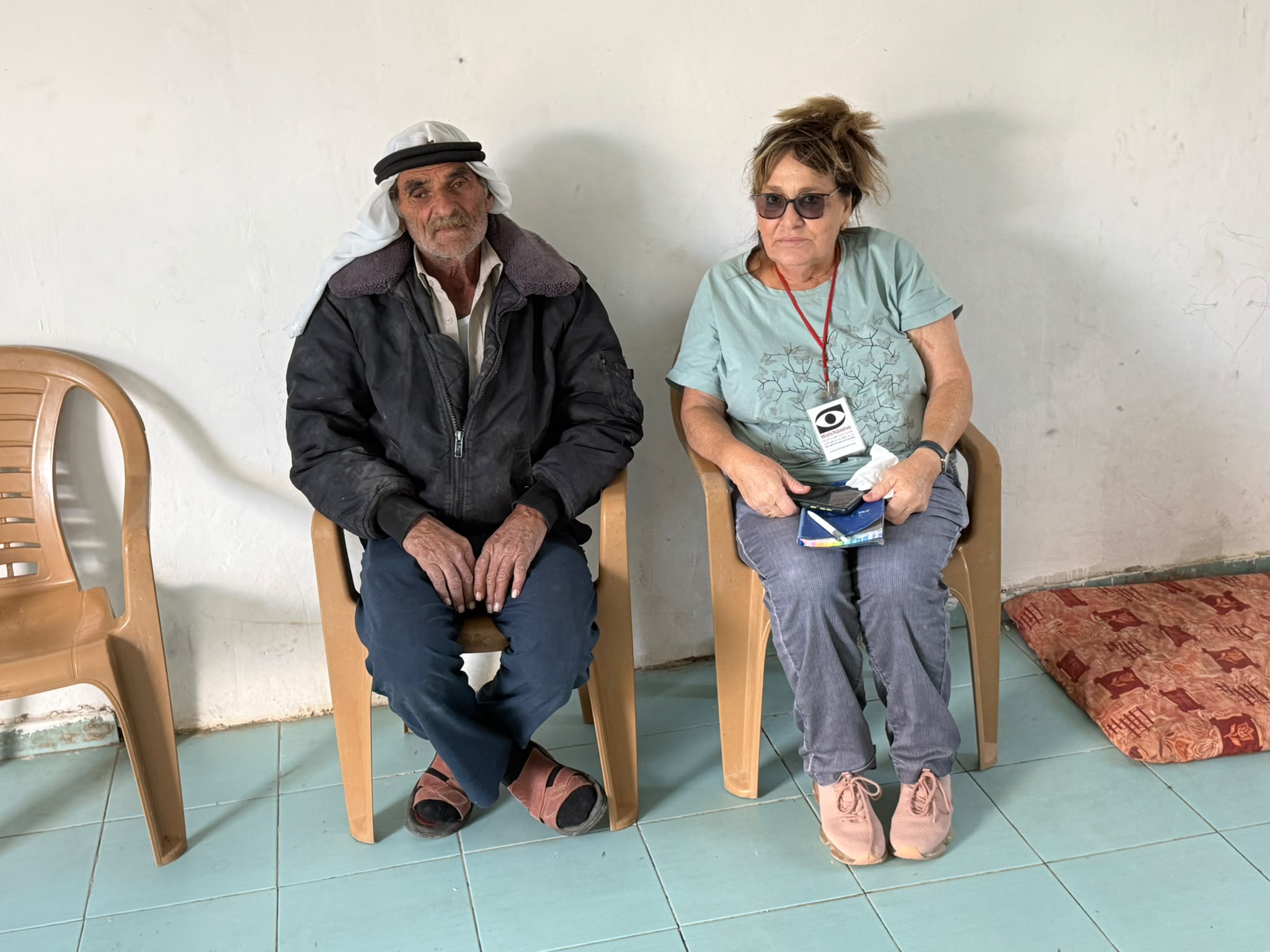 Muhammad D.Oct-29-2026Michal in Shaab Al-Butum with Ishaq Jabarin
-
