
Samra - About 60 dunams were eaten this week by settler Asael's cows
We came directly to Ayn al-Hilwa to unload the things we brought them, as they might help after the destruction of the Adel family’s central residence. The rubble is there in all its obvious cruelty, few attempts at getting at something out of the piles. The house owner is hospitalized for all the possible reasons. His sons and daughters, themselves with families of their own, are helpless and request charity. Food, food and more food. The Red Cross that brings a tent and food to every locality undergoing such an “event” is stopped by the Israeli army and the vehicle is sequestered. Thus, too, came Jewish holidays when the members usually helpful are not active.
We emptied the car and felt empty ourselves. The women and children left, and only 4-5 brothers and sisters remained, taking care of the cattle and of themselves. The situation is dire.

We went on to Samra to be with the residents there, is what we call “Protective Presence”. Most children went home to celebrate Eid al-Adha, the holiday of sacrifice. We began doing art work with them. We all enjoyed it, and the whole family cooperated.
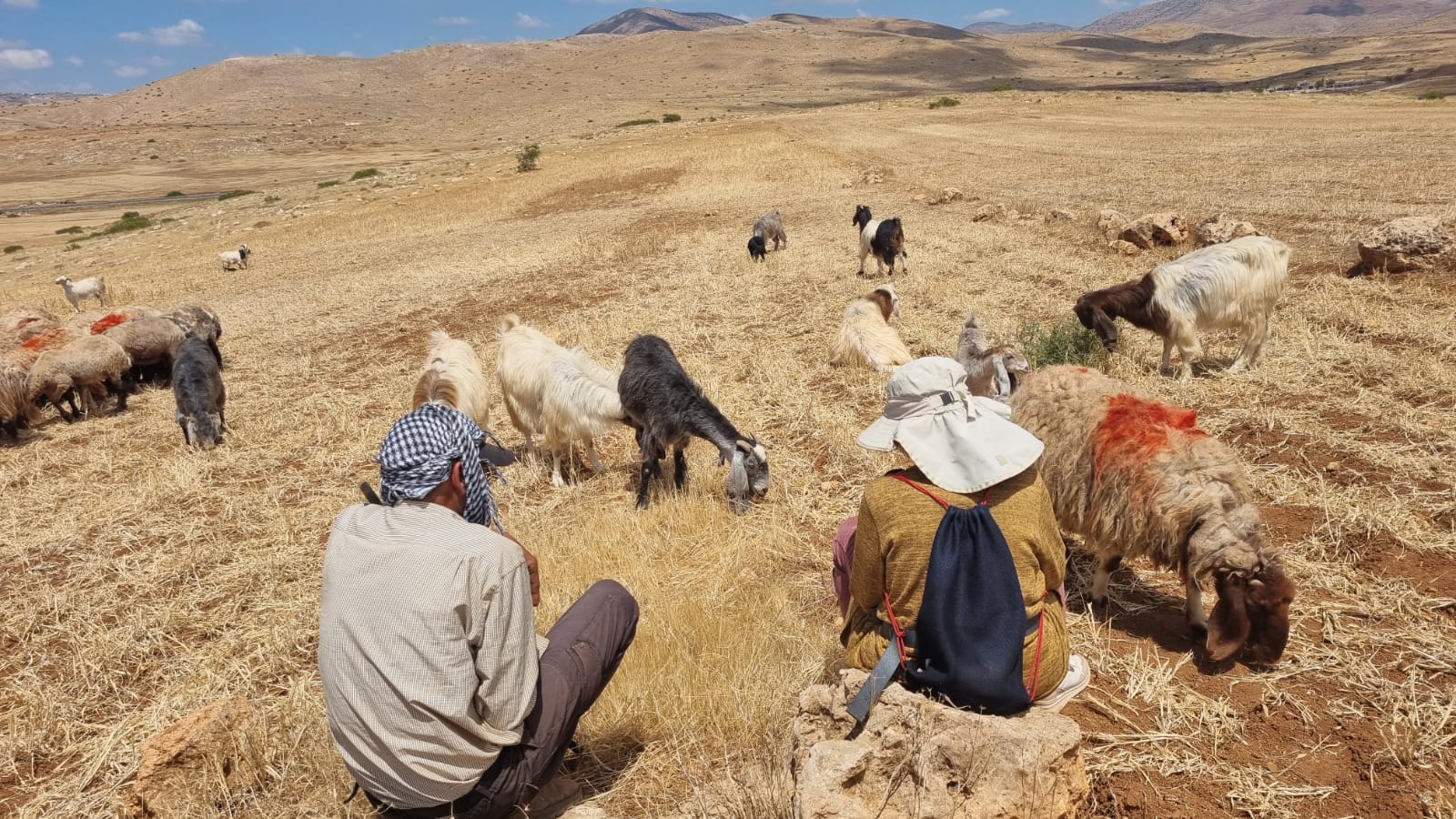
For breakfast we got fried lamb-liver with flatbread. After the poor lamb was slaughtered for the festive occasion. We went out to graze. Both flocks of the shepherds together. It’s a hot day. Summer is already here. We are shown their field, about 60 dunams of which have already been devoured this week by the cows of colonist Asa’el, grazing there peacefully one day this week, in front of the field owner’s eyes…
The shepherds try unsuccessfully to explain again how their expense accounts work out. In order to avoid broken hearts they prefer not to note anything down. They receive a loan from the landowner at the beginning of the year and return it gradually or with one-third of their income. Beyond this, all other expenses are paid by selling cheese and sheep. Better not do the math, Bosmat says, and rightly so. Grazing was difficult weather-wise but without hostilities, and we agreed with the shepherds that there will no more grazing accompaniment for us this summer. We shall stay indoors with the children.
Later that day we had the rest of the poor lamb’s parts for lunch. Sacrifice holiday it is, isn’t it? One of the house mistress’s brothers came for a holiday visit with a few of his daughters.
We visited T. who returned from his two and a half years administrative detention in an Israeli prison. He is as pale as someone who has not seen the sun for all that time. He is covered in clothes and answers with a smile. The same food that M. received at Ofer Prison. Nothing, with bread. Apparently identical menus in the prison system. Once every four days they exit their cell for a turn in the yard. Once every few days – a shower. No drink at meals. They drink from their cell faucet. 10 men. 6 beds. He didn’t want to speak of torture but we know he had his ribs broken. And the soul will take its time…
Location Description
'Ein al-Hilwe
See all reports for this place-
Ein al-Hilwe is a natural spring and a Palestinian grazing area in the Jordan Valley that was used by the Palestinian shepherd communities for watering their flocks and for daily use. As of 2021, settlers from the Maskyot settlement took control of the spring: they fenced it off, built a wading pool and a mikveh, and installed flags and recreational facilities.
Palestinians are effectively denied access to the spring, and are forced to make do with running water in a remote wadi or, when the road is blocked, buy water from vendors at high prices.
The spring is located in the heart of an area where illegal outposts are being established, as part of a broader trend of pushing Palestinian communities away by denying them access to essential resources. Neighboring communities such as Umm Jamal and Khirbet Samra have already left due to the pressure.
Over the years, MachsomWatch members have reported arrests on false claims by settlers, harassment and violence, including damage to herds, intrusion into homes, and the intimidation of children. MachsomWatch volunteers participate in a protective presence in areas around the spring to prevent harassment of shepherds due to the presence of settlers.
-
Jordan Valley
See all reports for this place-
Jordan Valley The Jordan Valley is the eastern strip of the West Bank. Its area consists of almost a third of the West Bank area. About 10,000 settlers live there, about 65,000 Palestinian residents in the villages and towns. In addition, about 15,000 are scattered in small shepherd communities. These communities are living in severe distress because of two types of harassment: the military declaring some of their living areas, as fire zones, evicting them for long hours from their residence to the scorching heat of the summer and the bitter cold of the winter. The other type is abuse by rioters who cling to the grazing areas of the shepherd communities, and the declared fire areas (without being deported). The many groundwaters in the Jordan Valley belong to Mekorot and are not available to Palestinians living in the Jordan Valley. The Palestinians bring water to their needs in high-cost followers.
 Bosmat HetzroniSep-24-2026Khalet Makhul – An unnecessary cleanup operation...
-
