
ארתאח (שער אפרים), חבלה, יום ב’ 18.10.10, אחה”צ
13:45 –Habla
The heat is incandescent. About ten people waiting at the entrance to the checkpoint. The bus carrying the girls from the Bedouin village waits on the other side. One of the people waiting tells us there’s a detainee in the inspection room, and at that moment we hear shouts from the building
Ten minutes later two soldiers come out to the gate. One of them has his rifle drawn. But all he wants is for the Palestinian to give him a light
Only after a few minutes it seems the person detained inside is released, and soldiers tell people to come in three at a time. The soldiers seem to know those coming through, and generally behave politely to them
On the other hand, we hear loud and very unpleasant shouts coming from a female MP in the inspection building
Meanwhile the bus driver has come out of the building, the soldiers inspect the luggage compartment and the bus with the girls goes on its way after having waited more than half an hour. We called the soldiers’ attention to the fact that these are small children sitting in a bus without air conditioning. The girls wave to us
Light traffic inside, a bicyclist with a package, a tractor loaded with sacks that undergo a superficial inspection
14:20–
We continue toward Azzun, and on the way see the miserable tin huts where the girls we saw on the bus live
The yellow gate at Azzun is open; we enter and turn north under the road
Jayyus
The grocery store we use as an information center is closed today. We stopped next to a Bedouin guy living right next to the fence. He gave us a cold drink and we saw the fence literally below us. His land is on the other side, about 500 meters away, where he raises sheep. To reach his land these days he has to take a taxi to Qalqilya and go through the Zufin checkpoint. This family is lucky. Since he lives on his pasture land and was not listed as a resident of Jayyus, he received a permit to go daily to his lands and even sleep “in a closed military area.” (In this case – a name given to a civilian area in the “seam zone,” where people need special permission to be found on their lands). His uncle, who’s a resident of Jayyus, wasn’t as fortunate. From the outset – the initial route of the fence left his house and lands located completely within the seam zone. Although he was cut off from his usual surroundings and had to go through checkpoints for medical treatment, employment, education, etc., he continued to work his land. When the High Court of Justice ordered the fence moved farther east, his house was now east of the fence but his land remained to the west. Since he has only a contract to purchase the land, but it isn’t registered to him in the tabu, he didn’t get a cultivation permit and lost the land. The uncle died ten days ago.
Falamya
15:50 – The gate is open from 05:00-17:00. People from Falamya cross, as well as those from Jayyus who have permission to do so. The checkpoint is manned by reservists sweating in the heat, usually with nothing to do. A few dozen people in the morning, dribs and drabs during the day. Does this indicate the residents of Falamya received very few permits? It’s worth finding out. By the way, the soldiers also are against the system of permits and its consequences for the residents.
Irtach
16:15 – Well-cared-for greenery around the parking lot next to the crossing, but the lot as well as the road leading to its entrance are closed to vehicles transporting the laborers – unlike in the past, the Palestinian returning from work now get out of the vehicles about 100 meters away from the crossing itself.
There’s a gravel lot nearby, but apparently the drivers would rather not drive on the stones. There are yellow signs everywhere reading “No photography. Security installation.” All of a sudden, a parking lot used only by laborers crossing has become a security facility.
The booths at the crossing aren’t manned. The laborers go through the revolving gate and come out.
Habla
See all reports for this place-
Habla CP (1393)
The Habla checkpoint (1393) was established on the lands of the residents of Qalqilya, on the short road that
connected it for centuries to the nearby town of Habla. The separation barrier intersects this road twice and cut off the residents of Qalqilya from their lands in the seam zone.(between the fence and the green line).
There is a passage under Road 55 that connects Qalqilya to the sabotage This agricultural barrier is used by the farmers and nursery owners established along Road 55 from the Green Line and on both sides of the kurkar road leading to the checkpoint.
This agricultural checkpoint serves the residents of Arab a-Ramadin al-Janoubi (detached from the West Bank), who pass through it to the West Bank and back to their homes. The opening hours (3 times a day) of this agricultural checkpoint are longer than usual, about an hour (recently shortened to 45 minutes), and are coordinated with the transportation hours of a-Ramadin children studying in the occupied in the West Bank.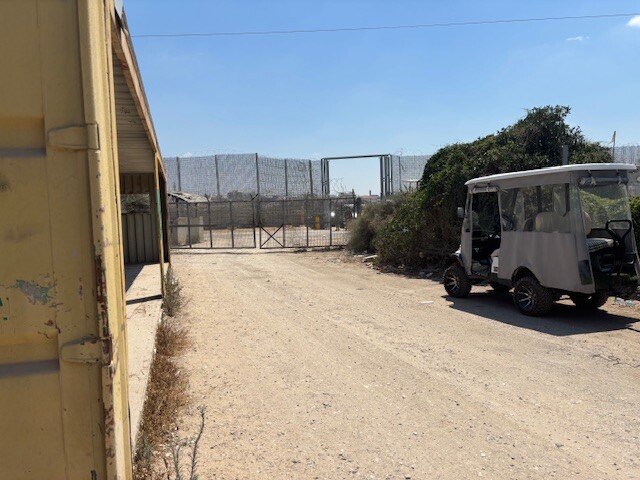 Nina SebaAug-18-2025Habla: The gate is in the process of closing
-
Irtah (Sha'ar Efrayim)
See all reports for this place-
The checkpoint is for Palestinians only. It is the main barrier to the passage of workers from the northern West Bank to Israel. Workers with a permit to work in Israel and also for trade (with appropriate permissions), medicine, and visiting prisoners. One can cross the checkpoint only on foot. The checkpoint is located north of Road 557 and south of Tulkarm. Operated by a civil security company, opening hours: between 4:00 and 19:00 on weekdays. As members of Machsom Watch, we began our shifts to this location in 2007. We arrived before it opened at 4 in the morning and report since, on the harsh conditions and the long and crowded queues of workers. The workers who pass by continue their journey by transportation to work throughout Israel. In the first period of its activity, about 3,000 and then 5,000 people passed through this checkpoint every day. Due to the small number of checking points and arbitrary delays for long periods of time in the "rooms", workers feared losing their transportation. Hence workers leave their homes at 2:30 at night to be among the first. Today, 15,000 pass and the transition is faster. Workers are still leaving their homes very early to get past the checkpoint at 7 p.m. In an adjacent compound, there is a terminal for the transfer of goods on a commercial scale, using the back-to-back method.
-