
Jordan Valley: Fearing soldiers at the checkpoint, the parents couldn’t get to their son in the hospital before he died
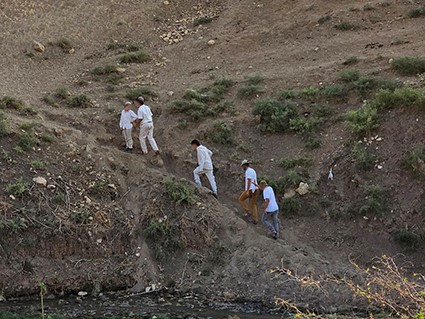
I left Tel Aviv in the early morning with two more volunteers and we reached El-Farisiya at 6:30. Three of us then went out to pasture with the herds, heading towards northwest Farisiya to graze in Wadi Shek. The other two volunteers remained in Farisiya as a protective presence and took over from the night shift. At 8:30 a.m., one of the volunteers who had stayed there accompanied the herds to En al-Hilwe. A vehicle belonging to the army or volunteers from Maskayot watched for a few minutes and then left.
Two volunteers who had spent the night at Humsa arrived in Farisiya in the morning and joined the volunteers who had returned from the pasture.
At 1030, three of us drove to B’s home at Khalet Makhul, where settlers were driving tractors around his property and in between the houses. They left when we arrived, but before they left, they filmed us and our car’s license plate.
We stayed with B and his wife to drink tea and he told us, in Hebrew, about the problems caused by the lack of rain – the sheep are sick, costs are rising, and they need to purchase fodder because there’s no grazing. He also spoke about his hopes for a change in government in Israel and criticized the Palestinian Authority, which he called thieves. In his opinion, the only solution is for one state where Jews and Arabs live together.
In the meantime, Shai from the settlement of Maskayot and coordinator of the northern valley in the Lands Department of the regional council, arrived in Farisiya. He parked his car opposite A’s home. A approached him and his daughter filmed the meeting. Shai threatened him and said he would call the army. “You’ll see what they’ll do to you. It’ll be worse than last time,” he said. The previous time was a month ago, when A was arrested on the charge of transporting equipment that could be used for illegal construction. He was held for several hours, beaten, and even burned by cigarettes that were put out on him. A was alarmed by the threat and we decided that one volunteer would always stay with him.
In the afternoon, while two volunteers were with Z’s herd of cattle at En al-Hilwe, eight settlers came from Maskiyot and walked towards Z’s home. We chased after them in an attempt to get the cows back to the hut without losing any of them on the way.
The settlers split into two groups; four continued to Z’s house and the other four went to K’s house where there were two volunteers. For about half an hour they moved between the open area and the homes (young men aged 15-16 and even one kid aged 12), sat down in one place, walked around another, and then left.
In the evening, I stayed to sleep at Z’s. We were almost asleep, when at 23:20, we received a call to say that Gilad, the settler, was at K’s place. I drove off at once and arrived three minutes later, but Gilad had already left. I went back to Z’s.
At 12:30 a.m., Gilad went past A’s home in Farisiya el-Ahmer. A short time later, I received another call from K, who said that Gilad had come back to his place. I returned there and saw Gilad driving his car towards Maskiyot. I decided to stay and sleep at their place.
When we’d already gone to sleep, all the phones starting ringing. F came running with his wife and daughter. His son had been rushed to hospital in critical condition. He asked for me and another volunteer to go with him to Tayasir checkpoint even though it would be closed at that time of night, in the hopes that with our help, they would allow him through to see his son. But his nephew convinced him that it might be very dangerous for him at the checkpoint and the army might shoot at him if he got close. Only an ambulance might, perhaps, get through. L called a few people to try and get one – but to no avail. An hour later, the son passed away. He’d had problems with his heart for a long time. It’s a large family and most marriages are within the family, so all the encampments in the area were in mourning. During the night, many members of the family arrived at Tayasir checkpoint, stood in line, and waited for it to open so they could go to the funeral.
Location Description
'Ein al-Hilwe
See all reports for this place-
Ein al-Hilwe is a natural spring and a Palestinian grazing area in the Jordan Valley that was used by the Palestinian shepherd communities for watering their flocks and for daily use. As of 2021, settlers from the Maskyot settlement took control of the spring: they fenced it off, built a wading pool and a mikveh, and installed flags and recreational facilities.
Palestinians are effectively denied access to the spring, and are forced to make do with running water in a remote wadi or, when the road is blocked, buy water from vendors at high prices.
The spring is located in the heart of an area where illegal outposts are being established, as part of a broader trend of pushing Palestinian communities away by denying them access to essential resources. Neighboring communities such as Umm Jamal and Khirbet Samra have already left due to the pressure.
Over the years, MachsomWatch members have reported arrests on false claims by settlers, harassment and violence, including damage to herds, intrusion into homes, and the intimidation of children. MachsomWatch volunteers participate in a protective presence in areas around the spring to prevent harassment of shepherds due to the presence of settlers.
-
Al-Farisiya / 'Ein a-sakut
See all reports for this place-
Al-Farisiya / 'Ein a-sakutA community of shepherds in the Jordan Valley opposite the settlement of "Rotem". Making a living from grazing sheep, the residents are exposed to harassment, abuse and theft from settlers who come to them from outposts and settlements in the area, and their grazing area is shrinking due to settler takeovers, fire zones and declared nature reserves.Machsom Watch companies participate in shepherd escort activities and provide a 24/7 protective presence, and there is continuous and warm contact with the community.
-
Khalet Makhul
See all reports for this place-
Khalet Makhul
A small settlement of a shepherd community located on the way to the settlement of Hemdat. Two nearby outposts make life miserable for the Palestinians, who make a living from grazing, and the army backs the settlers. As a result, the possible grazing areas are getting smaller.
The local children attend school in the settlement of Ein Al-Beida. Long lines of 3 hours sometimes stretch out at the Hamra and Tayasir checkpoints leading to the town of Tubas, making it difficult to get water, supplies, and sell the cheese, milk, and meat that the residents produce for their living.
Following a deadly attack at the Tayasir checkpoint in February 2025, the checkpoint was closed completely for the time being.
(Updated March 2025)
-