
The settlers abuse the Bedouins who were expelled from Al-Auja and are now on the outskirts of Lubnan a-Sharqiya.
We entered the West Bank via Road 5. This time we decided to go to Luban a-Sharqiya, for reports came in from there about colonist and army violence. There are no more Messiah flags at Ariel Roundabout. Works by the side of the road are still going on after trees were uprooted close to it. The house just before Marda still sports the Messiah flag waving proudly beside a miserable Israel flag, twisted around its flagpole. This time, too, no soldiers were there and the road to Marda was open. The road to Zeita Jama’in has been closed for years.
The sign against the Oslo Accords just before the Tapuach Junction is still there: “Settlement in Areas A and B annul the Oslo Accords through one’s feet”. The stops at Tapuach Junction all sport the Messiah flags. Later, along Road 60, we see Israel flags again and, on another stop, Messiah flags as well.
At Louban a-Sharqiya we entered a grocery store and met A., a welcoming, English-speaking woman. She invited us in and told us a bit of what was happening in the village. Luban is surrounded by colonies and outposts (Tapuach, Eli and others) and entered in three places. In two of them, the gates are permanently closed, and the third is blocked by dirt piles. The villagers open it themselves and the army repeatedly closes it.
She says that last Tuesday all three entries were closed. The army entered the village, placed cameras along the main road, and sometimes places an internal checkpoint just to harass people, and at the same time their land is still being confiscated. Soldiers and colonists walk around the village, especially near the school, and disturb schoolchildren. While we were there, around 1:25 p.m., three armored jeeps probably of the Border Patrol, drove along the main road and after a minute, came back down. A. also told us about the colonists who used to come from Eli to Wadi Abu el-Ayn and now come down from the outpost above Yasuf Palestinian village. The area between Luban and Salfit, Wadi a-Sha’er was – according to her – a quiet one. Now colonists have erected tents near Yasuf. The army takes these tents down and the people erect them again, time and again.
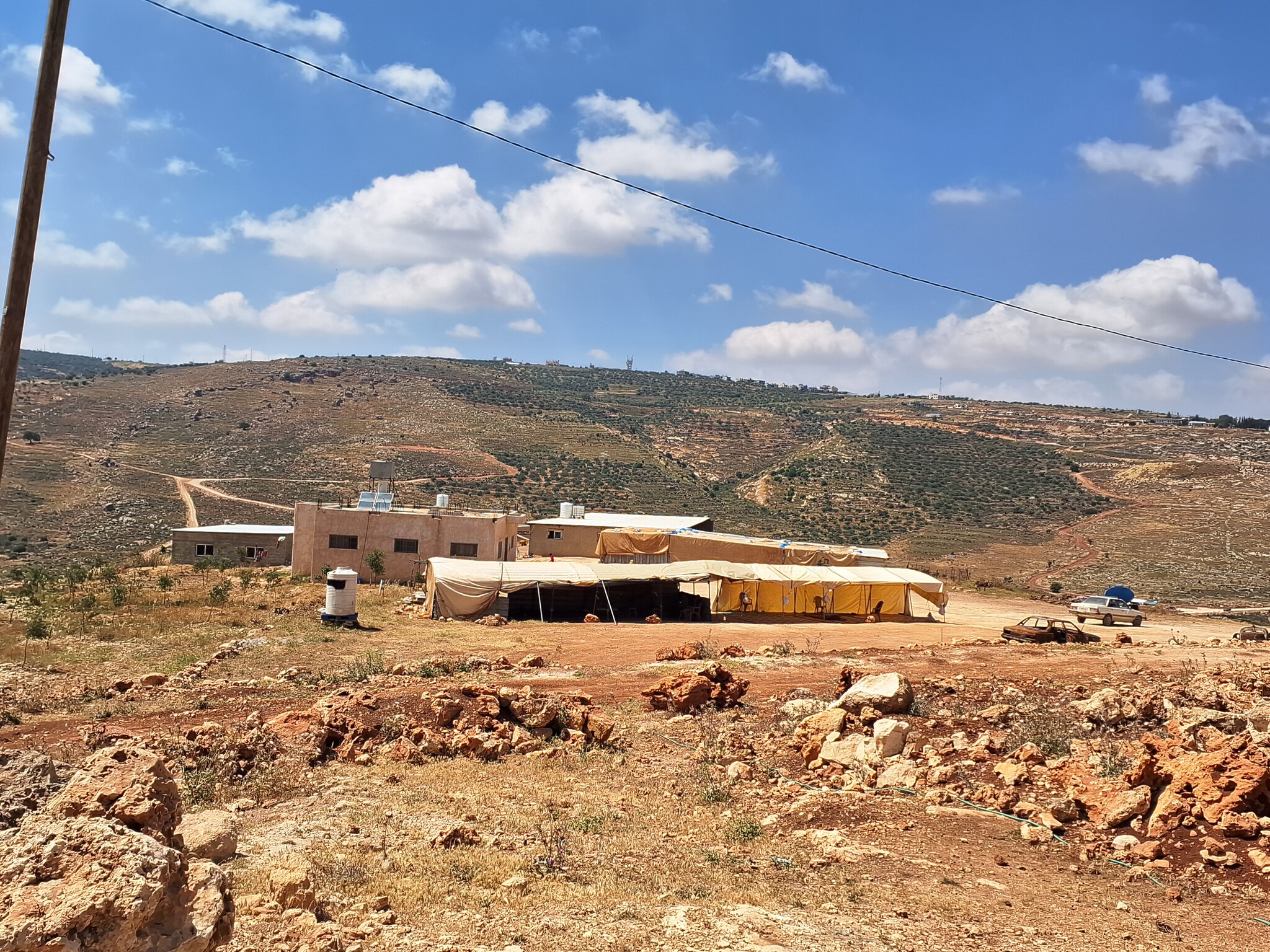
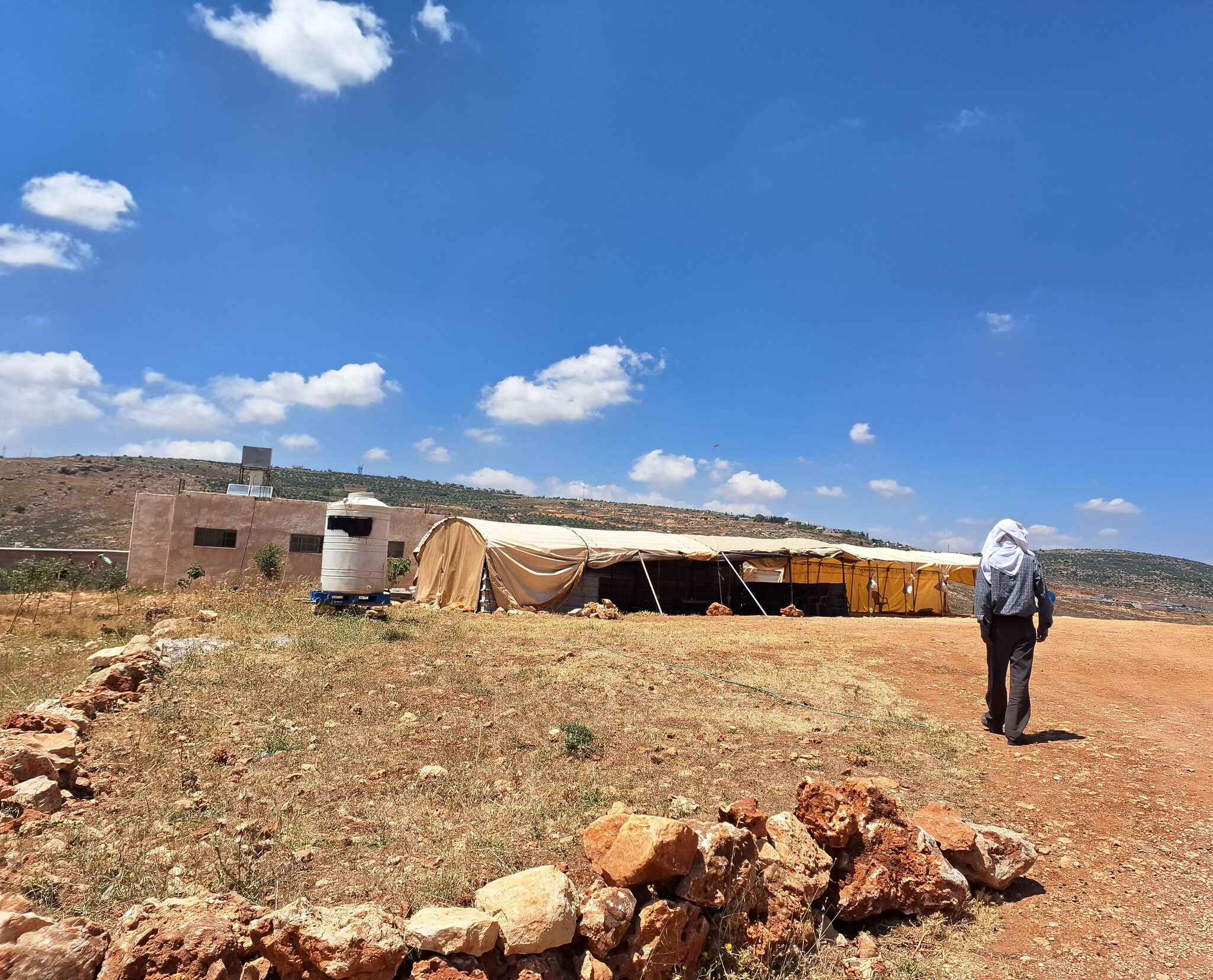
From the north-west to Luban, at the Wadi a-Sha’er area, live Bedouins of the Ka’abne clan. They come originally from the Al Auja area near Jericho, from which they were expelled and had settled on the outskirts of Louban a-Sharqiya. They are related to Bedouins on the outskirts of Duma (that in the meantime have also been expelled and living inside Duma). We went to visit them and hear their story.
We met I., an adult, and young A. They invited us to sit with them, Later I.’s wife joined us and we were treated to coffee. I’ said they had bought two dunams here after being expelled from Mu’arajat, built houses and made their living husbanding flocks. There are two houses and tent compounds there, a tin shack and another with tarpaulins. They receive their electricity from Luban as well as piped water (although we also saw a water tanker there).
But here too, they have no respite from colonists. Near their compound, two outposts still nameless, comprised of several caravans and some tents. One of them has already been there for two months. The colonists smashed windows in their home, incinerated cars and put to fire a shack while one of the sons was sleeping inside. The father released his son from the fire and they both suffered burns – the son in both hands and the father in one, and they still have not recovered. They also told us their phones were taken away so as not to take any pictures. At night they leave a watchman awake, and take shifts all night in order to chase colonists away.
I’ is the grandfather of the 18-year-old killed on May 13th. He says their flock was transferred to the Sinjil ara where the family have another compound, the colonists pursued them there as well accompanied by soldiers. The flock was stolen from them in several incidents by large groups of dozens of colonists accompanied by the army. The last incident took place on May 13, 2026. The youngster guarded the flock and tried to prevent the colonists from stealing it. Instead of protecting him and preventing the theft, soldiers guarded the colonists, shooting and killing him. They complained with both the Israeli and Palestinian DCOs and the answer they got was “It will be looked into”.
In total they had 1,720 sheep and these were all stolen from them. They now have no source of livelihood. When asked what they live on now, they answered that they have very little money left, about one-thousand shekels, and they hope that one of the charities will help. Beyond that, they trust Allah…
The Awarta checkpoint was unmanned by soldiers when we passed. A morning report mentioned there were soldiers there then, creating a serious traffic jam, so that the ride to Nablus took two hours. Beit Furik checkpoint was open as well. Soldiers were only on the watchtower, and an armored Front HQ jeep stood nearby.
From there we drove to Burin to visit our friend Doha. On our way we saw a sign, “Pioneers of Sanur, we only want to thank you” (we could not stop to take a photo). Just as we were parking near Doha’s house, a military jeep came down. As we disembarked, it ascended again. Doha said this was only the beginning, they are constantly riding around Burin.
She said that last night, on Sunday, May 24th, around 10:30 p.m., soldiers entered the village. They entered shops, take out anyone there into the street and forced them all to kneel, old and young equally. Then they entered homes, broke doors, took out their dwellers and ordered them too to kneel. It remained unclear whether any arrests were made. In the morning, schoolchildren were prevented from accessing their school. Soldiers stood at its entrance and sent the children back home.
Doha is tireless. She is always busy doing something. When we came, we found a dish with crocus flower petals which she dries and then grinds, and on the entrance porch she dries thyme leaves. She treated us to stuffed grape leaves she had made this morning and the olives she prepares from her own trees.
From there we drove out to see a new colonist outpost which we heard had been erected on the outskirts of Madama and Burin. Several tents and caravans have been erected on lands belonging to Madama village, under the Al Mura’ba’a checkpoint between Burin and Nablus. We met villagers saying colonists have prevented people from constructing a house nearby to continue building. The villagers took photos of the outpost but hurried to delete them for their phones are inspected at the checkpoint, and if the photos are found the people would be in trouble.
Location Description
Al-'Auja
See all reports for this place-
Al-'Auja
A large Palestinian town located on Highway 90 about 10 km north of Jericho, which also includes a small refugee camp and an UNRWA school. East of Al-'Auja are many shepherd communities (such as Maharaja and Ras al-Ain) living in shacks. They are frequently attacked by settlers from outposts in the area, including Yitav, Omer Farm and the outskirts of Jericho. The attacks include stealing flocks of sheep, evicting them from grazing areas and violence against the shepherds and the communities' homes. When the army and police are called to the scene, they do nothing, or intervene in favor of the attacking settlers. Valley activists and Checkpoint Watch companies between them have maintained a protective presence in these communities for several years. Uja is located on a large spring from which Israel pumps most of its water for the Valley settlements, and the rest of the water is led to Uja via open canals. These canals are subject to repeated blockage by settlers.
-
Beit Furik checkpoint
See all reports for this place-
One of the three internal checkpoints that closed on the city of Nablus - Beit Furik to the east, Hawara to the south, Beit Iba to the west. The checkpoint is located at the junction of Roads 557 (an apartheid road that was forbidden for Palestinians), leading to the Itamar and Alon Morea settlements and Road 5487. The checkpoint was established in 2001 for pedestrians and vehicles; The opening hours were short and the transition was slow and very problematic.Allegedly, the checkpoint is intended to monitor the movement to and from Nablus of the residents of Beit Furik and Beit Dajan, being the only opening outside their villages. Since May 2009 the checkpoint is open 24 hours a day, the military presence is limited, vehicles can pass through it without inspections, except for random inspections. (Updated April 2010)
-
Burin (Yitzhar)
See all reports for this place-
Burin (Yitzhar)
This is a Palestinian village in the Nablus governorate, a little south of Nablus, on the main road passing through the West Bank. The settlements: Yitzhar and Har Bracha, settled in locations that surrounded the village, placed fences so it is cut off the main road.
There are around 4000 inhabitants. Most of them are engaged in agriculture and pasture, although many graduates of the two secondary schools continue to study at the university. Academic positions are hardly available, they find work as builderd, or leave for the Gulf countries.
The village lands were appropriated several times for the establishment of Israeli settlements and military bases, and as a result, Burin's land and water resources dwindled. lSince 1982, more than 2,000 dunams of village land have been declared "state land" and then transferred to Har Bracha settlement.
Over the past few years and more so since 2017, the villagers have been terrorized by the residents of Yitzhar and Har Bracha, the Givat Ronen outpost and others. Despite the close proximity of soldiers to an IDF base close to one of the village's schools, residents are suffering from numerous stone-throwing events, vehicle and fire arson, also reported in the press.
In 2023, the prevention of the olive harvest in the village plot was more violent than ever. Soldiers and settlers walked with drawn weapons between the houses of the village and demanded that people stop harvesting in the village itself and in the private plots outside the village. The settlers from Yitzhar and Giv'at Roned raided the olive groves and stole crops. 300 olive trees belonging to the residents of Burin, near Yitzhar, were uprooted. The loss of livelihood from the olives causes long-term economic damage to the farmers' families, bringing them to the point of starvation.
(updated for November 2023)
-
Duma
See all reports for this place-
Duma
A village in the Nablus governorate, with 3,000 residents. They owned some 18,000 dunams, 500 dunams of which the village itself was built. However, after the settlement of Migdaleim annexed a large part of their land, their area was reduced to only 2,000 dunams.On July 31, 2015, two houses in the town were torched with petrol bombs. Sa'ad and Riham Dawabsha, and their infant, Ali Sa'ad Dawabsha, were burned to death. Another son was seriously injured. "Revenge" and "King Messiah" were spray painted on the walls of the house. The trial of the arsonist, the settler Amiram Ben Uliel, is still underway (2019), and a plea bargain was signed in May 2018 with the minor who participated in the planning of the arson.
The closure imposed by the army, the poor roads that they are forced use due to the lack of paving permits from the Civil Administration, along with the lack of public transportation, all these difficulties cut off the village from nearby Nablus and Ramallah.
-
Jamma'in*
See all reports for this place-
Jamma'in*
Jamma'in is a small town, with some of the best quarries in the area. The stone is sold all over Palestine and Israel and even outside the country. The city also has an industrial area. Although they are close to the Ariel and Tapuach settlements, Jama'in farmers have no daily problems with settlers. Harassment occurs mainly during the October harvest season - the settlers sometimes try to drive the farmers out of their plots. Jama'in has its own info-icon water reservoir tower. The water is obtained from sources and paid for by the Palestinian Authority. The city has one clinic that opens only 2-3 days a week. The biggest problem is that there is only one hospital in Nablus in an area of about 10,000 residents. This hospital is too small, does not have enough equipment, and not enough doctors.
Zeita / jama'in is a village of about 3000 inhabitants near Jama'in and Ariel. In the 1980s, land was taken from the village and transferred to settlements. Farmers in the village have lost some of their income. The settlements are located on the ridges, further away from Zeita, which is in the valley. The village does not often suffer from harassment.
The water sources for Zeita and Jama'in that have supplied water to the villages for centuries have been confiscated by the Mekorot company and the water is flowed to Ariel. Without a reasonable info-icon water supply the villages cannot develop agriculture or any industry.
The electricity comes from the Israeli Electric Company through Ariel and Jama'in.
The IDF oversees the main roads and entrances to the villages. -
Jama'in is a small town, with some of the best quarries in the area. The stone is sold all over Palestine and Israel and even outside the country. The city also has an industrial area. Although they are close to the Ariel and Tapuach settlements, Jama'in farmers have no daily problems with settlers. Harassment occurs mainly during the October harvest season - the settlers sometimes try to drive the farmers out of their plots. Jama'in has its own info-icon water reservoir tower. The water is obtained from sources and paid for by the Palestinian Authority. The city has one clinic that opens only 2-3 days a week. The biggest problem is that there is only one hospital in Nablus in an area of about 10,000 residents. This hospital is too small, does not have enough equipment, and not enough doctors. Zeita is a village of about 3000 inhabitants near Jama'in and Ariel. In the 1980s, land was taken from the village and transferred to settlements. Farmers in the village have lost some of their income. The settlements are located on the ridges, further away from Zeita, which is in the valley. The village does not often suffer from harassment. The water sources for Zeita and Jama'in that have supplied water to the villages for centuries have been confiscated by the Mekorot company and the water is flowed to Ariel. Without a reasonable info-icon water supply the villages cannot develop agriculture or any industry. The electricity comes from the Israeli Electric Company through Ariel and Jama'in. The IDF oversees the main roads and entrances to the villages.
-
Mu'arrajat
See all reports for this place
