
Ethnic cleansing among the remaining shepherding communities in the northern Jordan Valley

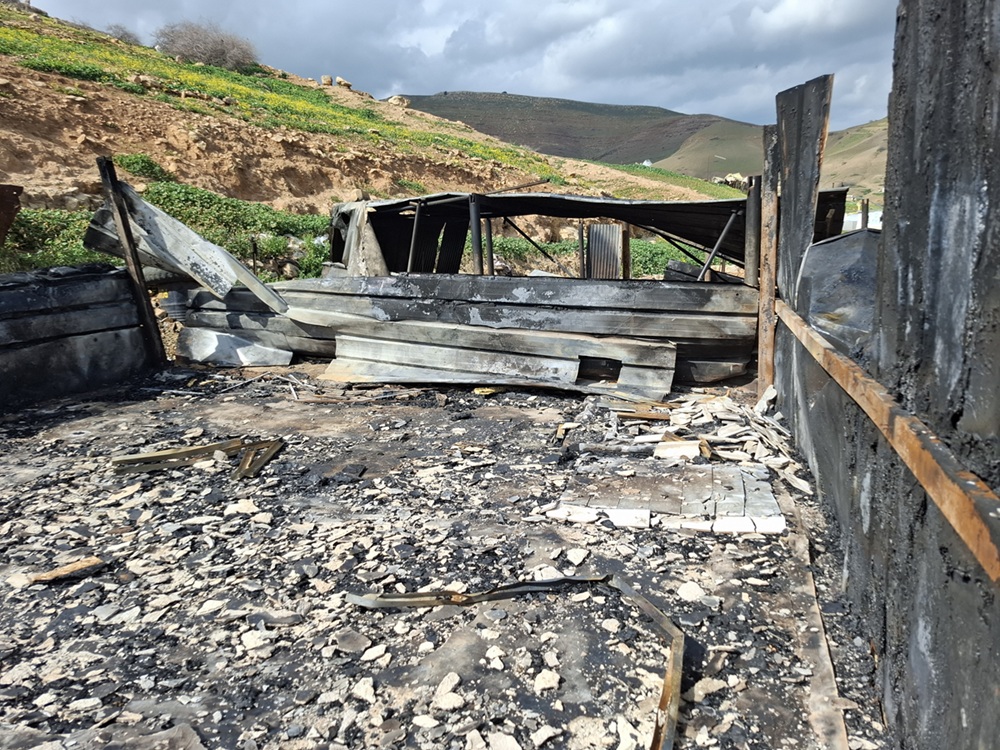


Community after community, village after village, all have fallen, after they fought the settlers with all their strength in an effort to hold onto their land. The villains with large skullcaps and wild sidelocks have slaughtered their sheep with insane brutality, stormed into their homes, invaded communities at night, stolen, and trampled, and in the end, all the Palestinians have fled from the Jewish terrorism – al-Burj, al-Meyteh, Um al Jmal, Nabil, Tarq, Hamam al-Maleh, northern Samra. Only three families have remained.
Until three months ago, the length of the road to Tayasir was full of life – families, children, flocks of sheep. Today I looked over the area from the heights of Al Burj, where more than once I sat in the company of Palestinian women in the shade of an expansive tree, and there wasn’t a living soul. Empty, abandoned, plundered. Only signs of sick aggression – squashed cans and burned houses, surrounded by empty beer bottles, signs that the villains even celebrated the destruction there.
And how can it continue when one night, a few months ago, settlers arrived accompanied by the army and confiscated a herd of around 120 sheep, and a few hours later, the stunned residents found them butchered on the surrounding hills, one sheep after another, with their bellies torn apart or skulls shattered. After that, the residents never got a full night’s sleep – alert and terrified, in fear of their children’s lives, they had to keep their eyes open 24/7 until they couldn’t go on anymore, and left.
A guest who visited the Jordan Valley for the first time asked innocently, “But the entire area is empty, there’s plenty of room for everyone.” She hadn’t understood that the goal is expulsion, ethnic cleansing. These criminals don’t actually have any interest in living here, they just want to make the place “Arabrein” (free of Arabs, just as their racist forerunners sought to make Europe Judenrein, free of Jews, in 1939).
In another place, S’s community, which had dwelt on private land here for hundreds of years, used whatever strength they still had to stay on their land. Two weeks ago, the settlers set up a one-tent outpost on the hill opposite the Palestinians’ home. They brought in a herd of cows and started out by moving them onto the local residents’ wheat fields so they could trample and eat everything. Then they brought the herd into the community, where they roamed freely among S’s tents and shacks, and the policemen who were called in simply mumbled “it’s allowed” and left. How come it’s allowed? Is it permissible to bring cows into private homes belonging to Jews?
And as happened to S., next to the neighboring village El Hadidya, on the hill overlooking the road, settlers set up an outpost next to the Palestinians. Straight away, they built a fence around the homes of the communities and forbade the Palestinian residence to use the path leading to the main road from the north.
At the entrance to the village we met two young Palestinians, who told us how the previous day they had stopped the settlers who had come to burn down their haystack. They showed us a video of how the young people of the community stood in their way and with loud cries and even beatings, they wouldn’t let the settlers into the village. We met Jordan Valley activists who were staying in the village as a protective presence. One of the children shouted mustawatan [settlers] to them and right then a settler appeared on an ATV, made a heroic turn on the hill above the houses, closer, closer, and then disappeared. Terrorism.
At the end of our visit, we dropped by to see Z’s family on the hill above Hamra. The determination and initiative of Mahmous and all his family, including his two daughters with special needs, boosted our mood for our journey home.
Location Description
Jordan Valley
See all reports for this place-
Jordan Valley The Jordan Valley is the eastern strip of the West Bank. Its area consists of almost a third of the West Bank area. About 10,000 settlers live there, about 65,000 Palestinian residents in the villages and towns. In addition, about 15,000 are scattered in small shepherd communities. These communities are living in severe distress because of two types of harassment: the military declaring some of their living areas, as fire zones, evicting them for long hours from their residence to the scorching heat of the summer and the bitter cold of the winter. The other type is abuse by rioters who cling to the grazing areas of the shepherd communities, and the declared fire areas (without being deported). The many groundwaters in the Jordan Valley belong to Mekorot and are not available to Palestinians living in the Jordan Valley. The Palestinians bring water to their needs in high-cost followers.
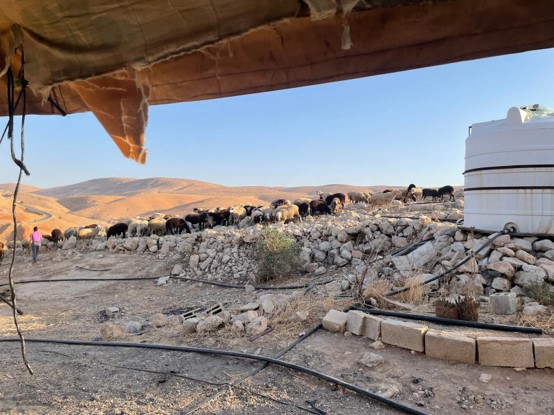 Rachel AfekOct-22-2026Jordan Valley, Hamra – Livestock searching for food
-
