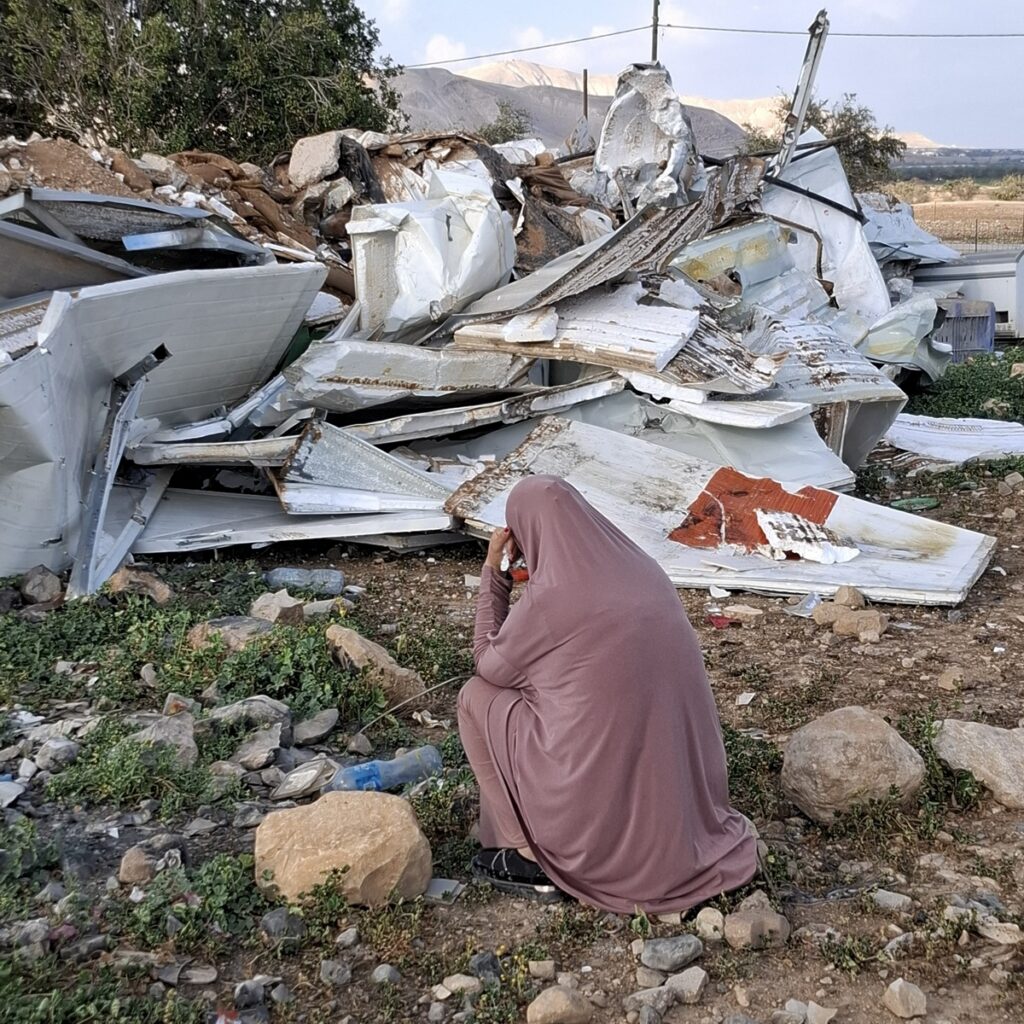
Shilo and Adei-Ad settlers, whose homes are built on lands expropriated from Turmusaya, have created a kind of invisible, “hidden barrier”which effectively prevents farmers from working their remaining lands. Even their American citizenship does not protect them from the settlers and the Army.
A new phenomenon—-we were told that Israeli police frequently enter the farm area and also the villages, to confiscate cars which the Palestinians use in agricultural lands only. The police claim that they are stolen cars, even when the owners have documents proving they purchased them.
——————————
10.00 in Turmusaya. We were well received by the Mayor and his deputy, Dr. N., who is an Engineering lecturer at Bir-Zeit University. They had heard of our coming only about 10 minutes before we arrived.
Turmusaya is a town, 95% of whose Palestinian inhabitants left years ago to live abroad, returning from time to time with their children. They now hold passports from the US, Canada or various South American countries. The Mayor told us that since Shilo was founded in 1979, they’ve endured expropriations of lands which were the private property of Palestinians. Over the years, settlers would come to cultivated lands and uproot trees under the Army’s protection. During the last year they have not done so.
They said that that very morning, a tractor had gone out to work land near Adei-Ad. The Israeli and the Palestinian DCO (Coordinating officers) had arranged this jointly. Without such arrangements, no one can work his land. This has been going on for 5 years. On such occasions—as happens in many villages—soldiers who are in the area come to observe the farmers. Then the settlers don’t approach. But farmers are only allowed to work their lands twice a year.
During the rest of the year, these are the areas that are separated from the Palestinian homes by “invisible barriers,”no less effective than iron or stone ones. The Palestinians own two fertile valleys, but, we are told, they are afraid to go there. One is the Turmusaya Valley, an area of 5000 dunams, and the other is in the Jenin area. The conversation which then ensued on topics related to the Occupation and politics was very illuminating.
CONFISCATION OF CARS. We asked for more details about the method adopted lately to confiscate cars which—-no longer considered fit for the highway, because they had been involved in accidents—are now used by Palestinians in village roads with little traffic. Dr. N, who lived in New York for 20 years, and returned because of his children, knows a young man whose car was confiscated. He phoned him, asking him to come and meet us. The young man came and told us that two weeks ago they took his car away. Two years ago he had bought it in Huwarra for 2000 sh. It is a used car, a model from 99, which he drove for agricultural purposes only. He had to pay a fine of 3000 sh. The car was not returned to him, although his tools were. The police said it was a stolen car.
We asked for his personal details so that we could find out how it was that a car, which was no longer considered fit for the highway, could yet be sold. But he did not agree to provide personal details.
We went to the falafel stand in Turmusaya, to meet A. with whom we had talked there last time. He claims that Israel confiscates such cars, so that farmers can’t work their land, and Israel can then appropriate it.
According to him, the police lately enters villages and set up sudden barriers in agricultural lands, so as to confiscate cars. Frequently, the police claim that these are stolen cars, even when documents prove that they were, in fact, purchased.
To understand this issue better, and to be able to ask official entities to answer these puzzling questions, we need more testimonies. We left at the Baladia and the falafel stand a series of questions on this topic, so as to make it easier for our interlocutors to collect the necessary information till our next visit.
12.00 Khirbet Abu Falah. This time, we hoped to meet someone from the madjeles, but we didn’t succeed. The cafe we visited once was also closed. Nor could we find a shopkeeper or anyone else to talk to.
12.30 Near Tapuah settlement we met H, who gave us the payment for the lawyer who is taking care of his request to change his status, so he is no longer barred from working in Israel.