
A failed confiscation of a tractor

Sunday, as usual the checkpoint is busy, parking is full ….
We drove to Abu Safi, who had told us that two days earlier Israel Kaplan, the settler who lives on the hill next to him, had called the police, claiming that Abu Safi was plowing in areas not his own. Police arrived and the DCO officer took his ID number and informed him that these are state owned lands and therefore the tractor would be confiscated. It should be clear that Abu Safi, an elderly and disabled person, cultivates all the surrounding areas on his own. He lives in Wadi Radim, with his small family (his wife and daughters), and the tractor is also his vehicle for bringing water, food for the family and animals, equipment, etc.
Luckily, there was a puncture in the wheel and they could not take the tractor.
He turned to Eyal who helps him in such cases and the plan was that today, Sunday, there would be a meeting of Abu Safi with the head of the Meitarim Council. Here they would try to find an solution to the “boundaries” on which all agree. We have not received a report of the meeting.
The tension, the pressure and the threats, is felt at all times. They are afraid of the settlers who will come and make a mess both in the house and outside and this stresses the family and also the animals and causes damage …
(A week ago, when his daughter was grazing, they came with an ATV, scared her and she ran home).
South Hebron Hills
See all reports for this place-
South Hebron Hills
South Hebron Hills is a large area in the West Bank's southern part.
Yatta is a major city in this area: right in the border zone between the fertile region of Hebron and its surroundings and the desert of the Hebron Hills. Yatta has about 64,000 inhabitants.
The surrounding villages are called Masafer Yatta (Yatta's daughter villages). Their inhabitants subsist on livestock and agriculture. Agriculture is possible only in small plots, especially near streams. Most of the area consists of rocky terraces.Since the beginning of the 1980s, many settlements have been established on the agricultural land cultivated by the Palestinians in the South Hebron Hills region: Carmel, Maon, Susia, Masadot Yehuda, Othniel, and more. Since the settlements were established and Palestinians cultivation areas have been reduced; the residents of the South Hebron Hills have been suffering from harassment by the settlers. Attempts to evict and demolish houses have continued, along with withholding water and electricity. The military and police usually refrain from intervening in violent incidents between settlers and Palestinians do not enforce the law when it comes to the investigation of extensive violent Jewish settlers. The harassment in the South Hebron Hills includes attacking and attempting to burn residential tents, harassing dogs, harming herds, and preventing access to pastures.
There are several checkpoints in the South Hebron Hills, on Routes 317 and 60. In most of them, no military presence is apparent, but rather an array of pillboxes monitor the villages. Roadblocks are frequently set up according to the settlers and the army's needs. These are located at the Zif Junction, the Dura-al Fawwar crossing, and the Sheep Junction at the southern entrance to Hebron.
Updated April 2022
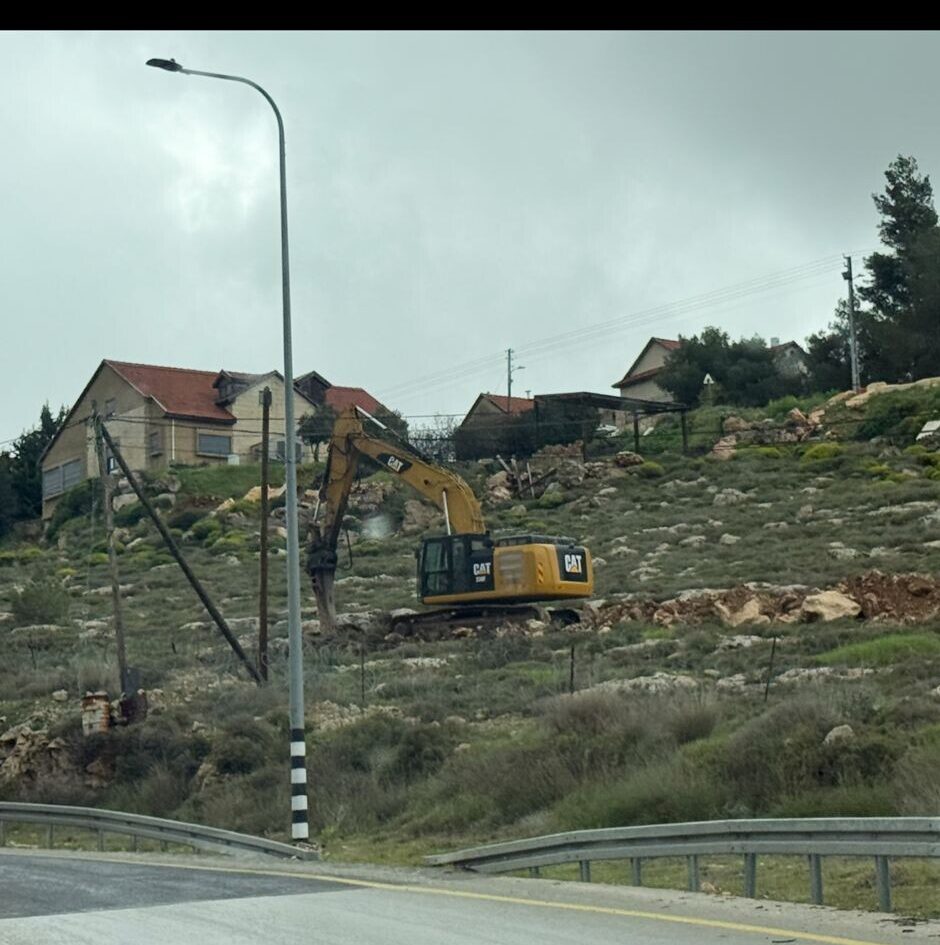 MuhammadFeb-24-2026South Hebron Hill, Beit Hagai: Paving an internal security road
-