
A-Tuwani, Dura-Al Fawwar Junction, South Hebron Hills, Susiya

Road 317
In the settlement Asael, an expansion takes place right in front of the eyes – caravans have been placed on green foundation pillars and builders were there to repair and install them.
At the Susiya junction, a flock of uniformly colored sheep are running after a shepherd settler in a yellow vest with a stick in his hand, it seems that they are on their way to trample another Palestinian plot.
In Susiya we visited Azzam. His tire pots are in bloom and a stark contrast to the desolation and hopelessness around. We just sat down and were presented with a beef meal with his finest olive oil. Azzam talks about the corona: It turns out that the number of patients have now been greatly reduced and Beate has closed the corona ward at the hospital. Anyone can get vaccinated (reinforcing what we heard from Abu Safi who went out to have his daughter vaccinated today). However the time between the first and second vaccination is not always clear, according to Azzam three months
We went to Umm Fokara to bring them the clothes that Ariela had collected in the kibbutzim.
We drove up the road from Maayan Abigail, and at the top of the hill, at the connection to Umm Fokara, the road is closed with concrete blocks brought by the settlers during the war. The villagers made a detour that allowed us to get to the road leading to the village, but we heard that already a van with a cart had overturned there. The road to the village is very difficult and in the part where we still can see asphalt, you can see the fresh damage left by the army’s D9 , a type of bulldozer, which further aggravated the siege on the village.
Fadel talked about their traffic problems. Now every exit from the village is through a difficult and long road to Tuwani. They receive water in a pipe from Tuwani which has been cut several times already (probably by the settlers). The water comes once every three days for one hour, and they fill the white containers that are planted like trees around the houses.
We returned the same bumpy and closed road to the main road.
Maon is expanding in all directions. On the eastern side you see new caravans placed on the ridge.
On the western side of Road 317, the settlers are busy building a high fence that borders the hill on which bulldozers work in flattening the land, apparently in preparation for the construction of additional barns.
Route 60
In front of the village Qilqis road works – construction of a wide road that allows the connection of the village on a wide road towards Hebron. The road is almost ready but still closed and in the meantime the traffic on it towards the village is on foot
On the hill on the side of the village a line of soldiers with rifles drawn, securing something.
Dura-Al Fawwar Junction: The vegetable stalls have disappeared, remnants of a fallen stall remain, and another modern gazebo that insists on selling fruit. Along the way are signs of the end of the agricultural year – after the harvest and before the hay harvest. The only routine unaffected by the occupation._
A-Tuwani
See all reports for this place-
A-Tuwani
The locals came to a-Tuwani during the 20th century from the village of Yatta. They settled in abandoned ruins, utilizing the arable land, pastures for grazing sheep and the abundance of natural caves for habitation. The residents who settled in the caves came from families who could not purchase land for houses in the mother villages, as well as shepherds who did not have enough land to graze. They were joined by clan members who quarreled with other families in the mother locality.
Some of the residents today live in concrete buildings built above the caves. In the area of the village are several water cisterns and an ancient water well called 'Ein a-Tuwani. Local residents are forced to buy water in containers and transport them through many road blocks to the village. With the help of international organizations, an electrical system was installed in the village. In the late 90s of the 20tTh century, an elementary school was established in the serving several small villages in the area.
In 2004, MachsomWatch began visiting and reporting from the Khirbet Tuwani cave village, which suffers badly from the settlers of nearby outposts, and especially from the extremist Ma'on outpost. . The settlers contaminate cisterns, poison the flocks and uproot trees.Particularly notable is the harassment of children from the surrounding villages on their way to school in a-Tuwani, so much so that military escort of children is required to separate them from the attackers (this was arranged following an initiative of the organization's members). In the past year, the escort has been without the vital presence of overseas volunteers.
Near a-Tuwani there are several families who have returned to the caves due to the incessant demolitions of the civil administration (as there is a total construction ban in all of area C). Destroyed are not only residential and agricultural buildings, but also water pipes, machinery. Even water cisterns are clogged up. a-Tuwani residents have created an association for non-violent demolition protests, but in the past year the army’s harsh harassment and settler violence have intensified and escalated. The incident of the small generator confiscation, which left a young man paralyzed, is one of many examples - any legitimate protection of property rights leads to violence and even shootings by the army and the civil administration.
Updated April 2022
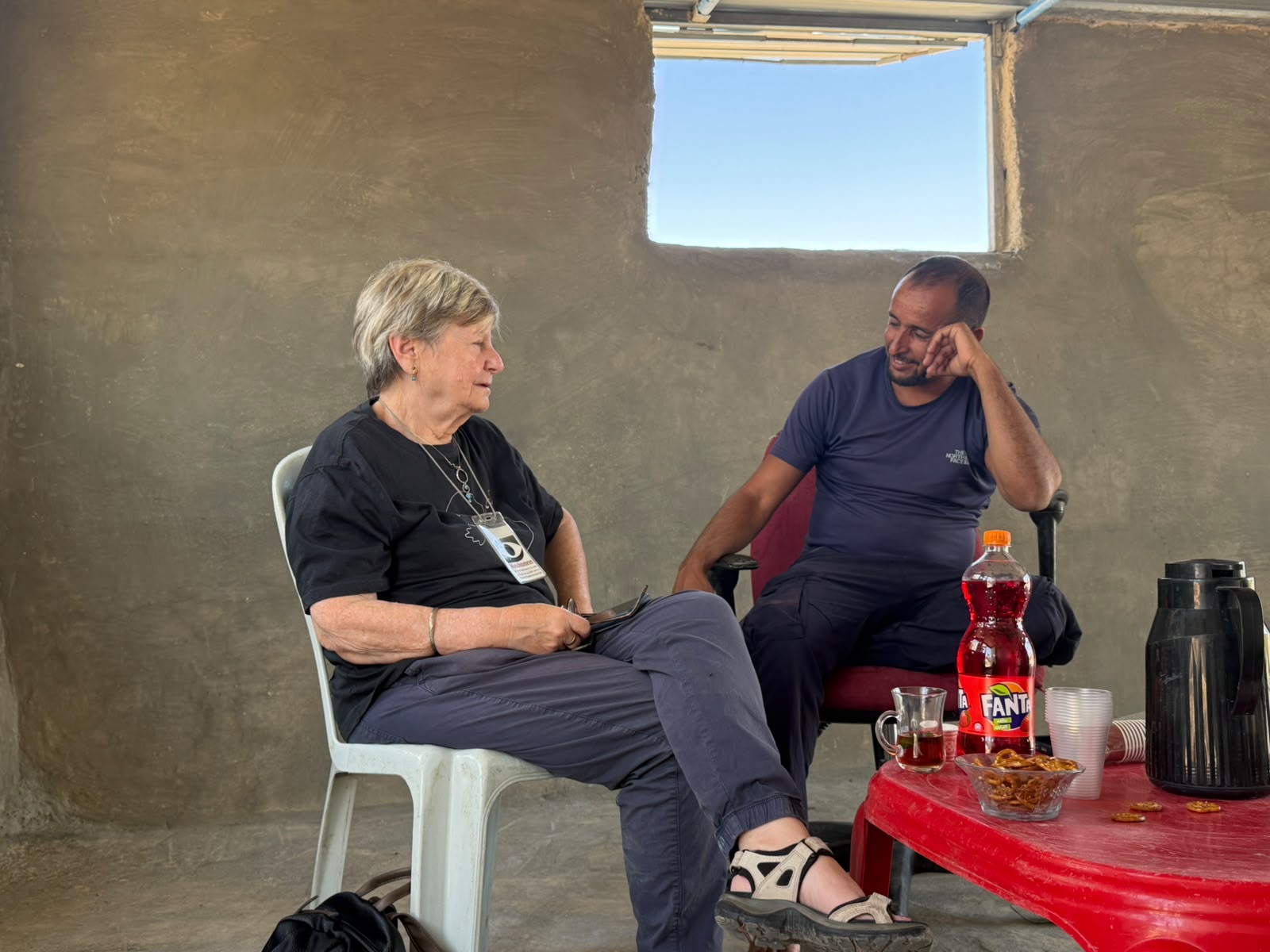 Muhammad D.Oct-10-2026Smadar with Najeh in Umm Qusa
-
Dura Al-Fawwar Junction
See all reports for this place-
Junction on Route 60: west - the town of El Dura, east - the Al Fawwar refugee camp. There is a manned pillbox at the junction. From time to time the army sets up flying checkpoints at the entrance to El Fawwar and Al Dura. Al-Fawwar is a large refugee camp (7,000 inhabitants in 2007) established in 1949 to accommodate Palestinian refugees from Be'er Sheva and Beit Jubrin and environs. There are many incidents of stone-throwing. In the vicinity of the pillbox there are excellent agricultural areas, Farmers set up stalls adjacent to the plots close to the road. In recent months the civil administration has set up dirt embankments thereby blocking access to the stalls, and making it impossible for the farmers to sell their vegetables. Updated April 2021, Michal T.
-
South Hebron Hills
See all reports for this place-
South Hebron Hills
South Hebron Hills is a large area in the West Bank's southern part.
Yatta is a major city in this area: right in the border zone between the fertile region of Hebron and its surroundings and the desert of the Hebron Hills. Yatta has about 64,000 inhabitants.
The surrounding villages are called Masafer Yatta (Yatta's daughter villages). Their inhabitants subsist on livestock and agriculture. Agriculture is possible only in small plots, especially near streams. Most of the area consists of rocky terraces.Since the beginning of the 1980s, many settlements have been established on the agricultural land cultivated by the Palestinians in the South Hebron Hills region: Carmel, Maon, Susia, Masadot Yehuda, Othniel, and more. Since the settlements were established and Palestinians cultivation areas have been reduced; the residents of the South Hebron Hills have been suffering from harassment by the settlers. Attempts to evict and demolish houses have continued, along with withholding water and electricity. The military and police usually refrain from intervening in violent incidents between settlers and Palestinians do not enforce the law when it comes to the investigation of extensive violent Jewish settlers. The harassment in the South Hebron Hills includes attacking and attempting to burn residential tents, harassing dogs, harming herds, and preventing access to pastures.
There are several checkpoints in the South Hebron Hills, on Routes 317 and 60. In most of them, no military presence is apparent, but rather an array of pillboxes monitor the villages. Roadblocks are frequently set up according to the settlers and the army's needs. These are located at the Zif Junction, the Dura-al Fawwar crossing, and the Sheep Junction at the southern entrance to Hebron.
Updated April 2022
Muhammad D.Oct-10-2026Smadar with Najeh in Umm Qusa
-
Susiya
See all reports for this place-
Susiya The Palestinian area lies between the settlement of Susya and a military base. The residents began to settle in areas outside the villages in the 1830s and lived in caves, tents and sukkot. To this day they maintain a traditional lifestyle and their livelihood is based on agriculture and herding. Until the 1948 war, the farmers cultivated areas that extended to the Arad area. As a result of the war, a significant portion of their land left on the Israeli side was lost. After the 1967 war and the Israeli occupation, military camps were established in the area, fire zones and nature reserves were declared, and the land area was further reduced. The Jewish settlement in Susya began in 1979. Since then, there has been a stubborn struggle to remove the remains of Palestinian residents who refuse to leave their place of birth and move to nearby town Yatta. With the development of a tourist site in Khirbet Susya in the late 1980s (an ancient synagogue), dozens of families living in caves in its vicinity were deported. In the second half of the 1990s, a new form of settlement developed in the area - shepherds' farms of individual settlers. This phenomenon increased the tension between the settlers and the original, Palestinian residents, and led to repeated harassment of the residents of the farms towards the Palestinians. At the same time, demolition of buildings and crop destruction by security forces continued, as well as water and electricity prevention. In the Palestinian Susya, as in a large part of the villages of the southern Hebron Mountains, there is no running water, but the water pipe that supplies water to the Susya Jewish settlement passes through it. Palestinians have to buy expensive water that comes in tankers. Solar electricity is provided by a collector system, installed with donation funds. But the frequent demolitions in the villages do not spare water cisterns or the solar panels and power poles designed to transfer solar electricity between the villages. Updated April 2021, Anat T.
-
