
Abu Dis, Container (Wadi Nar), Sheikh Saed, Wed 25.3.09, Morning
Sparse traffic flowing uninterrupted.
With the soldiers' permission, we crossed to the Palestinian side. Deep mud surrounds the turnstiles and the window for presenting documents. In order not to slip into the mud, those crossing swung on the metal spokes of the turnstile. We saw a woman (with a child) who slipped and had to step right into the mud. The commander told us that with every heavy rainfall the mud drifts into the checkpoint and it becomes difficult to cross. He said he had called the private company which takes care of the place to ask them to come but nothing has beeb done. In the meanwhile, after we suggested placing a plank over the mud, he ordered a soldier to place cartons.
We spoke to A., spokesman for the Civil Adinistration, and he asked us to write a letter so that the matter will be taken care of. We shall do so.
8:00 Al-Bawaabe (Pishpash)
Hallucinatory. We saw diggiing in preparation for putting up the wall, but were unable to figure out its path. On our way out we had a conversation with a soldier — we explained our views and heard his response, including partial agreement.
Upon our arrival we headed for the famous traffic sign on the edge of the lane where vehicles are detained, according to the agreement reached with the commander A. a few weeks ago (see report, 25.2.09). The checkpoint commander (another A.) immediately came up and asked us to move back out of the checkpoint area. He threatened to detain us if we refused. We moved back a few meters, and tried to contact the battalion commander, or A., the officer of the unit in charge of crossing points, who had also been present when the agreement about the location of our observation point had been reached.
At this point, the deputy comapany commander, S., arrived, and after an interchange which produced no results, the checkpoint commander came up with the detention forms. We refused to sign, he did not insist, and returned our ID's. We asked what would be done with these detention forms, and S. said that nothing would be done since we had not signed — they would be filed in the unit with the classification of "administrative cancellation." We protested forcefully about the policemen's abuse of their duty in writing a false report against us in order to obstruct our activities.
We must admit that, in principle, we feel it is rather useless to bother with these matters. It seems to us that the sensible thing would be to stand near the yellow concrete fence, and when the need arises (to talk to detained Palestinians), to move a few meters forward, but not beyond the traffic sign.
The conclusion we draw from this irritating episode: we should stand near the yellow fence, on the side of the checkpoint, with the possibility of moving forward when the need arises.
Abu Dis / Lazarus gate (formerly The Wicket)
See all reports for this place-
Abu Dis / Lazarus Checkpoint/Gate (east of the former “wicket”)
Construction of the wall in the Abu Dis area blocked all the gaps that allowed people to cross from al-Ezariya to the neighbourhoods of Abu Dis and Ras al 'Amud that are located within Jerusalem’s municipal boundary. The Lazarus checkpoint is a gate in the wall adjacent to the Lazarus Monastery. Until 2011 it had a door for pilgrims to al-Ezariya and for the monastery’s kindergarten pupils from al-Ezariya. The crossing is currently closed, but the site has infrastructure for conducting inspections.
-
Container (Wadi Nar)
See all reports for this place-
Wadi Nar Checkpoint ("Container", "The Kiosk") - a barrier for vehicles in Area B that is regularly manned - east of Abu Dis between Sawahra A Sharqiya and Bethlehem and its daughters. Controls Palestinian movement between the north and south West-Bank. Includes driving routes, access roads, spikes, traffic lights and signs. There is no pedestrian crossing. Open 24 hours a day with random checks enhanced on security alerts. The checkpoint is in Palestinian territory, allowing for separation between the north and the south Palestinian areas when necessary.
In 2015, the leading road from Azaria to Bethlehem was renovated, as well as the steep and narrow ascent to the Wadi Nar checkpoint, which was dangerously travelled in both directions! The temporary checkpoint was renovated and expanded, and pedestrian traffic was banned. From 2016, traffic travelling from the south bank to Azaria was directed to a one-way road near the Southern Keydar Jewish settlement.
Machsomwatch shifts visit this far-fetched checkpoint only occasionally.
(updated to July 2019)
-
Sheikh Sa'ed
See all reports for this place-
A checkpoint limited to pedestrians, located on Jerusalem’s municipal boundary.
The checkpoint sits on the separation fence at the entrance to Sheikh Sa’ad, dividing it from its neighbourhood of Jabel Mukkabar. It’s manned by Border Police soldiers and private security companies and operates 24 hours a day. Palestinians are forbidden to go through, other than residents of Jabel Mukkabar or Sheikh Sa'ad who have permits. Both groups are permitted through only on foot. Residents of East Jerusalem who don’t live in Jabel Mukkabar are also allowed to cross to Sheikh Sa’ad, but not in the opposite direction; they must return through the Sawahira ash Sharqiya checkpoint.
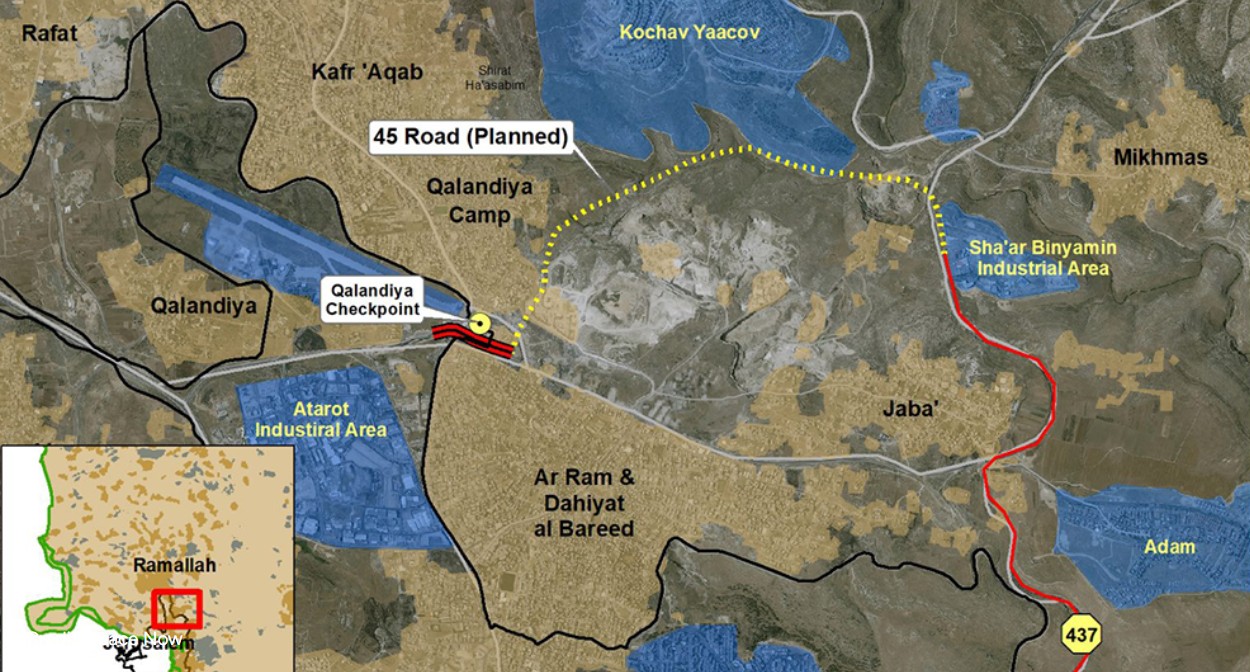 Anat TuegSep-9-2026Road 45. For Israelis only, from Road 60 near Kochav Ya'akov to the Qalandiya underpass
-
