
Abu Dis, Wadi Nar, Silwan, Sheikh Saed, Mon 4.7.11, Morning
|
7:00 Sheikh Saed
Y. of the border police greets us, sitting with his back to the checkpoint and armed with impressive military equipment. He forbids us to climb the hill, to the other side of the checkpoint — a waste of time since beyond the Sheikh Saed checkpoint it's still Area B, and we've been through this argument and resolved it often in the past.
By the way, there are almost no persons crossing. School children are on vacation and workers would have crossed by now. We call the Emergency Humanitarian Centre and the control centre of the Jerusalem Envelope (both in charge of security in the Envelope area). After a few minutes we are informed that they will talk to the soldiers at the checkpoint, and — in response to our question — Y. says "Go". We try to imagine the impression made by a soldier of this ilk on the children crossing, to say nothing of his interaction with the local population… (Hanna B is familiar with this persona and has complained more than once about his conduct at the checkpoints. She will complain again this time.) We conduct a short conversation with the drivers on the hill who express concern about livelihood. They tell us that two elementary schools are operative in Sheikh Saed, and 10 containers receiving supplies from Al-Ezariya, a 30 minute drive away.
7:20 Silwan
Miracles never cease. Many sidewalks have been created after the Supreme Court's order to undo all that had been constructed up to now. Not clear whether this is with the residents' agreement, and not clear whether this is a breach of the court order. At the end of the road there is a checkpoint with 2 policemen and 3 guards. They stop cars, check blue IDs on the computers — including youths travelling on public transportation — delaying traffic until the check is concluded. While this is going on we notice a Jewish vehicle bearing down with total disregard for the "no entry" sign. Apparently they have nothing to fear, after all what could happen to them if they're caught.
Anat talks to the Operation Department and the spokesperson of the Jerusalem police about this impromptu checkpoint and the checking of Israeli citizens travelling on public transportation. In answer to the question why here and not, say, in Beit Hakerem or Jaffa Road, the spokesman says that in the northern neighbourhoods, where he lives, this is common practice. This dialogue is not going anywhere and meanhile — a disturbance. A suspicious bag is found in the vicinity of the policemen. Sharp-eyed Idit tells the soldiers she saw the person who left the bag. He denies. The soldiers summon reinforcements and sappers, ignoring Idit's insistence that she saw the man putting down the bag (a Jew, who has disappeared in the meantime — they never thought to apprehend him). Twenty minutes later, with traffic at a stand-still, the man in the red shirt reappears out of nowhere with a police cap and a sign saying "drill". The policemen are astounded. Idit is relieved , she was not hallucinating. Needless to say, there is no word of appreciation from the policemen, but we feel we have earned our appellation — machsom-watch, in more sense than one.
8:20 Wadi Nar (from El-Azariya)
This time we witness a greater number of vehicles observing the signs directing traffic from the checkpoint in the direction of El-Azaria on the one-way route, slightly longer but more secure. The difference is probably due to the presence of a block of wood laid across the road, slowing down the drive into the steep descent. It permits the driver a few seconds in which to lift his eyes and obey the signs indicating the traffic changes. A further narrowing of the passage would be even more helpful.
A young detainee sits at the checkpoint, and after 15 minutes his friend arrives, carrying the ID he had forgotten at home. Both are released. The soldiers ask us, in a tone of surprise, whether we are not afraid to be here. The truth is that the many barking dogs at the checkpoint are scary…
|
Abu Dis / Lazarus gate (formerly The Wicket)
See all reports for this place-
Abu Dis / Lazarus Checkpoint/Gate (east of the former “wicket”)
Construction of the wall in the Abu Dis area blocked all the gaps that allowed people to cross from al-Ezariya to the neighbourhoods of Abu Dis and Ras al 'Amud that are located within Jerusalem’s municipal boundary. The Lazarus checkpoint is a gate in the wall adjacent to the Lazarus Monastery. Until 2011 it had a door for pilgrims to al-Ezariya and for the monastery’s kindergarten pupils from al-Ezariya. The crossing is currently closed, but the site has infrastructure for conducting inspections.
-
Container (Wadi Nar)
See all reports for this place-
Wadi Nar Checkpoint ("Container", "The Kiosk") - a barrier for vehicles in Area B that is regularly manned - east of Abu Dis between Sawahra A Sharqiya and Bethlehem and its daughters. Controls Palestinian movement between the north and south West-Bank. Includes driving routes, access roads, spikes, traffic lights and signs. There is no pedestrian crossing. Open 24 hours a day with random checks enhanced on security alerts. The checkpoint is in Palestinian territory, allowing for separation between the north and the south Palestinian areas when necessary.
In 2015, the leading road from Azaria to Bethlehem was renovated, as well as the steep and narrow ascent to the Wadi Nar checkpoint, which was dangerously travelled in both directions! The temporary checkpoint was renovated and expanded, and pedestrian traffic was banned. From 2016, traffic travelling from the south bank to Azaria was directed to a one-way road near the Southern Keydar Jewish settlement.
Machsomwatch shifts visit this far-fetched checkpoint only occasionally.
(updated to July 2019)
-
Sheikh Sa'ed
See all reports for this place-
A checkpoint limited to pedestrians, located on Jerusalem’s municipal boundary.
The checkpoint sits on the separation fence at the entrance to Sheikh Sa’ad, dividing it from its neighbourhood of Jabel Mukkabar. It’s manned by Border Police soldiers and private security companies and operates 24 hours a day. Palestinians are forbidden to go through, other than residents of Jabel Mukkabar or Sheikh Sa'ad who have permits. Both groups are permitted through only on foot. Residents of East Jerusalem who don’t live in Jabel Mukkabar are also allowed to cross to Sheikh Sa’ad, but not in the opposite direction; they must return through the Sawahira ash Sharqiya checkpoint.
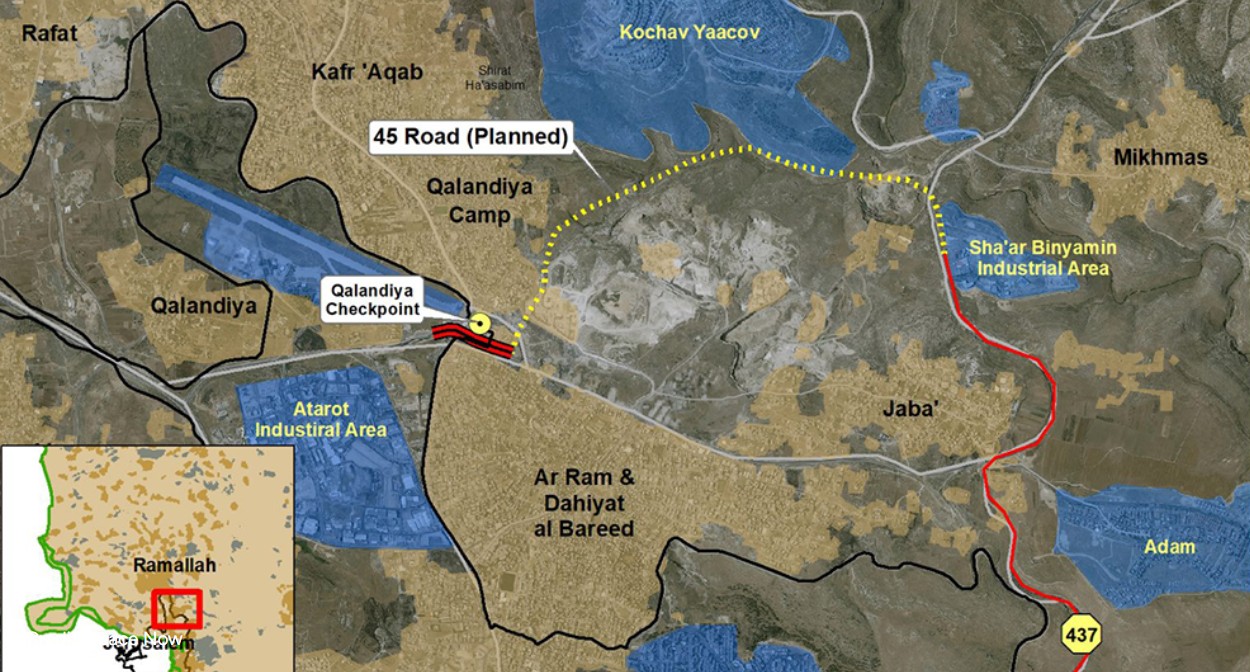 Anat TuegSep-9-2026Road 45. For Israelis only, from Road 60 near Kochav Ya'akov to the Qalandiya underpass
-
Silwan
See all reports for this place-
Silwan is south of the Old City of Jerusalem and has become one of the main confrontation areas with settlers.
-
