
AM
Tarqumiya Monday morning, 22 March 2004 Watchers: Ofra, Aldema (reporting) Note: This morning Ahmed Yassin was assassinated.Ofra arrived at 5:20; I joined her at 6:15 (overslept) .A lot of workers passed through the checkpoing, about 200-250 and perhaps even more, both agricultural laborers and construction workers. At first they passed through slowly, but after 20 minutes Ofra asked if it was possible to speed the pace up (a queue had formed) and the soldiers summoned a military jeep nearby and one soldier remained in it while three others, including the driver, got out and all 4 checked the queue, which now moved forward very quickly. After that, the workers who arrived waited for a short time and then were inspected by one or two soldiers standing at the checkpoint. The soldiers did the checking in a businesslike and polite manner, without warmth, and made notes in an unsystematic way. They also checked and registered various vehicles, which passed through. There were no special problems.The buses with the families came in stages. A bus and a minibus from the West Bank were there already at 5:30, and another 4 buses arrived later. The delay was due to their being held up at the Ras al Jora roadblock. We tried to help with this but some of our phone calls got no answer: the IDF Humanitarian Center [to which suspected abuses are reported], DCO Hebron [IDF Civilian Administration office], etc. The office of the Hebron Brigade CO did answer, and the young woman said that they were under pressure (due to the Yassin assassination), but that she would check and get back to us. After a while the buses arrived, and we called, wanting to tell her that there was no need for her to bother, but the moment Ofra gave her name on the phone the girl said: “Ofra, I don’t have the time,” and put the receiver down.The Israeli buses also arrived in waves, and the civilian police were already there. Everyone waited, and it wasn’t clear if they would be allowed to visit today, because of the assassination, and if there was any point in getting out to go through inspection; also the man from the DSO had not yet arrived, so no one had yet begun to inspect the families. Today we stood right next to soldiers and were not confined to the edges of the checkpoint, either because these soldiers were very businesslike or because in the beginning Ofra had been alone. At about 07:00, the soldiers were told (we heard it on the on the telecommunications system) that the border had been closed and no one was allowed to pass through because of the assassination. The DSO arrived and said the order applied also to the families. The representatives of the Red Cross observed this (a problem of the possibility of riots in the jails) so that they too did not press for inspection and departure, in order not to make a pointless journey with all the children and the families.The soldier asked (over the phone), “What about the workers who had already crossed into Israel that morning?” He was told that that whoever had crossed through had crossed through. We saw a few workers (4-6) being brought back. Another group of workers who arrived at Tarqumiya was told to return home, because the border was closed today. We talked to them and told them it was because of the assassination and that the soldiers had received orders and it was not the soldiers’ own decision. It seemed they understood this and even expected it — “So we go home to the wife,” — one can’t help feeling for them when it is clear that all they are looking for is a day’s work.While the families were waiting, we spoke to a man who was apparently one of the bus drivers. He said there is a problem at the Nokdim roadblock — they sometimes get held up there for an hour and a half with travelers who come through the Allenby bridge checkpoint, because the Beit Jalla crossing is closed. He called us over to tell us this. He said he “knew us” and mentioned the names of several women. He said it was a problem, especially because in the buses he drives from the roadblock there are young women, children etc.All in all, apart from the announcement of closure [restriction of passage], which apparently affected the trucks most because most of the workers had already passed through, the day passed without problems. It seems to us to that this is due to the soldiers of the company staffing the checkpoint now – “Halif” Company. They change places all the time. The regular company is in training. One of the soldiers was an Arab boy – he spoke Arabic obviously – significant knowledge under those circumstances. The atmosphere was relaxed on the whole.
Hebron
See all reports for this place-
According to Wye Plantation Accords (1997), Hebron is divided in two: H1 is under Palestinian Authority control, H2 is under Israeli control. In Hebron there are 170,000 Palestinian citizens, 60,000 of them in H2. Between the two areas are permanent checkpoints, manned at all hours, preventing Palestinian movement between them and controlling passage of permit holders such as teachers and schoolchildren. Some 800 Jews live in Avraham Avinu Quarter and Tel Rumeida, on Givat HaAvot and in the wholesale market.
Checkpoints observed in H2:
- Bet Hameriva CP- manned with a pillbox
- Kapisha quarter CP (the northern side of Zion axis) - manned with a pillbox
- The 160 turn CP (the southern side of Zion axis) - manned with a pillbox
- Avraham Avinu quarter - watch station
- The pharmacy CP - checking inside a caravan with a magnometer
- Tarpat (1929) CP - checking inside a caravan with a magnometer
- Tel Rumeida CP - guarding station
- Beit Hadassah CP - guarding station
Three checkpoints around the Tomb of the Patriarchs
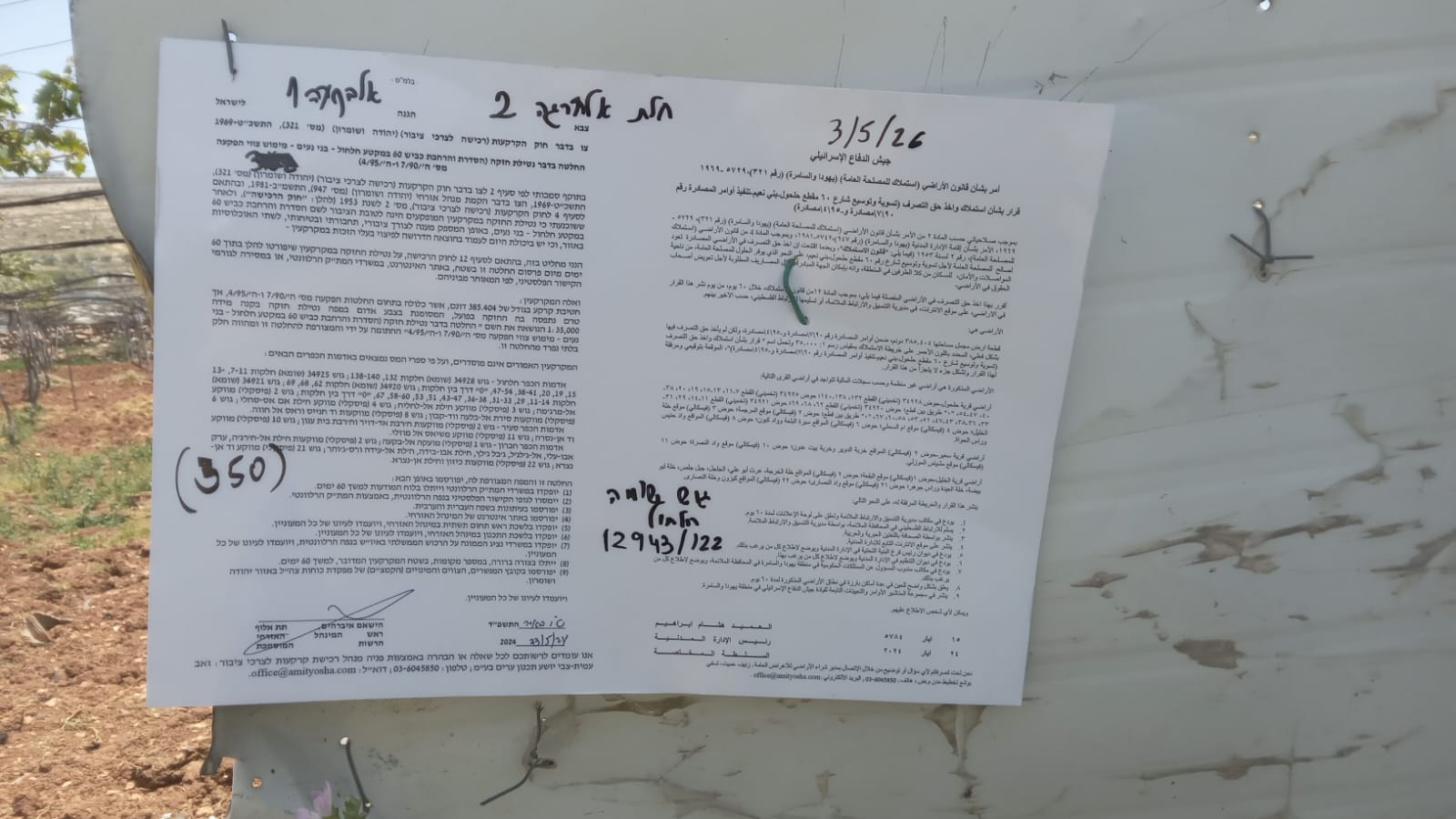 Muhammad D.May-13-2026Hebron - Request for compensation for land expropriation
-