
AM
Internal roadblocks, Mount Hebron 28/3/2004 Watchers: Naomi S., Haya N., Elena L. (reporter) We left the Shoket junction at 6:35. En route we saw a manned roadblock at the turning towards Tene, and one car – apparently from Dahariya – was held up there. We stopped at the Dura–Al Fawar intersection. There was a Hummer on the Dura side; the road from Dura was blocked and therefore taxis couldn’t cross, but the movement of Palestinians on foot was unimpeded. We distributed visiting cards. After about 5 minutes soldiers got out of the Hummer, looked at us in an unfriendly manner and one of them began to speak on the phone. We didn’t wait to see if he would halt the movement of the pedestrians as long as we stayed there, but continued on our way to Hebron. At the Sheep’s crossing, the movement of Palestinians in both directions was unimpeded. There was a Hummer on the Hebron side. We didn’t stop but continued on to route 356 towards Yata. We reached the place where there had been a spot-check road block on 21/3/04. There was no roadblock there this morning, and we returned to the Sheep’s Crossing.We parked about 100 meters from the crossing and approached it on foot. The moment we arrived a soldier approached us and asked us to stand next to the Hummer (for our “personal safety”), and at the same time the soldiers halted the movement of the Palestinians on both sides of the crossing. Elena said to the soldier who spoke to us that “we have permission to be here”, but he shook his head in denial. Meanwhile Naomi had made contact with the Lavi regiment and spoke to Rinat who didn’t know what MachsomWatch was. Naomi explained the situation to her and she promised to make enquiries and then get back to us. Elena had called brigadier general Eisnkut’s bureau, and the young man who answered her promised to get back to her. Haya photographed the Palestinians waiting on the Hebron side, and a soldier asked her not to take photos. In order not to hold up the Palestinians any longer (there were now about 40 on the Yata side and about 20 on the Hebron side), we got into our minibus and drove to the top of a nearby hill, where the soldiers would not be able to see us very easily. From there, we saw that the movement of Palestinians across the intersection had been renewed. The time was 7:40. We waited in vain for the promised return calls. About 10 minutes later, the soldiers spotted us and the Hummer drove up to us. The driver asked us to leave, “because there had been shots there in the past”. We left at about 8:00 am. In view of the fact that this blackmailing trick has become the norm at the Sheep’s Crossing, we think that there is no point in returning there until we manage to speak to the brigade CO, and the matter is dealt with. If the brigade CO doesn’t help, then we should meet with brigadier general Eisenkut. And it would be a good idea to get written authorization, which we could show to the soldiers at the roadblock. Until the matter is dealt with once and for all, we should do no more than make occasional, irregular visits to Sheep’s Crossing, in order to prevent the soldiers from thinking that they have got rid of us and that they need not worry about our reports. On the way back we saw that the crossing at Dura continued to be closed to taxis.
Hebron
See all reports for this place-
According to Wye Plantation Accords (1997), Hebron is divided in two: H1 is under Palestinian Authority control, H2 is under Israeli control. In Hebron there are 170,000 Palestinian citizens, 60,000 of them in H2. Between the two areas are permanent checkpoints, manned at all hours, preventing Palestinian movement between them and controlling passage of permit holders such as teachers and schoolchildren. Some 800 Jews live in Avraham Avinu Quarter and Tel Rumeida, on Givat HaAvot and in the wholesale market.
Checkpoints observed in H2:
- Bet Hameriva CP- manned with a pillbox
- Kapisha quarter CP (the northern side of Zion axis) - manned with a pillbox
- The 160 turn CP (the southern side of Zion axis) - manned with a pillbox
- Avraham Avinu quarter - watch station
- The pharmacy CP - checking inside a caravan with a magnometer
- Tarpat (1929) CP - checking inside a caravan with a magnometer
- Tel Rumeida CP - guarding station
- Beit Hadassah CP - guarding station
Three checkpoints around the Tomb of the Patriarchs
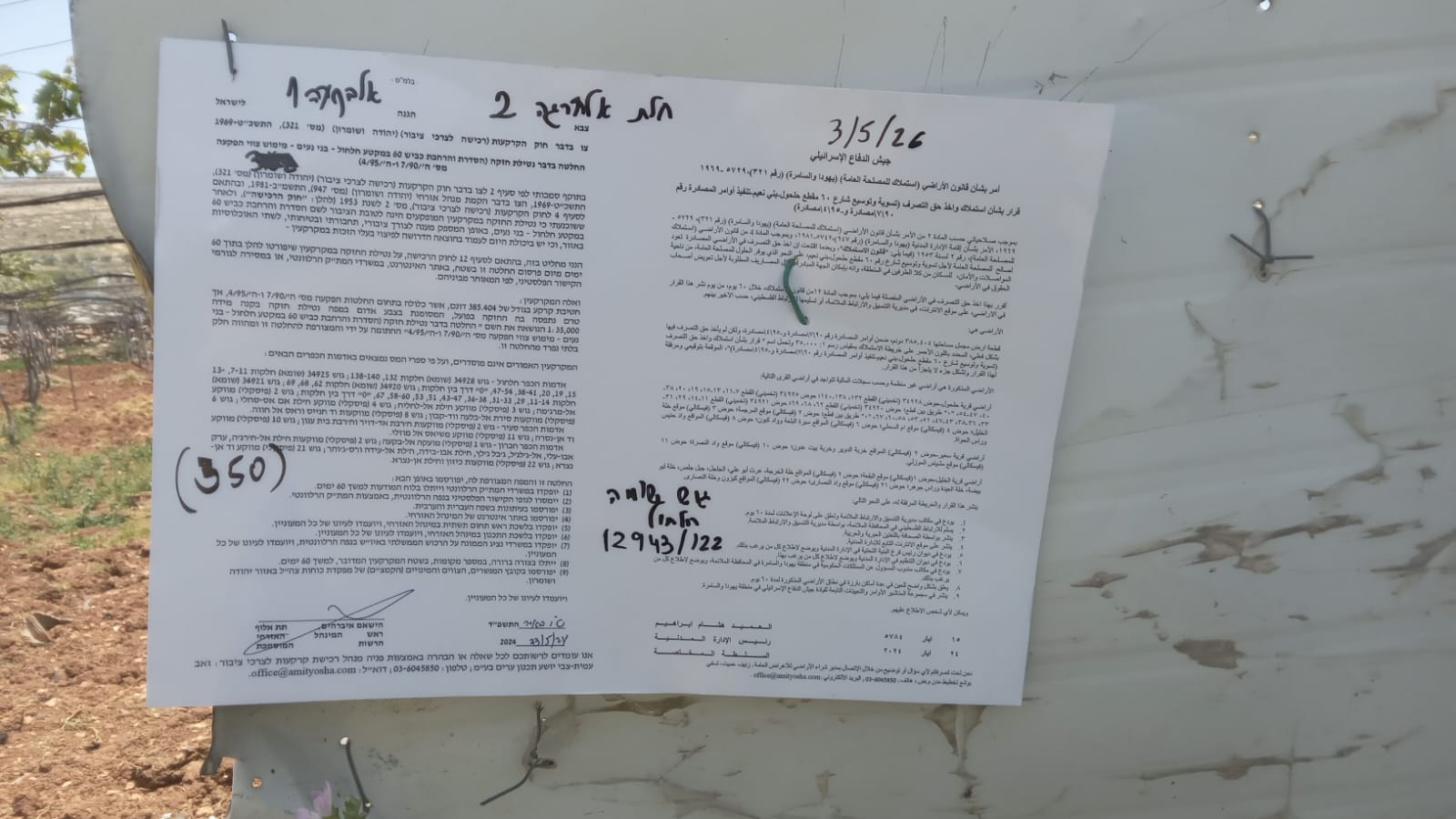 Muhammad D.May-13-2026Hebron - Request for compensation for land expropriation
-