
AM
Southern Mount Hebron 29/3/2004 Watchers: Devorah A., Hagit B. (reporting) We left Shoket junction at 6:30. The roads were open and empty – no military vehicles and no Palestinian traffic. There was nobody around, and it felt as if the whole country was empty – green fields, “a wonderful country”. We reached Dura-ElFawar junction – in army terms, junction 123 – at seven o’clock. The traffic of Palestinian taxis and other vehicles, that had been permitted to cross Route 60 as part of the “easing up” measures, was again blocked. The metal gates on both sides of the road were locked. There is a distance of about 800 meters between the sides of the taxis from El-Fawarand the taxis from Dura. People cross the junction by foot. When we arrived, there was a great deal of pedestrian traffic and many taxis on both sides. There were mainly pupils crossing on their way to school, as well as many other men and women going about their daily business or running errands in the district city of Hebron. We got out the car and stopped at the edge of the road. The driver remained in the car. From the pillbox – the guard tower of “big brother” – we heard the cry of the soldier from above shouting at us: “What are you doing here? You are endangering yourselves. Get back in the car at once and park it under the pillbox”. We told him that we can take care of ourselves and began to speak with the Palestinians and hand out Moked (Center for the Defense of the Individual) cards. We were received with gladness and with a feeling that they are not alone. We stood on the right side of the road in the direction of El-Fawar (the directions I’m referring to are the direction of Beersheba–Jerusalem). At 7:10, we heard a shot.=red> At that time, there had not been any provocation on the part of the Palestinians. The traffic of pedestrians continued from side to side. At a distance of about 30 meters from us on the road in the direction of Dura, two youth were injured. One of the Palestinians called us. We ran in the direction of Dura beyond the taxis and the people that had congregated there. You should have seen the look on people’s faces, the anger, the self-control, and their endless ability to absorb events. The two boys were dragged to a taxi, which took them to the Alia Hospital in Hebron. The driver that took them told us when he returned (we waited for him so that we could find out more details) that the distance from Dura to the hospital was 20 minutes and he just passed them on to an ambulance. There is another internal checkpoint from Dura to Hebron. We are unable to enter there as it is in Area A. Both children had been injured in the legs. They were walking close to each other – one got hit directly and his friend was injured from the ricochet of the bullet. We saw the blood stains on the road and in the taxi. The shooting was not in accordance with IDF orders and not in accordance with IDF rules on opening fire. There was no provocation, no crowding, no danger!!! The innocent passage of individuals between two villages in their own land. The soldiers that were there were from the Lavi Division, and immediately after the shooting the commander came with six additional soldiers as reinforcement. They stood with rifles drawn. I understand from the short dialogue that followed with one of the soldiers that they were also surprised about the shooting.Immediately we tried to contact as many people as possible that we thought should and must know about what happened: Yonni from the IDF Spokesman’s Office in the Southern Command; Hebron Brigade Commander’s office (we spoke with Yossi); Dan Goldenblatt, Parliamentary Assistant of Roman Bronfman; The IDF Emergency Office; Ran Cohen’s Parliamentary Assistant; Alternative Information Center (we left a message); Carmela Menashe from Kol Israel radio station; Shay Hezkani, Galei Zahal (the IDF radio station) Territories Reporter.At the suggestion of Dan Goldenblatt we got back in the car and went to the police station to file a complaint. In any case of shooting, a complaint should be filed with the Israel Police.These are the facts. And the rest …the helplessness, the trigger-happy hand, the injustice, the brainwashing soldiers go through, the difference between blood and blood, all headlines that have become clich?s – nobody takes any notice and nobody stops it.. This is no longer a newsworthy item and we can move on to preparing for the “Seder” and saying, “it will be OK”. We should note on the eve of Passover the exodus from Egypt, and there is no exodus from the occupation. Two young boys who went to school will remain with the cast and the scars – I have already written: “A wonderful country”.
Hebron
See all reports for this place-
According to Wye Plantation Accords (1997), Hebron is divided in two: H1 is under Palestinian Authority control, H2 is under Israeli control. In Hebron there are 170,000 Palestinian citizens, 60,000 of them in H2. Between the two areas are permanent checkpoints, manned at all hours, preventing Palestinian movement between them and controlling passage of permit holders such as teachers and schoolchildren. Some 800 Jews live in Avraham Avinu Quarter and Tel Rumeida, on Givat HaAvot and in the wholesale market.
Checkpoints observed in H2:
- Bet Hameriva CP- manned with a pillbox
- Kapisha quarter CP (the northern side of Zion axis) - manned with a pillbox
- The 160 turn CP (the southern side of Zion axis) - manned with a pillbox
- Avraham Avinu quarter - watch station
- The pharmacy CP - checking inside a caravan with a magnometer
- Tarpat (1929) CP - checking inside a caravan with a magnometer
- Tel Rumeida CP - guarding station
- Beit Hadassah CP - guarding station
Three checkpoints around the Tomb of the Patriarchs
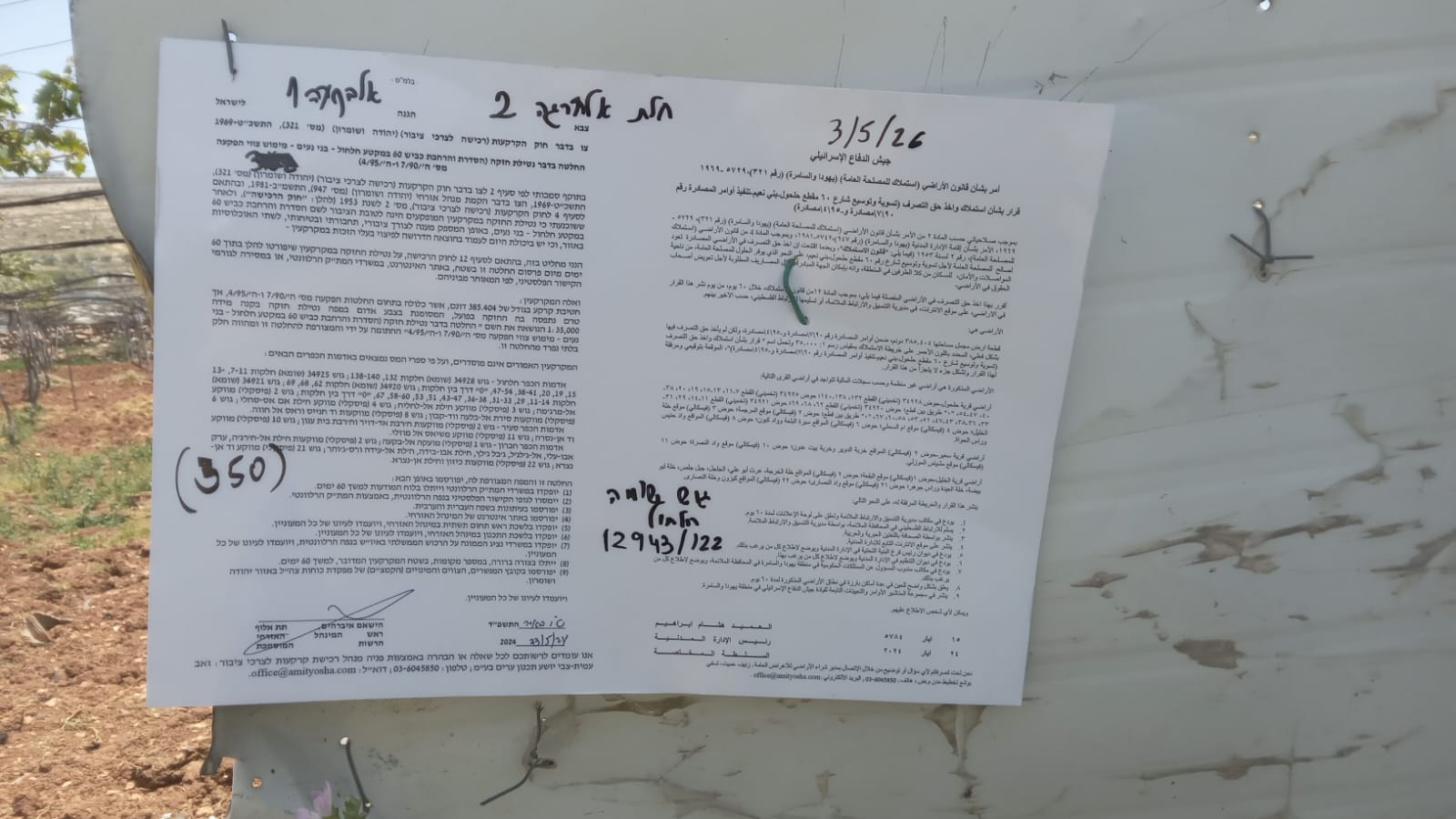 Muhammad D.May-13-2026Hebron - Request for compensation for land expropriation
-