
AM
HUWWARA, Sunday morning, 7 March 2004Observers: Hannah L., Micki P., Alona C., Yehudit A.How the intolerable becomes the norm09:30 — Route 5 alongside the village of Harris.We noticed that the army was on the spot. One military vehicle and five soldiers. There were some 20 Palestinian workers waiting for a Palestinian taxi that would transport them via Palestinian roads to their place of employment which was roughly opposite us on the other side of the road. The soldiers had their eyes skinned lest their flock disperse or, in the lingo of the soldiers, they were making it possible for them (the Palestinians — the security risk) to go off to work. They just must not set foot on Route 5. The line moved at a reasonable pace. 10:20– HuwwaraThe Habad [Hassidic out-reach sect] was engaged on a Purim festival tour of the checkpoints, complete with masks and rattles, handing out the traditional Purim gifts to the soldiers. At the southern end of the checkpoint there were 25 men and women waiting on line and 10 cars . Passage through the checkpoint was according to the usual rules, at times there was even some consideration shown over and beyond what was strictly required. When we got there, there were seven detainees who were released quite quickly, except for one who was still under investigation. A lorry driver who was getting the run around over his licence renewal sought our help in this matter and we made some telephone calls during which the people we spoke to took down his details and promised to look into the matter. He was so optimistic about this and so full of gratitude, but, as always, I suspected that he was due for a disappointment.Two men presented a piece of paper showing that they had a doctor’s appointment. But a piece of paper is not like an ambulance. They were refused passage through the checkpoint even after we had made phone calls and pressed for an officer to come, and even after he arrived on the scene he did not help.A young man who had lost his identity card was not allowed through the checkpoint to go to renew it. This was an episode that went on for some time. A permit that he had received from O., one of the officers in the area, was deemed insufficient. But, after a lot of hard work by Micky, the problem was eventually solved.We arranged a ride, just to the next place for checks, for a women stretched out in a taxi and obviously very sick — perhaps even unconscious. But to get her into the second car — that was a job for two men who had to carry her over to the vehicle— why all this? Because that’s the way things are done here.At the other side of the checkpoint, the five soldiers who were manning an almost deserted installation, prevented Alona from going to see what was happening with an ambulance that was being held up for an overly long time. They claimed that the ambulance was beyond the area in which Alona had a right to be. Alona, however, stood on her right to be there and eventually a woman soldier produced a police warrant card, confiscated Alona’s identity card and stood her in a corner pending the arrival of police reinforcements that she had called for. We were on the other side of the checkpoint and had noticed by now that Alona was not on her way back to us. I went over to try to defuse the situation and I really tried to sweet-talk the young woman soldier. But she was not about to budge. On the contrary, when Alona moved just a little way out of the corner to which she has assigned her, she screamed at her just as she always does to others. She ordered me not to take photographs, and even told me I could not so much as hold the camera in my hand. And she also flashed her police warrant card at me, too. In the middle of the action– the soldiers closed the checkpoint. We waited with Alona until the soldiers came and showed us a piece of paper declaring this closed military area . Whether or not this was a legal order, it just didn’t seem worthwhile arguing.Before they evicted us, the soldier/policewoman vented her anger at us by asking how we, as Jews, could be mixed up with “these shits here”. We waited for Alona on the other side and when the police showed up she was set free immediately. It seems that the police did not have too much sympathy with the whole drama and gave the soldier/policewoman a telling off. But I think one can and should avoid such unnecessary and damaging incidents.14:00 — at the Ariel junction checkpoint on our way home : 22 detainees, some had been there since 07:00– according to the soldiers they were Palestinians who had been in Israel without having valid permits and had been caught en route to work in Kfar Kassem. In another version of the story, they had been caught en route to work in another village where they were permitted to be. They had apparently been stopped because they were riding in a vehicle that had yellow [i.e. Israeli] number plates. The soldiers said they were waiting for reinforcements who would take them to the police station in Kedumim or to Azzun where they told us they would be released.
Huwwara
See all reports for this place-
The Huwwara checkpoint is an internal checkpoint south of the city of Nablus, at the intersection of Roads 60 and 5077 (between the settlements of Bracha and Itamar). This checkpoint was one of the four permanent checkpoints that closed on Nablus (Beit Furik and Awarta checkpoints to the east and the Beit Iba checkpoint to the west). It was a pedestrian-only barrier. As MachsomWatch volunteers, we watched therre since 2001 two shifts a day - morning and noon, the thousands of Palestinians leaving Nablus and waiting for hours in queues to reach anywhere else in the West Bank, from the other side of the checkpoint the destination could only be reached by public transport. In early June 2009, as part of the easing of Palestinian traffic in the West Bank, the checkpoint was opened to vehicular traffic. The passage was free, with occasional military presence in the guard tower. Also, there were vehicle inspections from time to time. Since the massacre on 7.10.2023, the checkpoint has been closed to Palestinians.
On February 26, 2023, about 400 settlers attacked the town's residents for 5 hours and set fire to property, such as houses and cars. Disturbances occurred in response to a shooting of two Jewish residents of Har Bracha by a Palestinian Terrorist. The soldiers stationed in the town did not prevent the arson and rescued Palestinian families from their homes only after they were set on fire. No one was punished and Finance Minister Smotrich stated that "the State of Israel should wipe out Hawara." Left and center organizations organized solidarity demonstrations and support actions for the residents of Hawara.Hawara continued to be in the headlines in all the months that followed: more pogroms by the settlers, attacks by Palestinians and a massive presence of the army in the town. It amounted to a de facto curfew of commerce and life in the center of the city. On October 5, 2023, MK Zvi established a Sukkah in the center of Hawara and hundreds of settlers backed the army blocked the main road and held prayers in the heart of the town all night and the next day. On Saturday, October 7, 23 The "Swords of Iron" war began with an attack by Hamas on settlements surrounding Gaza in the face of a poor presence of the IDF. Much criticism has been made of the withdrawal of military forces from the area surrounding Gaza and their placement in the West Bank, and in the Hawara and Samaria region in particular, as a shield for the settlers who were taking over and rioting.
On November 12, 2023, the first section of the Hawara bypass road intended for Israeli traffic only was opened. In this way, the settlers can bypass the road that goes through the center of Hawara, which is the main artery for traffic from the Nablus area to Ramallah and the south of the West Bank. For the construction of the road, the Civil Administration expropriated 406 dunams of private land belonging to Palestinians from the nearby villages. The settlers are not satisfied with this at the moment, and demand to also travel through Hawara itself in order to demonstrate presence and control.(updated November 2023)
.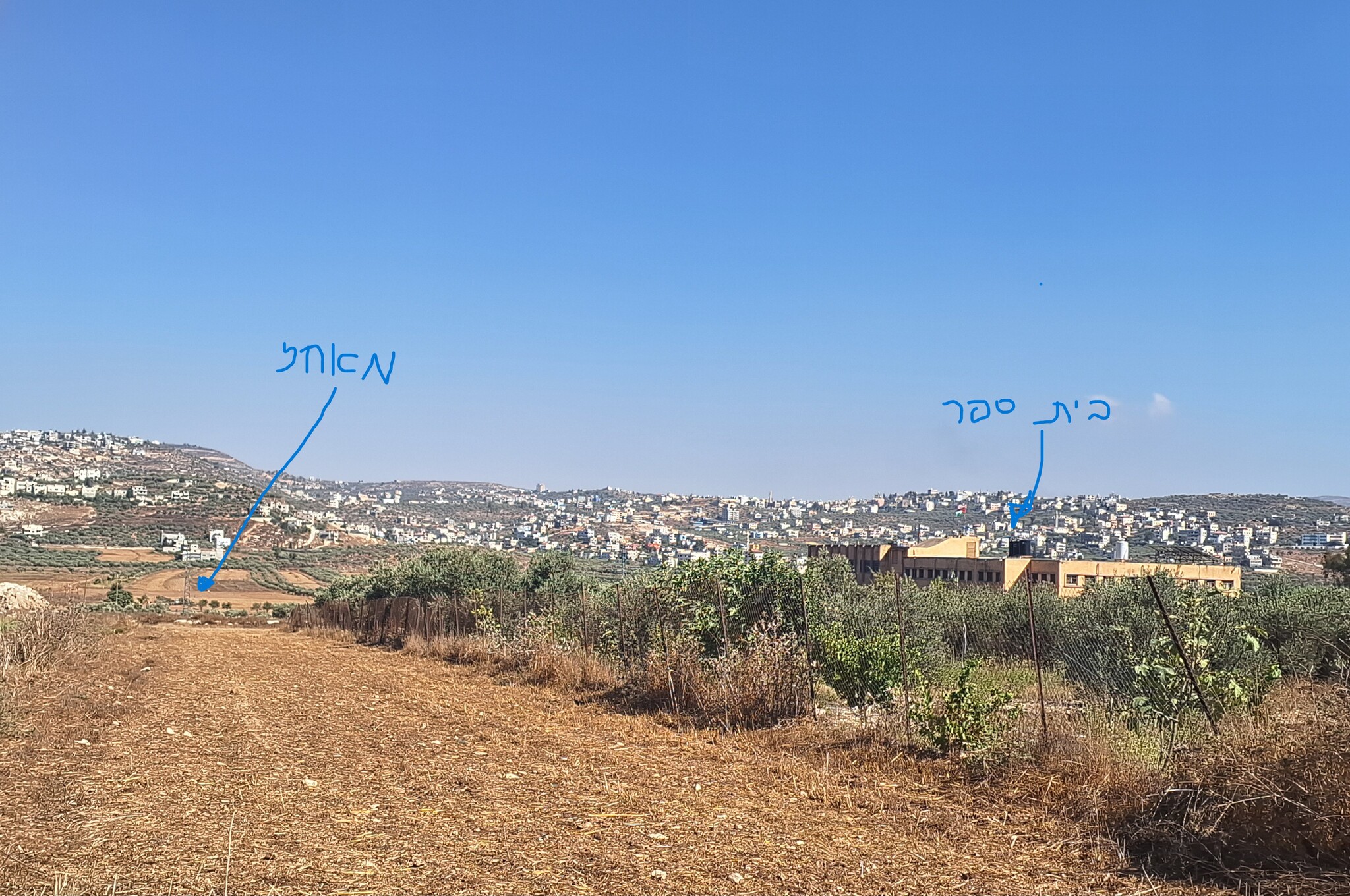 Ronit Dahan-RamatiAug-24-2026Huwara: The school on the outskirts of town and an outpost hidden among the trees
-
