
AM
Abu-Dis, Wadi-Nar, Mishor Adumim 30/3/2004 Watchers: Michaela R., Hannah E., Yael Y., Ora K., Yehudith S. (reporting), Liz (a guest from Women in Black, London) and Yoram S., documentary film maker and his camera man Danny. Yoram S. is making a film about MW 06:55, Wadi-Nar. The checkpoint is closed completely. Six soldiers, two of them women, are sitting in the “shade” created by the pillbox. A little later, a blue policeman arrives. Two ambulances, from both sides, are transferring a doctor or someone from a medical team who has to get to Bethlehem. Down in the wadi there is a jeep and anyone attempting to go up to the container area, where the checkpoint is, is sent back to Bethlehem. Five Palestinians, Hebron residents, want to go home but are not allowed to. They go back. One of them says this has been going on for a week now.A Border Policeman by the name of Shahaf tells us to keep our distance from the checkpoint but mainly keeps Danny, the cameraman, from shooting, claiming: “This is a closed area”. Of course, he has no written command and after a short give and take, Danny continues shooting.There is no crossing from either side, a complete closure. There are no cars, and only very few pedestrians are trying without success to cross even if they have permits. Three men were sitting on the side of the road and told us their IDs were taken away from them at the jeep down in the wadi. There is one detainee who has been waiting since 5:30 AM. Two of us go up to him individually. He has come from Bethlehem and has a work permit to work in Ma’ale Adumim. The checkpoint soldiers took his ID. When we asked Shahaf when it would be returned to him, he said: “Another 7 minutes. His ID is being checked by ‘operations’”. After another few minutes, we go and ask if there is an answer for him. The answer is not good: he is detained and will be let go only after “operations” decide what to do. Michaela calls Avi Biron (who has replaced Edri, the BP officer in charge of Wadi-Nar) and he says he will check. The blue policeman says that if he were in charge of the matter, the whole thing would have ended already. But, he says, the Police computer is not connected to either the BP one, the IDF one or the GSS one. Therefore, he can’t help out. When we went back to the cars, Shahaf ran after us remonstrating that one of us, who had approached the detainee, had shown him, with a movement of her hand, how to go around the checkpoint. She reacted forcefully. We went back to the checkpoint where he sat with his back towards us. We gave him a piece of our mind. He smiled and hardly reacted. Only when Hannah said she could be his grandmother, he answered cheekily: “I’m lucky you aren’t”. Yael Y. came back to the checkpoint to tell him that, although she doesn’t speak Arabic, hardly any Hebrew, she is a retired judge and knows the rules well and we don’t help people to avoid the checkpoints. This goes to show that a small hand movement used while talking to a detainee is enough to start up Shahaf’s poisonous glands (and there are others like him, for sure). 08:20, Mishor Adumim Road checkpoint. A jeep (#611-140) with a driver and three BP men. One monitors from the hill on the side of the road. The commander of the CP asks politely that we keep our distance from it. A transit stands there with all its contents on the road: juices, food cans, cookies. Some of the cans are open. We wanted to speak with the driver and were asked (truly not brutally) to talk to him after the check-up. Just harassment! We wanted to help him put the stuff back in the car and were told we couldn’t do that; it’s not our business. A soldier checks every taxi individually; 4-5 taxis are waiting some distance from the checkpoint for inspection. We are asked again and again to distance ourselves from the area. An ambulance of the Red Crescent is summarily checked and passes on to Jerusalem. 08:55, Bet Faja. When we arrived, a jeep 522 exited the alley. When we went down to the end of the ally, we saw that the wall will very soon close in on the entrance from Al-Ezariya. A crane is lifting the cement blocks and erecting the wall. Men from the Seam Line Security are watching, one of them (at least) a Bedouin from the Negev. Three BP soldiers are sitting in the shade under the trees. Two Palestinians appear. One of them has a shop in East Jerusalem and the other has a permit. He is a member of a medical team in Al-Mkased. The permit is valid until June 2004. He didn’t get permission to go through. When we started going back, Michaela saw a doctor she knows who wanted to get to the Augusta Victoria hospital. He was there with his wife, a pediatrician with a Czech passport. The doctor has trouble passing every single day going by way of Bet Faja. He goes straight to the BP soldiers under the trees. He did not get permission. We also went there, with the film crew, and begged the soldiers to let him through. Patients are waiting for him, he is a surgeon (he is a brain surgeon who worked for years in the US). The soldiers keep repeating the same argument: this is not a regular checkpoint, that the doctor and his wife have to go via Az-Za’ayyem or Ma’ale Adumim which are legal checkpoints. The doctor goes up to the camera; he is very agitated. He was angry at Sharon, at the system, which is so humiliating, and said that if everyone was like us (meaning the MachsomWatch) all would be fine. Michaela called the Physicians for Human Rights and talked with Hadas, then tried to get the BP, the humanitarian number, but in the end, the doctor and his wife passed through because of our pressure. They parted from us with a handshake and warm words. 09:40, the Pishpash gate. Three BP men stand on the eastern side of the opening. A passage of stairs was made by the police. A staff of three medical men with permits valid until June 2004 are not allowed to pass. They tell us they have been waiting for two hours. The doctors pass only after they see that Michaela is on the telephone (with the PHR). A woman with a disabled little girl, holding a hospital appointment slip in her hand but without a permit, is not allowed to pass.Jeep #22-551 comes round the western side of the opening. In it are a little girl of around six or eight years old and a woman arguing with the soldiers. One of them checks all kinds of documents she carries. We couldn’t make out what they were. Then we noticed that he casts doubt on whether the girl is the woman’s daughter. He bends over the child asking her the name of her mother. The child is frightened and unable to answer. The soldier is hissing through his teeth and threatening the mother with his finger: “You are going to be arrested today!” taking her to the jeep. The air is tense. After a discussion at the jeep, an ear splitting siren is sounded. Then the jeep turns around and leaves. The woman and the child return to the eastern side. They are not allowed to pass. Our feeling was that, had we not been there, the woman might have been beaten up.
Hebron
See all reports for this place-
According to Wye Plantation Accords (1997), Hebron is divided in two: H1 is under Palestinian Authority control, H2 is under Israeli control. In Hebron there are 170,000 Palestinian citizens, 60,000 of them in H2. Between the two areas are permanent checkpoints, manned at all hours, preventing Palestinian movement between them and controlling passage of permit holders such as teachers and schoolchildren. Some 800 Jews live in Avraham Avinu Quarter and Tel Rumeida, on Givat HaAvot and in the wholesale market.
Checkpoints observed in H2:
- Bet Hameriva CP- manned with a pillbox
- Kapisha quarter CP (the northern side of Zion axis) - manned with a pillbox
- The 160 turn CP (the southern side of Zion axis) - manned with a pillbox
- Avraham Avinu quarter - watch station
- The pharmacy CP - checking inside a caravan with a magnometer
- Tarpat (1929) CP - checking inside a caravan with a magnometer
- Tel Rumeida CP - guarding station
- Beit Hadassah CP - guarding station
Three checkpoints around the Tomb of the Patriarchs
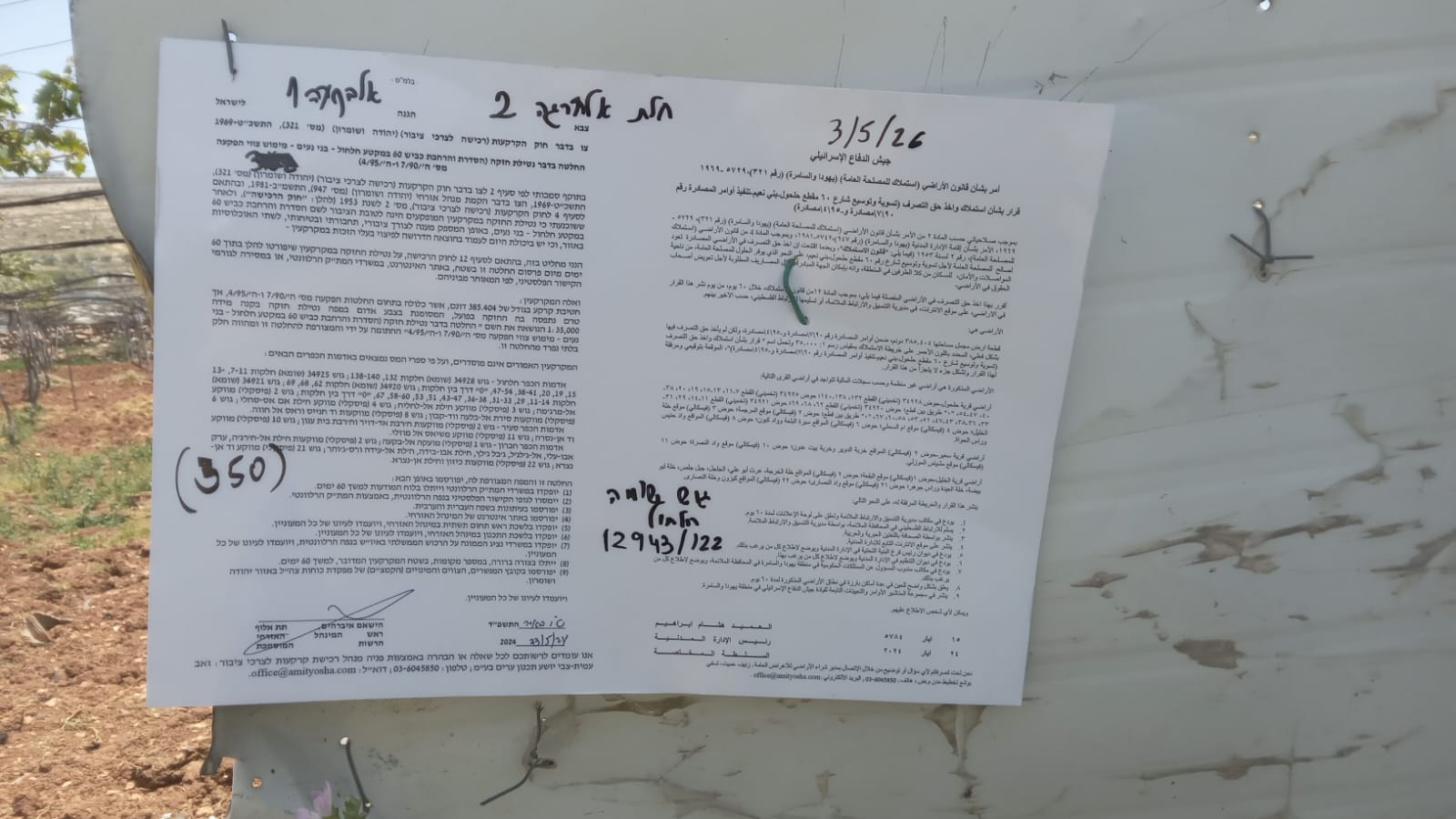 Muhammad D.May-13-2026Hebron - Request for compensation for land expropriation
-