
AM
Wadi-Nar, Abu-Dis 13/4/2004 Watchers: Michaela R., Yael L.-J., Channah A., Judith S., a guest Ma’ale Adumim. On our way to Wadi-Nar we passed at 7.20 a.m. the checkpoint at Ma’ale Adumim — a jeep that blocked the traffic. The soldiers were checking one car, while 6 yellow cabs and one transit were waiting in an ordered distance of about 50 meters. When we returned at 9.20 a.m., there was no checkpoint anymore. Wadi-Nar. When we arrived at 7.40 a.m., the situation was like that: 4 border policemen were sitting on a kind of terrace, one was moving. At the Bethlehem-end of the CP were 18 drivers standing, waiting for their decision. We approached the drivers and were not stopped by the soldiers. The drivers told us, that they were stopped by a jeep in the valley before the checkpoint, their identity cards were taken, and they were ordered to wait in front of the CP. There they stood waiting between half an hour to two hours. Some of them were truck drivers. Their trucks were loaded with food in Hebron and they were on their way to Ramallah. Though they had permits, they were not allowed to cross, because some new order that the soldiers got. An older man showed us a document about a necessary heart surgery. He wanted to go to the hospital for further checking. While we were talking to the waiting men, a soldier came urging us to leave. He told us that there was a closure. Michaela called Rafi Amsalem from the DCO and he confirmed that, and said that trucks with food could go to Bethlehem only and be driven back empty; no truck with food would be allowed to pass to other places. For this special permits were needed. During this telephone conversation, the man with the heart disease disappeared. At 8 a.m., the shifts of the border police changed. Now came Sagi. The first thing he managed was to interrupt the stream of people walking up the hill from the road in the valley to the road to Abu-Dis, most of them students. He stopped 22 of them and took their identity cards. All of them, most of them girls, were students on their way from Bethlehem to Bir Zeit. Before and after this action people were passing the hill without control. But the 22 detainees were sent back to Bethlehem after their papers were checked. The young commander Sagi told us, that the CP is a “closed Military Zone” and that we had to leave. We would not be allowed to speak with “his” detainees, the students. He threatened us with calling the regular police for taking measures against us. We told him that until now we had done our work in the area of the CP, but left for a while for further investigations. Some of us had observed that two transits, being parked in the area of the CP, had left with damage. These cars we found parked near the transit station on the way to Abu-Dis. We saw one driver who was changing a punctured wheel. He told us, that the night before, at Ma’ale Adumim CP, the soldiers had cut into the tyre and pushed a gun into the front window, which was damaged. They had also damaged the rear lights of the car. We found two other transits with broken rear lights. According to the drivers, the soldiers had done it on Sabbath. Another driver told us, that he had to pay a fine of 500 NIS in order to have his confiscated car back, because of driving Palestinians without the necessary papers. On our way back to the CP, we met a contractor who told us, that he was constructing near the CP. He had to have cement — the cement factory could be seen near by — but the army wouldn’t let him get there. He asked for our assistance, which we regretted not being able to give. At 8.50 a.m., 11 students were still waiting to get back their identity cards and being send back to Bethlehem. While we were staying at Wadi-Nar 3 ambulances, some garbage trucks and 2 empty trucks could pass. Abu-Dis. We reached the Pishpash gate at 9.20 a.m. A lot of transits were around. The border police were checking the people on their way to Jerusalem on the Eastern side of the wall. The four policemen in charge were not aggressive and let people with blue identity cards and a handicapped older man pass. Mount of Olives. On our way back to West Jerusalem, we saw soldiers checking people in the street leading along the Mount of Olives.
Hebron
See all reports for this place-
According to Wye Plantation Accords (1997), Hebron is divided in two: H1 is under Palestinian Authority control, H2 is under Israeli control. In Hebron there are 170,000 Palestinian citizens, 60,000 of them in H2. Between the two areas are permanent checkpoints, manned at all hours, preventing Palestinian movement between them and controlling passage of permit holders such as teachers and schoolchildren. Some 800 Jews live in Avraham Avinu Quarter and Tel Rumeida, on Givat HaAvot and in the wholesale market.
Checkpoints observed in H2:
- Bet Hameriva CP- manned with a pillbox
- Kapisha quarter CP (the northern side of Zion axis) - manned with a pillbox
- The 160 turn CP (the southern side of Zion axis) - manned with a pillbox
- Avraham Avinu quarter - watch station
- The pharmacy CP - checking inside a caravan with a magnometer
- Tarpat (1929) CP - checking inside a caravan with a magnometer
- Tel Rumeida CP - guarding station
- Beit Hadassah CP - guarding station
Three checkpoints around the Tomb of the Patriarchs
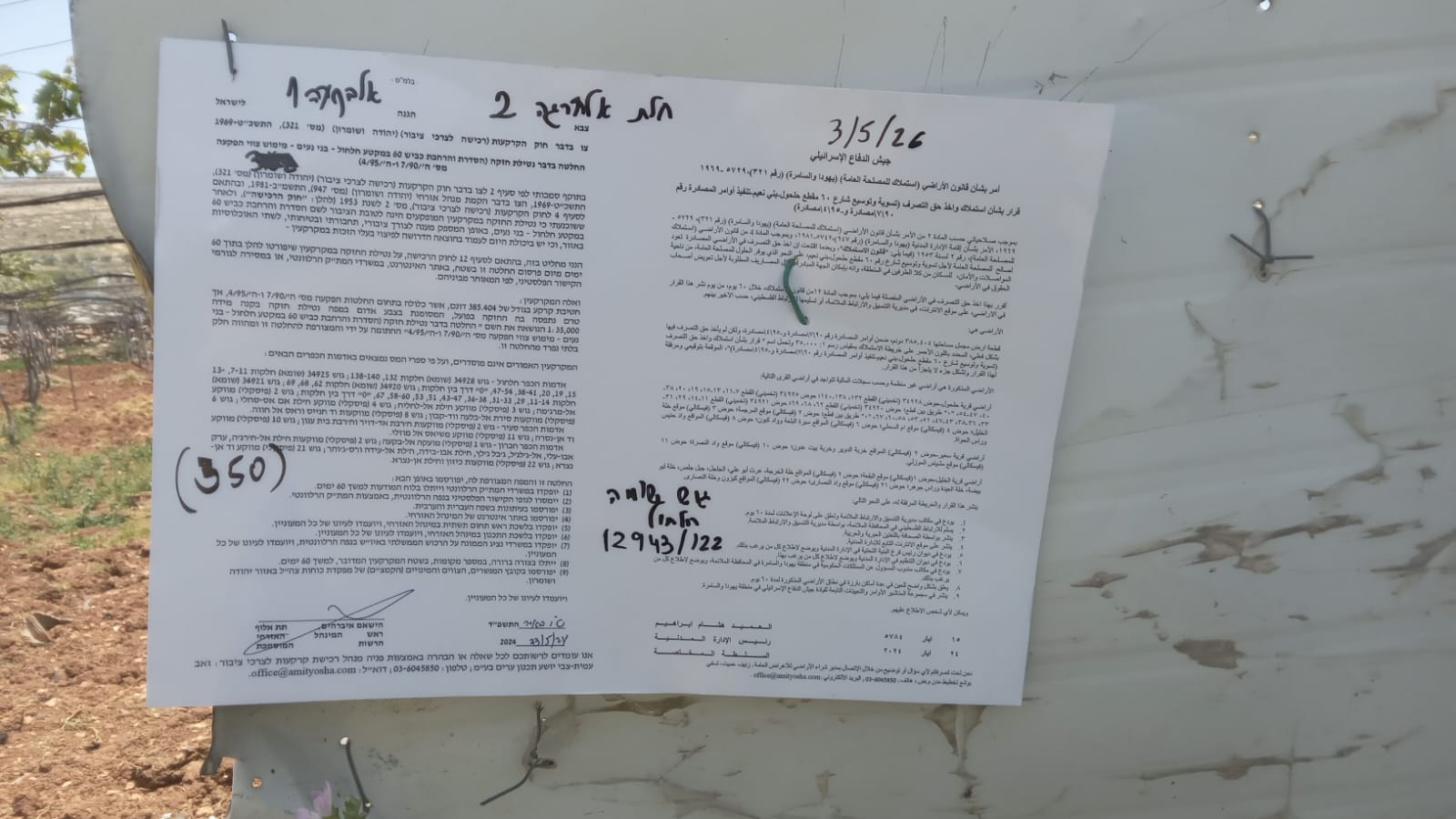 Muhammad D.May-13-2026Hebron - Request for compensation for land expropriation
-