
AM
JUBARA, Sunday 21 March 2004 AM Observers: Naomi K., Esti C. (reporting) color=red>07:45: Two children’s buses went by. We were told there were no problems. We talked to several villagers who said they were pleased with the new arrangement, unlike P., head of the local council, who is extremely dissatisfied, because it’s under army auspices.At the checkpoint, a boy of about 16 had been tied up as a punishment. “He’s causing problems and disturbing the soldiers, ” said A., the checkpoint commander. Three men, caught after having been illegally in Israel , were having their documents checked ,as usual. They were young, all related, and from Hebron; they said they had come to the wedding of a relative at Hirbet Jubara, and had tried to go through the checkpoint without permits, naturally. They got the usual punishment, having to wait for hours for their “checked” documents. The checkpoint seemed quiet, with nothing special happening until we begin talking to the people there. A police vehicle went through towards Nablus; there were many trucks. Thirty taxis waited for the army’s orders on what was to be today’s rule: and it transpired that there would be no passage for taxis. Yesterday all the taxis went through. Today – no. Nor was there any passage from Tulkarm today by car – only on foot. A taxi-driver from Shofa, 5 kilometres east of Tulkarm told us that the previous evening, Saturday night, several bulldozers had arrived and dug a deep trench around the village to prevent cars going in or out. Shofa is cut off. Even donkeys can’t get through. P., a van driver, was obliged to leave his taxi with a friend in Tulkarm and had to walk five kilometres there and back because he had to work.A family of five from Hableh, were held up at the checkpoint en route to the hospital in Tulkarm, where they go every day for transfusions for their three children who have thalassemia, a rare genetic blood disease. We told H., from Physicians for Human Rights (PHR), and she will deal with the matter. They spend whole days on the journey to and from hospital. They walk a considerable distance from one taxi to another and their distress was evident.There was also a woman of about 45 from Tulkarm, who went through to Hirbet Jubara yesterday without a permit. The (“nice”) soldier let her through. Today they won’t let her back. We telephoned the DCO, which checked – her details were confirmed and we were told she was not under police restriction and could pass through. A., checkpoint commander, didn’t agree and insisted that he was the one who would decide. Our friend N. suddenly arrived and helped us a great deal. At 10:00 we left to see what was happening at Shofa. We called N. on the way and he reported that A. had “released” the woman.From the Israelis-only road, the trench around the village was not visible to anyone who didn’t know about it. We saw fresh piles of earth, came closer and saw a long, deep trench around the village. I reported to S. from PHR and he came to see. We returned through the Jitt junction. There were about 50 young people there, sprawled in the sun. We asked the soldiers at the junction what was going on and they told us that they’d “removed them” from several buses. In other words, they stop buses, go in, check, take suspects off as they see fit and allow them to enjoy the view until their documents have been checked.
Hebron
See all reports for this place-
According to Wye Plantation Accords (1997), Hebron is divided in two: H1 is under Palestinian Authority control, H2 is under Israeli control. In Hebron there are 170,000 Palestinian citizens, 60,000 of them in H2. Between the two areas are permanent checkpoints, manned at all hours, preventing Palestinian movement between them and controlling passage of permit holders such as teachers and schoolchildren. Some 800 Jews live in Avraham Avinu Quarter and Tel Rumeida, on Givat HaAvot and in the wholesale market.
Checkpoints observed in H2:
- Bet Hameriva CP- manned with a pillbox
- Kapisha quarter CP (the northern side of Zion axis) - manned with a pillbox
- The 160 turn CP (the southern side of Zion axis) - manned with a pillbox
- Avraham Avinu quarter - watch station
- The pharmacy CP - checking inside a caravan with a magnometer
- Tarpat (1929) CP - checking inside a caravan with a magnometer
- Tel Rumeida CP - guarding station
- Beit Hadassah CP - guarding station
Three checkpoints around the Tomb of the Patriarchs
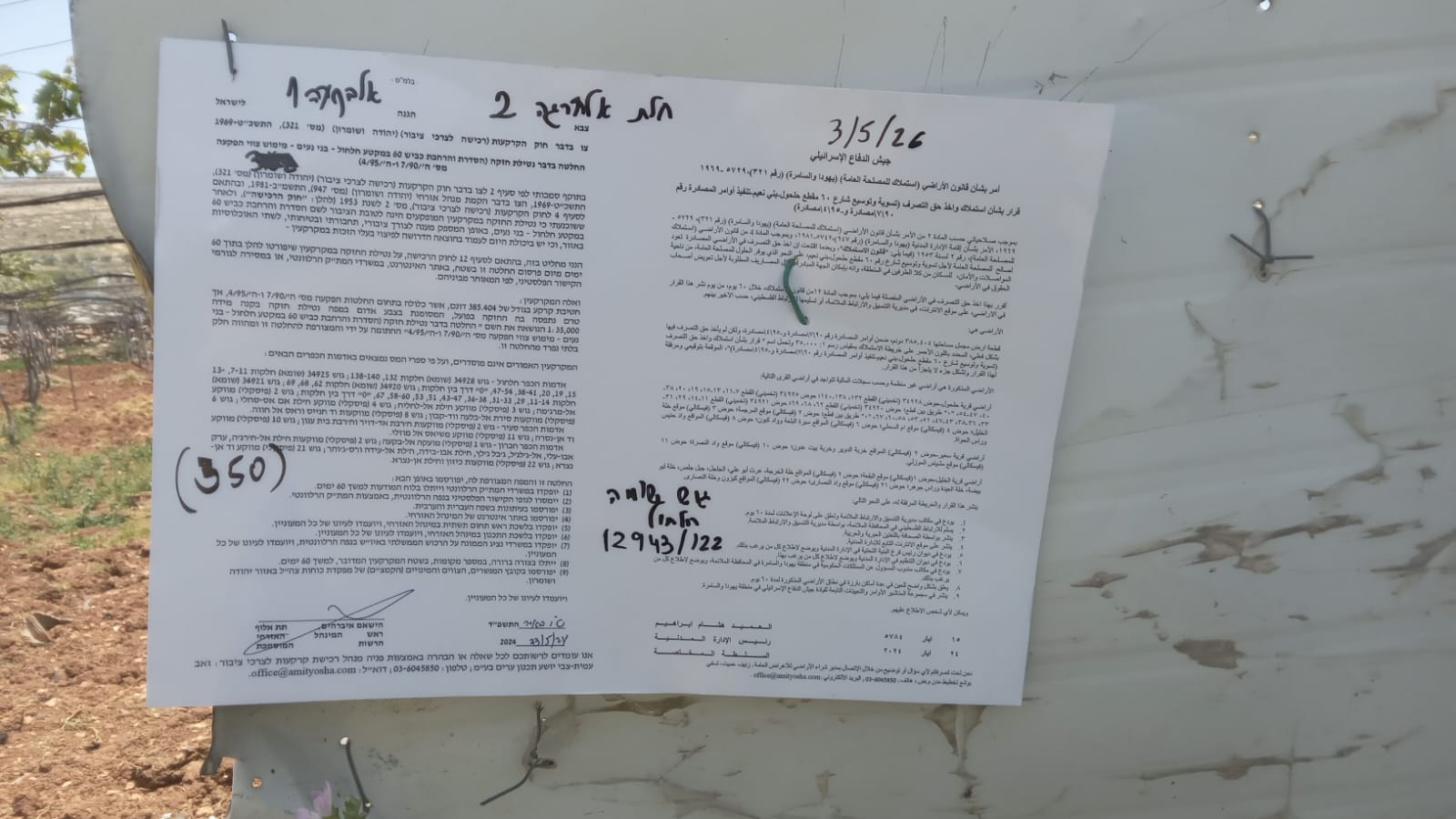 Muhammad D.May-13-2026Hebron - Request for compensation for land expropriation
-