
AM
ZA’TARA, SARRA, BEIT FURIK, HUWWARA, Sunday 16 May 2004 AM Observers: Hannah L., Dina A., Snait ( reporting) color =red>SummaryThere were really serious warnings [of planned terrorist attacks] , resulting in strict adherence to the restrictions imposed on the 16 to 35-year-old age group . There were numerous detainees held for many hours especially at Huwwara North. Water was available ( see below). Vehicles were confiscated for periods of four days at Beit Furik and Huwwara. The main issue today was the problem of people who live in Nablus (and have Nablus listed as their place of residence in their ID cards), but who could not prove that they had had a permit to leave it, and were now refused permission to return home.The District Co-ordinating Office (DCO) [the army section that deals with civilian matters] worked irregularly; the people in the army’s “humanitarian” centre tried to help, D.B. was extremely helpful.There are plans afoot to dig a deep trench in the area of the Beit Furiq checkpoint to prevent people from evading it on their way to Nablus from the surrounding villages. It may be worthwhile checking whether this trench will also cut the villages off from each other .Maybe we should repeat our demand that computerized means be introduced at the checkpoints for cross-checking the ID cards of detained people, just like those in use by the Israel Police, rather than depending on the slow pace of the checks now done by the General Security Services [also known by the Hebrew acronym Shabak or the initials Shin Bet].07:20 — Za’taraAs usual, there were two soldiers checking and one covering them. They were quite efficient and checked bus passengers by examining their ID cards rather than making them get off. There were 11 vehicles waiting to be checked. 07:45 — SarraThere were no Palestinians around. The soldiers talked to us, rather than trying to drive us away. The teachers had already gone through to work. Sarra residents are allowed to go on foot down the hill on the recently repaired road towards Jit, Qedumim etc; and may also go on foot or by car or cab on the road leading towards Nablus and its surrounding villages. There were no detainees, and no houses requisitioned by the army.08:00 — At the entrance to the road from Sarra to Shavei Shomron there was an unannounced road block. Some as yet unidentified building is going on at the turning. The patrol operating the road block seemed to be made up of reserve soldiers (officers), who were efficient and quite polite: they allowed those who appeared to be over 35 to pass through quickly; an ambulance, too, went through unhindered. But bus passengers had to get off for ID card checking, which took a while.08:10 — There was a long queue of lorries at the Awarta entrance to Nablus08:20 — Beit FuriqThe line on both sides of the checkpoint moved quite fast. A new, functioning water container was in place.Large scale building activity was going on, with a bulldozer at work. The soldiers said that a new asphalt path was being laid, and shade was being arranged for those waiting in the queue. The line which marks the spot where cab drivers must let off their passengers, and where those who drive up to the checkpoint along the dirt-roads leading to it must also stop, has now been moved a significant few score metres further away from the checkpoint proper. Two mechanical diggers were parked ready to excavate a long trench that will apparently cut across all the dirt roads that now connect the villages with the road to Nablus and thus make it impossible to circumvent the checkpoint. This project needs looking into: will this ditch also cut the villages off one from the other ? Some other noteworthy instances: A Jordanian citizen without an ID card — a complicated case being taken care of by the Centre for the Defence of the Rights of the Individual. Three commercial vans had been confiscated a day earlier ( for driving up too close to the checkpoint and for using the road reserved for [Israeli Jewish] settlers only). The confiscation order had been for four days and the drivers were given written confirmation of what had happened and the date on which their vehicles would be released . One of the drivers had come to try and get his van out early. We didn’t manage to do anything for him, but in the course of trying we realized just how harassed and overworked the soldiers, including the officer, are at this checkpoint, where the shifts of duty are very long. It didn’t exactly help us in our work.On the way back, we saw that the line of lorries now hardly existed. 10:30 — Huwwara South and North Queues on the south side moved forward quickly, there were hardly any detainees.We managed to help a sick man and his family, and another couple. We did not manage to help two Palestinian telephone company technicians. There was a water container but the main faucet was broken. Dina suggested bringing metal cups with chains to attach to all the water containers. The women’s line on the north side moved quickly, as did the line for men over 35. But the other line was very slow. There was a functioning water container. The shade over the detainees area has disappeared. In addition to numerous soldiers, there were also three officers, besides the DCO representative, present at the checkpoint. In the 90 minutes we spent here, there were always many detainees, certainly over 50 of them at any given time, many having waited since early morning. The tension and impatience which built up slowly became manifest and was dealt with sharply by the officer in charge of the detainees. We tried every telephone number we could think of to help speed up the Shin Bet checking. We helped only very little, if at all. The checkpoint officer would not release anyone until they had been cleared , as he wanted “to know who tries to go through this checkpoint”. Around 10:00, some 20 people who had been waiting since early morning were sent back to Nablus as no answers had been received in their cases. Among those waiting were people on their way to the DCO office, with forms already filled in and stamped etc. [Machsomwatch women have spent time observing what happens at the DCOs and have realized that almost invariably far more than one day-long visit to a DCO is needed before any permit is given, and one must arrive early in the morning, as the office opens, because there is always a queue .] We helped in the case of a person with an appointment for an operation in Ramallah, and in another case of a couple with a small child who was to be treated for cancer in Ramallah. D.B. talked with them and helped quickly and efficiently; the hold-up here was with the DCO.Eight cars were confiscated for four days because their drivers had crossed the notional [and invisible] line as they entered the checkpoint from Nablus : it is possible that we helped shorten this punishment time to “only” two days — but this must be checked tomorrow.10:40 – 11:20 — Huwwara South We were presented with a cluster of cases that had one common feature: people who had left Nablus by various means, but could not now return home ( even though Nablus is their place of residence by every criteria including the address that appears in their ID cards ) because they could not produce an exit permit!! Thus there was a man and his wife who had been to a dentist in Ramallah; a man back from a visit to China with permits from the Allenby Bridge international crossing between Israel and Jordan; somebody who had left Nablus for another city in connection with his job, etc. etc. The checkpoint is efficiently run, but the officer in charge was inflexible in any case which called for independent judgement. He promised to release the first case within an hour, which he did. We did not manage to help any of the others. It was particularly frustrating to see the traveller who stood there with two big suitcases, while even Y. from the army’s “humanitarian” centre could offer no better solution than sending him to the Nablus DCO to get a permit !11:30 — Za’tara was almost empty. All we saw were three vehicles waiting to go through.
Huwwara
See all reports for this place-
The Huwwara checkpoint is an internal checkpoint south of the city of Nablus, at the intersection of Roads 60 and 5077 (between the settlements of Bracha and Itamar). This checkpoint was one of the four permanent checkpoints that closed on Nablus (Beit Furik and Awarta checkpoints to the east and the Beit Iba checkpoint to the west). It was a pedestrian-only barrier. As MachsomWatch volunteers, we watched therre since 2001 two shifts a day - morning and noon, the thousands of Palestinians leaving Nablus and waiting for hours in queues to reach anywhere else in the West Bank, from the other side of the checkpoint the destination could only be reached by public transport. In early June 2009, as part of the easing of Palestinian traffic in the West Bank, the checkpoint was opened to vehicular traffic. The passage was free, with occasional military presence in the guard tower. Also, there were vehicle inspections from time to time. Since the massacre on 7.10.2023, the checkpoint has been closed to Palestinians.
On February 26, 2023, about 400 settlers attacked the town's residents for 5 hours and set fire to property, such as houses and cars. Disturbances occurred in response to a shooting of two Jewish residents of Har Bracha by a Palestinian Terrorist. The soldiers stationed in the town did not prevent the arson and rescued Palestinian families from their homes only after they were set on fire. No one was punished and Finance Minister Smotrich stated that "the State of Israel should wipe out Hawara." Left and center organizations organized solidarity demonstrations and support actions for the residents of Hawara.Hawara continued to be in the headlines in all the months that followed: more pogroms by the settlers, attacks by Palestinians and a massive presence of the army in the town. It amounted to a de facto curfew of commerce and life in the center of the city. On October 5, 2023, MK Zvi established a Sukkah in the center of Hawara and hundreds of settlers backed the army blocked the main road and held prayers in the heart of the town all night and the next day. On Saturday, October 7, 23 The "Swords of Iron" war began with an attack by Hamas on settlements surrounding Gaza in the face of a poor presence of the IDF. Much criticism has been made of the withdrawal of military forces from the area surrounding Gaza and their placement in the West Bank, and in the Hawara and Samaria region in particular, as a shield for the settlers who were taking over and rioting.
On November 12, 2023, the first section of the Hawara bypass road intended for Israeli traffic only was opened. In this way, the settlers can bypass the road that goes through the center of Hawara, which is the main artery for traffic from the Nablus area to Ramallah and the south of the West Bank. For the construction of the road, the Civil Administration expropriated 406 dunams of private land belonging to Palestinians from the nearby villages. The settlers are not satisfied with this at the moment, and demand to also travel through Hawara itself in order to demonstrate presence and control.(updated November 2023)
.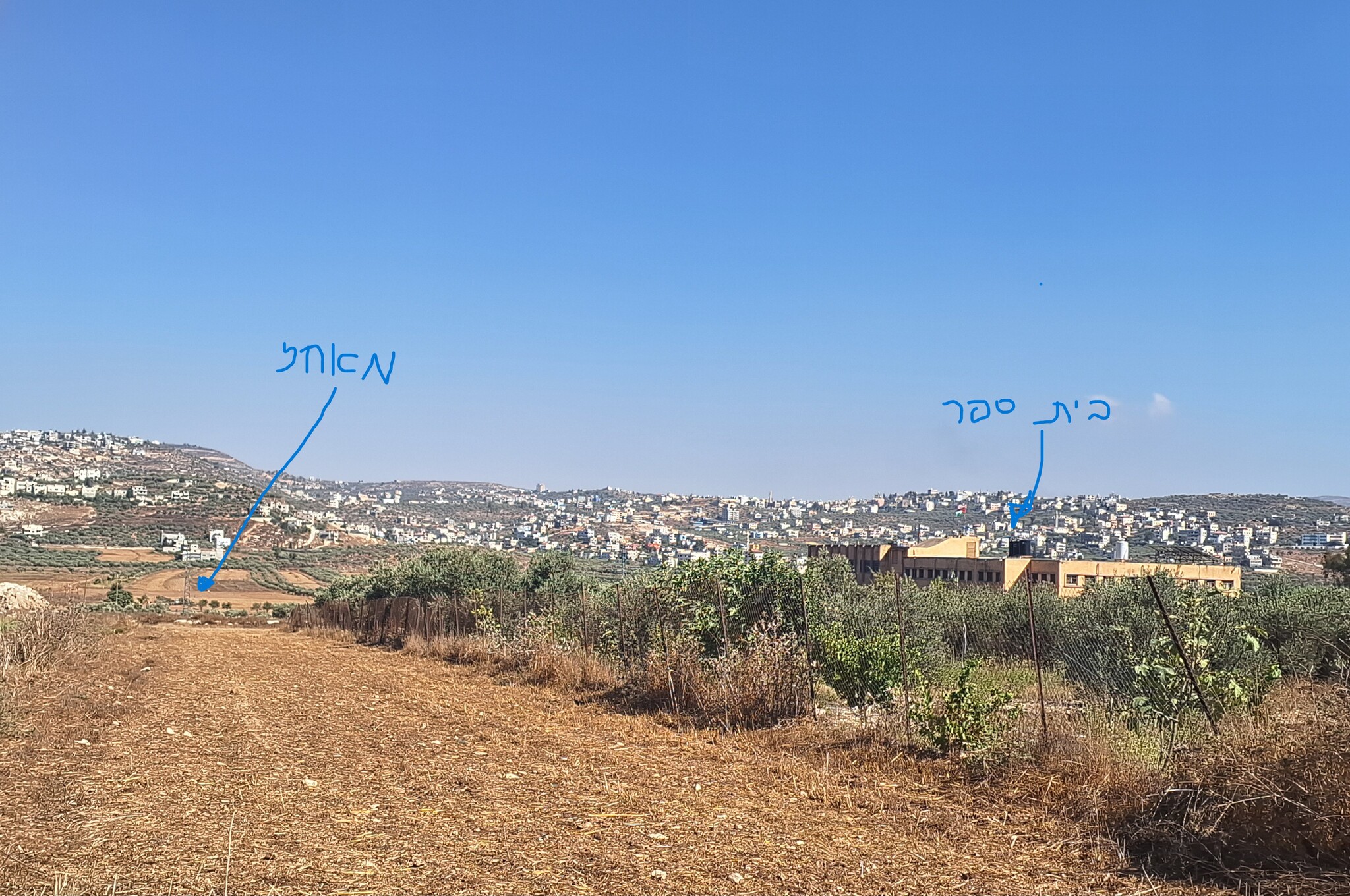 Ronit Dahan-RamatiAug-24-2026Huwara: The school on the outskirts of town and an outpost hidden among the trees
-
Sarra
See all reports for this place-
Sarra
The checkpoint is installed between the Palestinian village of Sera and the district city of Nablus,
Since 2011, internal barriers Located among the West Bank Israeli settlements have somehow allowed, Palestinian residents to travel and move and reach various Palestinian cities.
After the terrible massacre by the Hammas on October 7 upon Israelis in the communities around Gaza, internal checkpoints manned by the army were installed to prevent free passage for Palestinians.
Many restrictions were imposed on the Palestinians in the West Bank. The prevention of movement shuttered the possibility of making a living in Israel. The number of Palestinian attacks by Israeli extremist settlelers increased along with the radicalization of the army against the Palestinians.
The conduct at the Sera checkpoint is one of the manifestations of the restrictions on all aspects of the Palestinians' lives.
-
