
AM
Abu Dis and Sawahre Wednesday morning, 2 June 2004 Observers: Sylvia P., and Levana R. (reporting). 6:30 – Cliff Hotel and the surroundings seemed deserted. On the roof of the settlers’ house we saw a few guards from a security company.At the Pishpash – the crossing is open – we met N. (who driver a Transit – multipassenger taxi van). They haven’t yet received an answer to the complaint they submitted to the Mahash (Policeman Investigation Unit).6:45 – Wadi Nar (Container) CP – a giant queue of vehicles coming from Bethlehem, Hebron and surroundings. One soldier checks everything: IDs, cars, trucks and their loads, and delays people.People told us that the checkpoint was opened only at 6:15. Five or six taxis full of passengers on their way to Ramallah, and one taxi on its way to Jordan (the latter’s passengers have a flight departing at 13:00 from Amman) are waiting and people are very impatient. Everything moves slowly. They say: “You must know, this is the worst checkpoint”.Sylvia got an answer from the soldiers at the checkpoint that they are checking the ID cards and in 10 minutes they will be returned. And so it happened. Two young men who were in a bus on their way to Mecca, tried their luck by walking through the checkpoint. Because of the noise around they didn’t hear the BP soldier calling them to check. He ran after them and scolded them. The bus crossed and was waiting for them past the checkpoint. At 7:30 there is no change in the queue. Two ecumenical volunteers arrive and they photograph, take notes and refer to the queue as “madness.” We saw a Border Police jeep parked like 15-20 minutes at the checkpoint, blocking one of the lanes. In the meanwhile there was no checking of cars. It obviously increased the queue length and the sense of helplessness. There were almost no pedestrians crossing the checkpoint; they were all on the uphill. 7:40 – I phoned the DCO [IDF Civil Administration office, that issues permits and sometimes sends staff to the checkpoints as reinforcements]. The common promises… “We will check…” “At Wadi Nar there are no problems”, the female soldier said after she checked with Adi, another female soldier. A Red Cross car arrived in order to take care of 4-5 buses with families that are going to visit prisoners. The BP soldier asks the driver to put the line in order and to ask the trucks that are waiting for a few hours already to let the buses pass first (how exactly? where to move?). It is an impossible task.The driver told us that he comes with the buses from Bethlehem, since the DCO there doesn’t issue any permits. He must take care that the buses are not stopped all the way to Ofer camp prison. When buses come from Hebron, they have a permit so it is enough if we are there and give a look. MachsomWatch note:Buses always cross on Wednesday mornings – our shift day. 8:30 – All the time new trucks and taxis increase the queue. And even if some cross, the wait is still very long. I phone the DCO again. She promised to check (what’s new?) but added – “According to orders, I cannot talk with Machsom Watch.” She didn’t agree to give her name. 8:45 – On our way back to the Transit, one of the drivers says: “They do it because of you[r presence]; they see you and they slow down. What does it help?” Inside the Transit, we met another passenger: a kindergarten teacher that lives in Bethlehem in front of Rachel’s Tomb and works at Beit Tsafafa. We asked why she goes this way rather than crossing directly at Bethlehem, she answered: “In Bethlehem [CP] they are the worst, they abuse and humiliate, and they are not ready to listen to a single word. There I have no chance; here I have some chance to cross… I must work.”What will be…??
Cliff Hotel
See all reports for this place-
Cliff Hotel
A checkpoint on Jerusalem’s municipal boundary.It sits on the separation fence south of Abu Dis. The checkpoint is manned by Border Police soldiers and private security companies and operates 24 hours a day. Palestinians are forbidden to go through, other than residents of the Qunbar and Surhi families who live west of the separation fence, some of whom have blue ID cards and others have entry permits to Jerusalem. Other Palestinians, including residents of East Jerusalem, are not permitted through the checkpoint. Visitors to the families are permitted through the checkpoint only after their hosts obtain permits for them at the checkpoint.
-
Hebron
See all reports for this place-
According to Wye Plantation Accords (1997), Hebron is divided in two: H1 is under Palestinian Authority control, H2 is under Israeli control. In Hebron there are 170,000 Palestinian citizens, 60,000 of them in H2. Between the two areas are permanent checkpoints, manned at all hours, preventing Palestinian movement between them and controlling passage of permit holders such as teachers and schoolchildren. Some 800 Jews live in Avraham Avinu Quarter and Tel Rumeida, on Givat HaAvot and in the wholesale market.
Checkpoints observed in H2:
- Bet Hameriva CP- manned with a pillbox
- Kapisha quarter CP (the northern side of Zion axis) - manned with a pillbox
- The 160 turn CP (the southern side of Zion axis) - manned with a pillbox
- Avraham Avinu quarter - watch station
- The pharmacy CP - checking inside a caravan with a magnometer
- Tarpat (1929) CP - checking inside a caravan with a magnometer
- Tel Rumeida CP - guarding station
- Beit Hadassah CP - guarding station
Three checkpoints around the Tomb of the Patriarchs
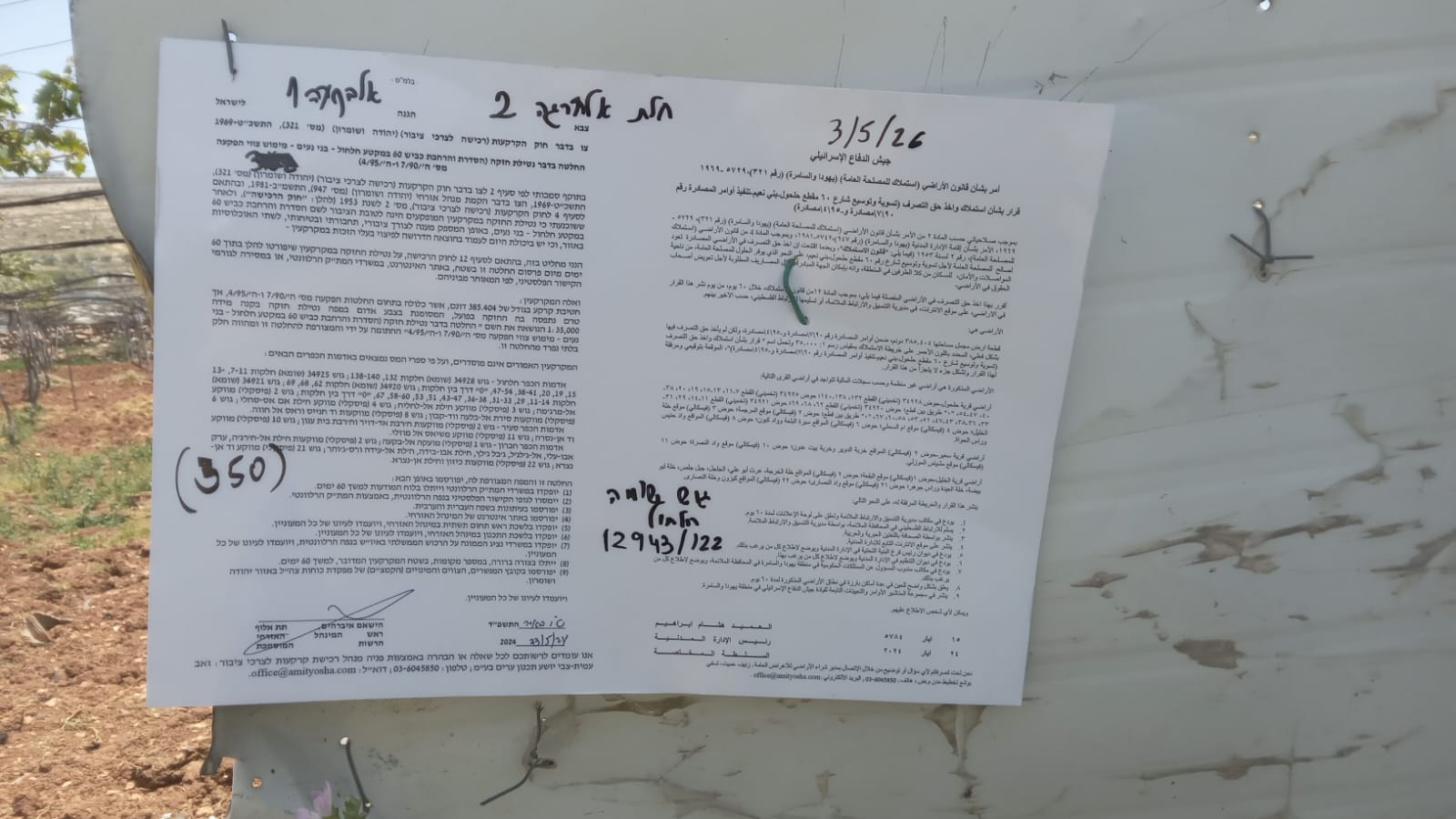 Muhammad D.May-13-2026Hebron - Request for compensation for land expropriation
-