
AM
Abu-Dis Tuesday morning, 15 June 2004Watchers: Michaela R., Jael, Ruth (guest from Germany) and Hannah Y. (reporting). At 6.45 we arrived at Wadi Nar, also known as ‘the Container’ CP or Sawahre. There were many Border Police soldiers. Michaela told us that the checkpoint is on the only North-South road in the West Bank that Palestinians are allowed to use, for instance if they want to travel from Hebron to Ramallah and back. Theoretically it is, therefore, a highway. In reality, however, it is not much more than a dirt road on which vehicles, pedestrians and donkeys travel as slowly or as fast as the army allows them to move at any given moment.When we arrived at the checkpoint, some pedestrians were passing through it unbothered. Drivers of private cars do not get permits, but on both lanes some twenty taxis and trucks stood waiting until the Border Police men and women had finished their breakfast. Michaela asked if an ambulance that stood waiting in line, could please be allowed to continue on its way. The Border Police man said the car was not an ambulance at all, but simply transporting medication, which was not very important in his eyes. Nevertheless, the white car with red lettering was let through. Presently the northbound line of cars started to move. One exhibited a sign: “Don’t worry”. At 7.15 the southbound line also came alive.A few taxis were detained until the drivers’ papers were scrutinized in depth. After a while the road was so dusty that the Border Police soldiers decided to sprinkle it with water. There were some problems with the hose, which kept the boys busy long enough for quite a number of cars to pass unchecked. When we left Wadi Nar, two cars were still detained. We visited the Pishpash gate and saw how the famous Apartheid Wall [a.k.a. Separation Fence] blocks the road so that there is no more need for a checkpoint. The eight-meter high monster is not completely finished, though. On both sides of the road there is still the possibility to scale it by climbing on boulders and improvised ladders. This was done in both directions by scores of Palestinians, among whom were women carrying huge bundles of merchandise from their villages to Jerusalem, and youngsters who live at ‘our’ side of the wall and study at ‘their’ side. In A-Tur Michaela pointed out a neighborhood blessed with two Palestinian hospitals (El Mokassad and Augusta Victoria) and many educational institutes. The finished wall will stand between this neighborhood and the adjoining villages. A Palestinian woman told us she has Israeli ID documents and is the headmistress of a school, but lives with her husband (who does not hold Israeli documents) on the other side of the wall. What will happen when the wall is completed and she can no longer climb the boulders to go and teach her pupils? Comment: Truly, you must see this wall to realize what tragedy is already taking place, and mind you well: this is only the beginning.
Hebron
See all reports for this place-
According to Wye Plantation Accords (1997), Hebron is divided in two: H1 is under Palestinian Authority control, H2 is under Israeli control. In Hebron there are 170,000 Palestinian citizens, 60,000 of them in H2. Between the two areas are permanent checkpoints, manned at all hours, preventing Palestinian movement between them and controlling passage of permit holders such as teachers and schoolchildren. Some 800 Jews live in Avraham Avinu Quarter and Tel Rumeida, on Givat HaAvot and in the wholesale market.
Checkpoints observed in H2:
- Bet Hameriva CP- manned with a pillbox
- Kapisha quarter CP (the northern side of Zion axis) - manned with a pillbox
- The 160 turn CP (the southern side of Zion axis) - manned with a pillbox
- Avraham Avinu quarter - watch station
- The pharmacy CP - checking inside a caravan with a magnometer
- Tarpat (1929) CP - checking inside a caravan with a magnometer
- Tel Rumeida CP - guarding station
- Beit Hadassah CP - guarding station
Three checkpoints around the Tomb of the Patriarchs
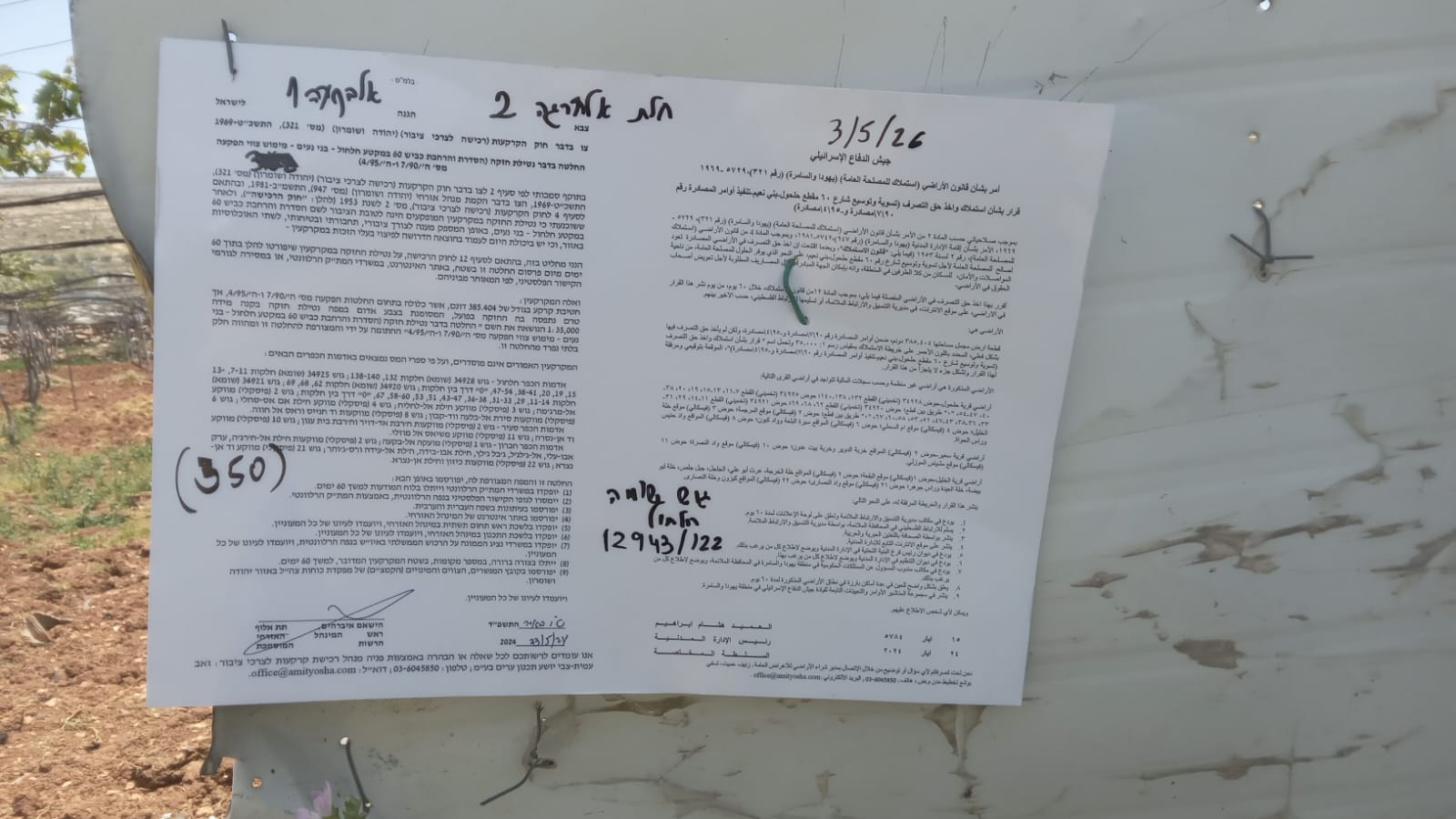 Muhammad D.May-13-2026Hebron - Request for compensation for land expropriation
-