
AM
South of Hebron Sunday morning, 14 March 2004 Watchers: Orit S., Nomi S. (reporting) 06:30 AM – We left the Shoket junction with Ibrahim, the driver. At 6:50 AM, with the village of Al-Simia on our left, we saw a car with a Palestinian number, which had been stopped at the side of the road by some soldiers in a military jeep. We stopped to find out what the problem was. We talked to the two people whose car had been stopped. They were from Al-Simia; one of them, on his way to work, is the principal of the elementary school which is located on the other side of Hwy #60. The other, a statistics teacher with an MA from the University in Hebron, wanted to get to Hebron. Both of them knew that the army does not allow them to cross the road by car, but they had decided to defy the order since they had no other reasonable way to get to their destination (due to other temporary checkpoint roadblocks). The officer from the jeep talked to them in fluent Arabic, and they explained to him why they had decided to take the chance and cross the road by car. They had tried to get a permit from the DCO [IDF Civilian Authority administrative office], but had never been able to get to talk to anyone there. After about 25 minutes, with no response from the GSS [Israeli Security Service], the officer returned the ID cards and allowed them to cross the road by car. Maybe our presence helped.We continued to the Yata-Hebron junction. We got there at 07:30 AM and asked Ibrahim to park the car a bit further on, in order not to bother the soldiers. Not many people were crossing in either direction and there were no soldiers around. We walked around 100 meters in the direction of Yata in order to see the obstacle created by the army in order to prevent cars from passing from one side of the junction to the other. We talked to some people standing there. They told us that last night soldiers had entered Yata and created a checkpoint in the middle of the village from 1800 PM till 20:30 PM and one could not pass in order to get home. We were also told that this morning around 06:00 AM, passage across the road between Yata and Hebron had been stopped and that people had been forced to sit (in the mud) around an hour.Meanwhile we saw that a humvee had arrived at the junction. The soldiers announced a curfew and people were turned back. We immediately left the junction and informed the soldiers that this was our intention. As we walked towards the car we tried calling the various telephone numbers on our contact lists, most of which did not answer. Orit managed to get a hold of Efrat at the IDF Humanitarian Center. She promised to find out the reason for the curfew and whether we were the cause. We drove a short distance in the direction of Hebron and returned to the junction. We saw that passage was again free. Orit notified Sgt. Eli Zachs from the IDF Humanitarian Center [hotline for suspected abuse alerts]. He explained that the reason for the curfew was that the area had been declared a military zone; as we had gone more than 50 meters away from the junction, this was in violation of some injunction. In the meantime the soldiers noticed our car a short distance from the junction and again stopped the passage. We still had Eli on the phone and he suggested that maybe the reason was that we were disturbing the work of the soldiers. We explained that we are sitting in the car at a distance from the junction and therefore this couldn’t possibly be the reason. We also explained to Eli that at this junction the soldiers are interfering of our work, and that this is not IDF policy. We left at 08:15 AM. We believe that this problem should be dealt with in a better way at a higher level. We should also consider having the MachsomWatch shift get to the junction at least half an hour earlier in the morning.
Hebron
See all reports for this place-
According to Wye Plantation Accords (1997), Hebron is divided in two: H1 is under Palestinian Authority control, H2 is under Israeli control. In Hebron there are 170,000 Palestinian citizens, 60,000 of them in H2. Between the two areas are permanent checkpoints, manned at all hours, preventing Palestinian movement between them and controlling passage of permit holders such as teachers and schoolchildren. Some 800 Jews live in Avraham Avinu Quarter and Tel Rumeida, on Givat HaAvot and in the wholesale market.
Checkpoints observed in H2:
- Bet Hameriva CP- manned with a pillbox
- Kapisha quarter CP (the northern side of Zion axis) - manned with a pillbox
- The 160 turn CP (the southern side of Zion axis) - manned with a pillbox
- Avraham Avinu quarter - watch station
- The pharmacy CP - checking inside a caravan with a magnometer
- Tarpat (1929) CP - checking inside a caravan with a magnometer
- Tel Rumeida CP - guarding station
- Beit Hadassah CP - guarding station
Three checkpoints around the Tomb of the Patriarchs
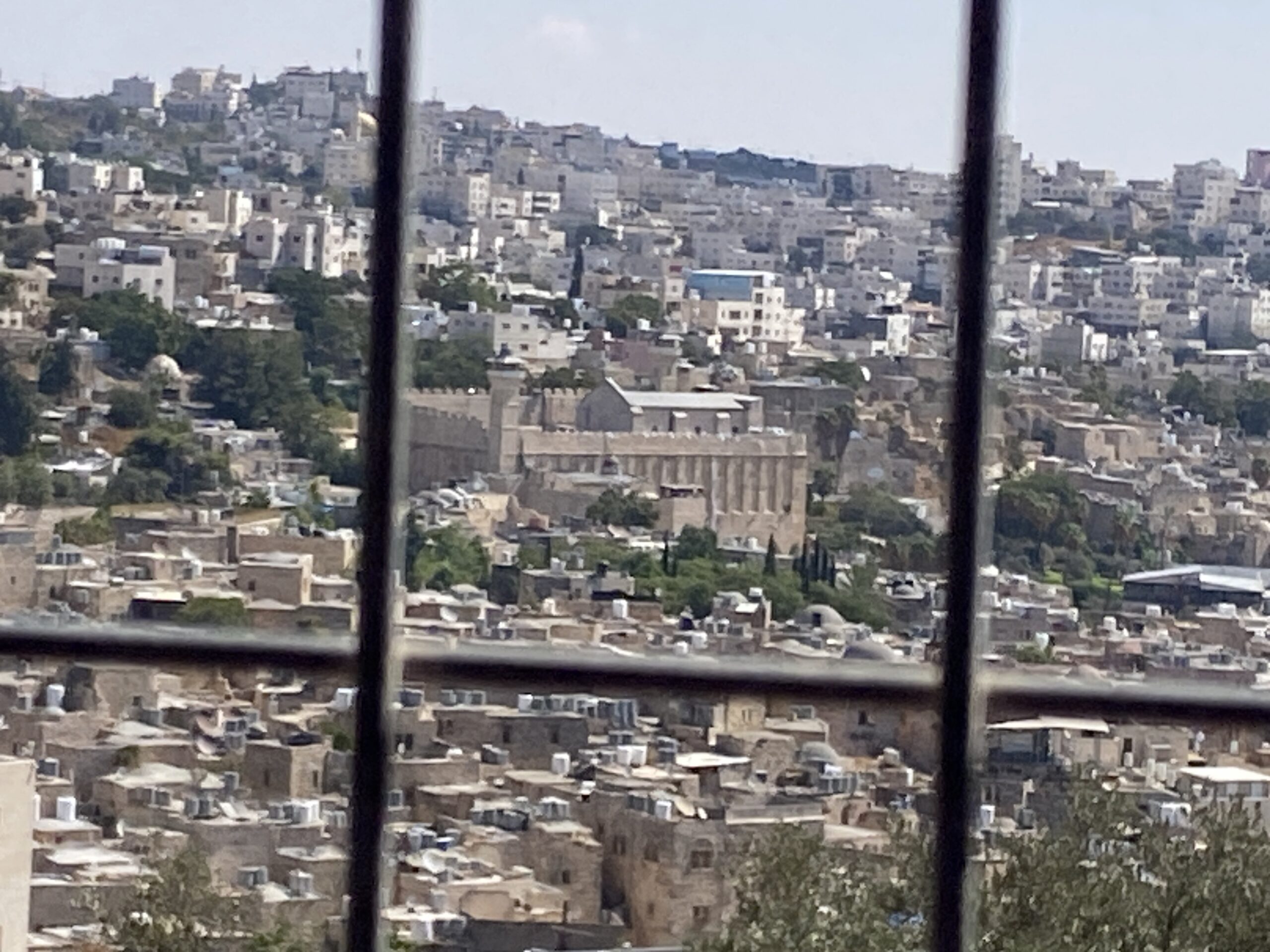 Yael ZoranSep-24-2026Hebron and the Cave of the Patriarchs from Beit Hashalom
-
