
AM
Tarqumiya 17/02/04 Hagit B., Sarit H. (reporter) We arrived at Tarqumiya at 05.45. We crossed to the Palestinian side of the checkpoint, this time with no objections or remarks on the side of the border policemen. It seems that they got used to our presence there. One of the BP (named Arthur) was a bit hostile towards us, but he did not make any overt remarks.The passage of the Palestinian workers was smooth and fast. This time two at a time were allowed to approach the checkpoint, and their documents were checked fast and efficiently. We could not see any inappropriate behavior or unusual practice. Hagit asked them whether buses with families of Palestinian detainees were supposed to arrive as there were “blue” police cars and buses waiting on the Israeli side of the checkpoint. This time the police cars escorting the buses to the Ktziot prison (what is usually called Ansar camp) arrived on time, we were hoping that the calls and letters sent to the Liaison and coordination office would make the passage of the families faster. Six buses coming from the Hebron area arrived at 7.00 am. The policemen were already impatient and joking that the Palestinians fell asleep. Later this impatience and anger made them to be really creative in delaying the already delayed convoy of families and relatives. Fifteen minutes elapsed and nobody seemed to be in charge of the passage of the prisoners’ families to Israeli buses and mini-buses. We asked one of the border policemen to call the liaison officer, to which he answered that they already have done it. The liaison officer – Omri – showed up at 7.10-7.15 and met there the Red Cross liaison person (by the way, Omri was polite and patient all along the way).It took some time until entire families, women, young children, babies began to step down the Palestinian buses and to approach the blocks where a makeshift checking point was set up. People were carrying suitcases, bags and parcels, which they had to totally unpack. As there is no arrangement whatsoever. Food, clothes, and other things were laid on the asphalt. The checking process was rather thorough and took a long time. The nasty border policemen had a metal detector device but he seemed to enjoy seeing people unpacking every single piece in their parcels. He was then replaced by another BP which conducted the searches in a much more professional way. As the process began to take too much time Hagit asked Omri, the liaison officer, to use the metal detector device in order to make the passage of people faster, to which he agreed. The whole process, checking and searching, transferring the families to Israeli buses and mini-buses took two hours. The checkpoint was understaffed. It would be worthwhile to write a letter to the DCO and to the Red Cross as well, and ask to reinforce the staff on days that the prisoners families pass through the checkpoint. This is a long trip, people leave their houses early in the morning, have to pass through the internal checkpoints, then wait until they are checked and searched before they enter Israel and step into Israeli buses. After that most of them travel more than two hours to the different destinations (this time people visited their sons at Ktziot or Ansar, Damoon and Hasharon jails). Upon their arrival to the jail they go through searches again (which may take up to two hours) and then they are left 40 minutes to be with their relatives. Sometimes they have to wait until the blue police escorting them arrives. The whole process is long, exhausting and maybe the transfer to Israeli buses unnecessary. Yet another problem is the unclear division of labour between the Border Police, the blue police and the IDF (the liaison officers). This unclear division of labour was the cause of small quarrels between the representatives of the different branches, which were quite unwilling to cooperate with each other. This lack of cooperation causes unnecessary delays to the families. Even at moments in which there were no tracks or persons waiting to cross the checkpoint. The Border Police made a point in not helping the IDF representative. The Palestinian buses driving the families wait for them at Tarqumiya until they come back in the evening hours. The drivers are not allowed to drive to another place to have a meal, and of course there are no facilities there.While the families were being searched and checked and transferred to the Israeli buses and mini-buses the checkpoint routine continued. A bottleneck of trucks and people developed. We saw no reason why people should wait, given that the border policemen were quite idle. We approached them, and asked them if there is any reason why people (mostly merchants) are waiting such a long time. At the point the queue began to move.By 8.30, the last bus (the sixth one) was still stuck and the detainees families were still waiting to be checked and to pass. The blue police came up with an original request. They wanted the Israeli liaison officer to make a list with the names and ID numbers of the people in the different buses. An argument developed between the police officer and the IDF liaison officer, as the IDF officer said that the agreement was to have only the number of persons at each bus. Finally the Palestinian liaison person agreed to make the list. The blue police request was rather capricious, as they were pissed off at the delay. We think that this capricious requests, stemming mainly of prestige struggles and the knowledge that they are dealing with a powerless population should be brought to the attention of the authorities, as the families are those who pay the price.We left the check point at 8.45. The buses were still waiting, but most of the checking and searching was over. There was no mobile checkpoint at Beit Gobrin.
Hebron
See all reports for this place-
According to Wye Plantation Accords (1997), Hebron is divided in two: H1 is under Palestinian Authority control, H2 is under Israeli control. In Hebron there are 170,000 Palestinian citizens, 60,000 of them in H2. Between the two areas are permanent checkpoints, manned at all hours, preventing Palestinian movement between them and controlling passage of permit holders such as teachers and schoolchildren. Some 800 Jews live in Avraham Avinu Quarter and Tel Rumeida, on Givat HaAvot and in the wholesale market.
Checkpoints observed in H2:
- Bet Hameriva CP- manned with a pillbox
- Kapisha quarter CP (the northern side of Zion axis) - manned with a pillbox
- The 160 turn CP (the southern side of Zion axis) - manned with a pillbox
- Avraham Avinu quarter - watch station
- The pharmacy CP - checking inside a caravan with a magnometer
- Tarpat (1929) CP - checking inside a caravan with a magnometer
- Tel Rumeida CP - guarding station
- Beit Hadassah CP - guarding station
Three checkpoints around the Tomb of the Patriarchs
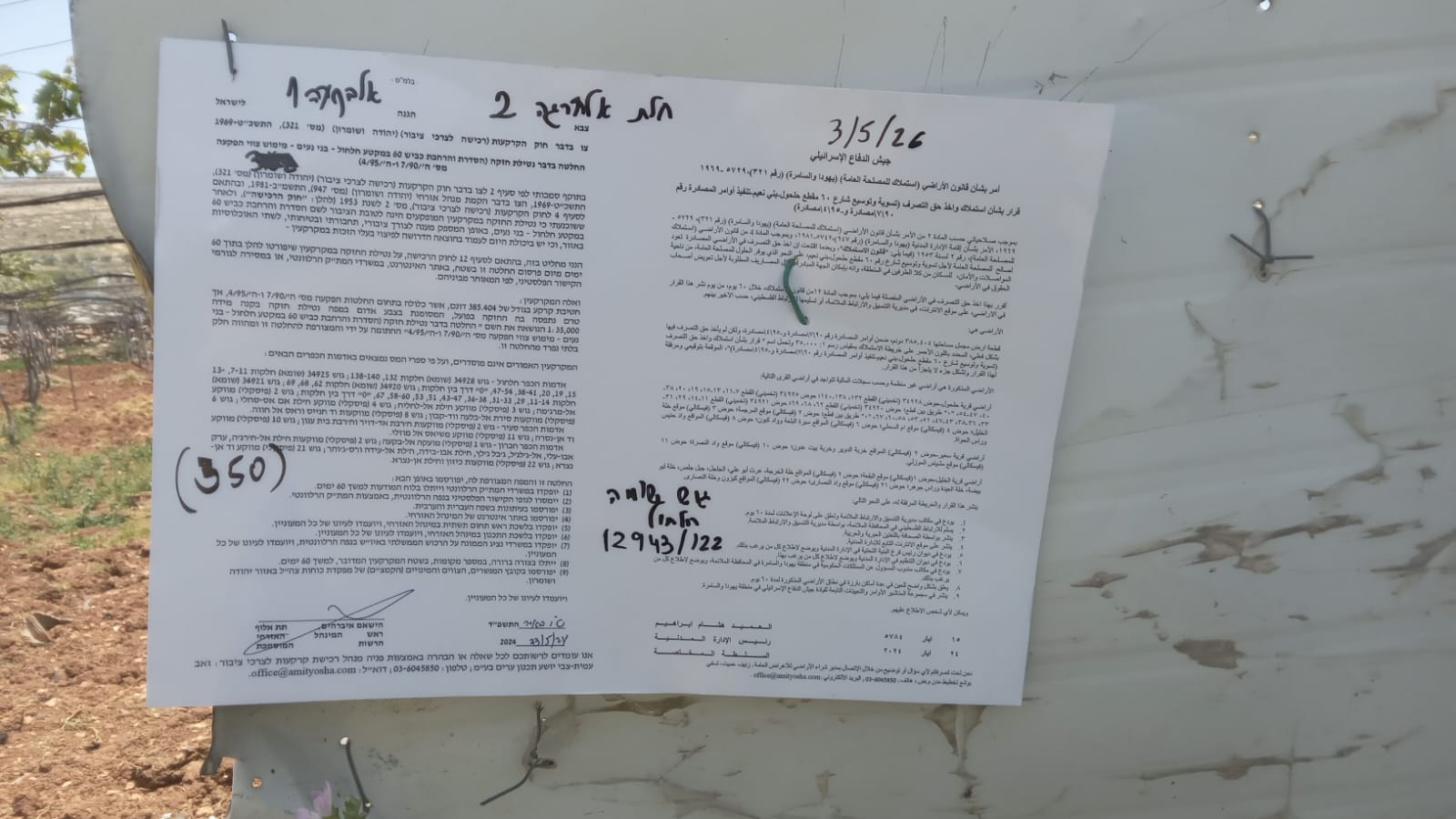 Muhammad D.May-13-2026Hebron - Request for compensation for land expropriation
-