
‘Anabta, Ar-Ras, Azzun, Jubara (Kafriat), Qalqiliya, Wed 30.7.08, Morning
Summary:
Inspections went slowly for laborers at the Eliyahu Crossing.A driver was detained because of a Palestinian flag decorating his windshield.The fate of an Arab peace activist in Tulkarm – persecuted by extremist coreligionists and also the Shin”Bet (Israeli General Security Service).There an apparent intention to change the direction of the entrance to Jubara.A prohibition on transporting scrap metal from Jubara to the Territories.
06:45 Qalqilya (Eliyahu) Crossing
Several dozen laborers who work in Alfei Menashe (a veteran Jewish-Israeli settlement, west of the Separation Wall) are awaiting inspection. One of them makes a written list of the queue. The inspections started at 5 a.m., and till now 155 people have gone through. There are those who say they’ve been waiting since 4 a.m. A Border Policeman checks their bags of food, and an MP, sitting in a booth, checks their ID documents. It seems that the pace is reasonable in light of such minimal staffing.
06:45 – 07:00 Qalqilya Checkpoint
Occasional vehicles in both directions pass quickly. A detained taxicab has been parked at the side, for ten minutes according to the driver. The checkpoint commander is unwilling to explain why. The driver says it’s because of the decoration on the front windshield: a Palestinian flag.We phone the IDF Humanitarian “Moked” [hotline for alleged abuse cases]. Five minutes later the driver is instructed to remove the flag and is allowed to drive on.A Palestinian vehicle is stopped and documents taken “for inspection” (what inspection?). These are returned after two minutes. Was this done for our benefit?
‘Azzun
The entrances to Hwy #55 are open.
08:50 – 09:35 Anabta (Einav) – returning from Beit Iba
There are no queues on either side. Cars are passing with no inspection, at most are stopped for a question or two. A bus is detained: two soldiers get on and take several ID documents for inspection on the portable computer in the guard tower.
We had a long, friendly discussion with the checkpoint commander, a Druze with the rank of lieutenant. Among the topics, he expressed interest in us and what we do.At the checkpoint we we meet with Mahmood from the Tulkarm branch of “Halonot” [“Windows” – a Palestinian/Israeli peace organization], and give him bags of clothing. It turns out that he’s blacklisted by the Shin”Bet and Sylvia [a Machsom Watch volunteer who works on these cases—ed.] is taking care of the matter. He’s “between a rock and a hard place”: on the one hand he’s persecuted for taking part in an Israeli organization; his office has already been torched and in the mosques they preach against him. On the other hand, he’s persecuted by the Israeli authorities because he has a relative in prison.
09:45 Jubara
The checkpoint commander says that as a “gesture to the village inhabitants,” a gate will be opened in about a month beside the Crossing (that is, near the house of Abu Khatem) as an entrance checkpoint to Jubara, and the Agricultural Gate from the direction of Ar-Ras will be closed. (This latter meaning, apparently, that it will go back to being an agricultural gate open some three hours in a 24-hour period.) This seems to be a significant worsening of conditions, both for the residents and for the landowners in the enclave, and even more so for the “illegals” [i.e. Palestinians in Israel without authorization]. Tami C. [of Machsom Watch] says that this strikes her as illogical; that is, so bad that the IDF won’t do such a thing, meaning to close the exit in the direction of Ar-Ras.
09:50 – 10:15 Ar-Ras Checkpoint (“Farm No. 8”)
At the side of the checkpoint stands a horse in poor condition, beside a wagon loaded with scrap metal and plastic. According to the checkpoint commander, he came from the direction of Jubara. There’s a directive from the DCO [District Coordinating Office of the Civil Administration], that prohibits bringing scrap metal into the Territories. Therefore the man would have to turn back with his wagon to Jubara. Besides this, the horse was in a bad way and wouldn’t be able to haul the wagon any further, so the man was told to rent a vehicle.
The man, who lives in Far’un, asked for mercy. Not only was he not going to be allowed to transport the goods, the rental vehicle would cost him money. Finally, a truck arrived to take the contents of the wagon. Nati was prepared to take the poor horse to be cared for. Luckily her husband vetoed this, otherwise what would Nadim [driver of the minibus for Machsom Watch shifts—ed.] have done?A week ago we saw a wagon drawn by a donkey, hauling the burnt-out shell of a car. We found the car beside Gate 753; this is also in the framework of the abovementioned prohibition.
'Anabta CP
See all reports for this place-
'Anabta CP
The checkpoint is located south of the village of 'Anabta, at the intersection of Road 60 (leading to Nablus at the entrance to Area A), with Road (57, 557, 5576) facing west towards the Einav settlement and the checkpoint at the exit from the West Bank - Figs checkpoint. Until 2010 we used to watch the intersection and report the long columns created due to a slow inspection of the vehicles in both directions. Oct-28-2011Anabta checkpoint 24.10.11
-
'Azzun
See all reports for this place-
Azoun (updated February 2019)
A Palestinian town situated in Area B (under civil Palestinian control and Israeli security control),
on road 5 between Nablus and Qalqiliya, east of Nabi Elias village. The inhabitants are allowed to construct and improve infrastructures. The Separation Fence has confiscated lands belonging to the town's people. In 2018 olive tree groves owned by one of its inhabitants were confiscated for the sake of paving a road to bypass Nabi Elias. Azoun population numbers 13,000, its economic state dire. Its infrastructures are poor, neglect and poverty rampant. In the meantime, the town council has completed paving an internal road for the inhabitants' welfare.
Because of its proximity to the Jewish settler-colony of Karnei Shomron and its outposts, the town suffers the intense presence of the Israeli army, especially at nighttime: soldiers enter homes, arrest suspects, trash the house and sometimes ruin it, as they do in numerous places in the West Bank. At times a checkpoint closes the entrance to the town, so no one can come in or get out.
-
A-Ras (The Children Checkpoint)
See all reports for this place-
A-Ras (The Children Checkpoint)
On Tulkarm-Qalqiliya road (574), east of Hirbet Jubara. tia checkpoint is dedicated to residents traveling to and from Tulkarm, so they should not cross apartheid road 557 (only permissible for settlers).
-
Jubara (Kafriat)
See all reports for this place-
The Jabra checkpoint was on Road 557, south of Tulkarm, on the side of the Figs Pass, which is located within the Palestinian Authority (a few kilometers east of the Green Line), and serves as an entry barrier from the territories to Israel. The checkpoint to the village of Jubara, which until 2013 was in the seam area, blocked and surrounded by a fence, was intended for the passage of the family members of the house next to the checkpoint, and also for the MachsomWatch volunteers (with special permission only), on their way to checkpoint 753. on the other side of the village. The soldiers supervising the "fig crossing" also supervised the crossing at this checkpoint, in our shifts we often waited a long time until the key was found and the gate opened. The checkpoint was abolished and became part of the separation fence that was moved west following the High Court.
-
Qalqiliya checkpoint
See all reports for this place-
Qalqilya is surrounded on all sides by the separation barrier. The only exit from the city is in the east of the city on the road that leaves the city in an easterly direction. This is where the checkpoint was located. When the checkpoint was active until 2009 our shifts watched long queues of cars being inspected at the only exit from the city to the West Bank. The checkpoint was canceled, but there is a military presence at the entrance to the city.
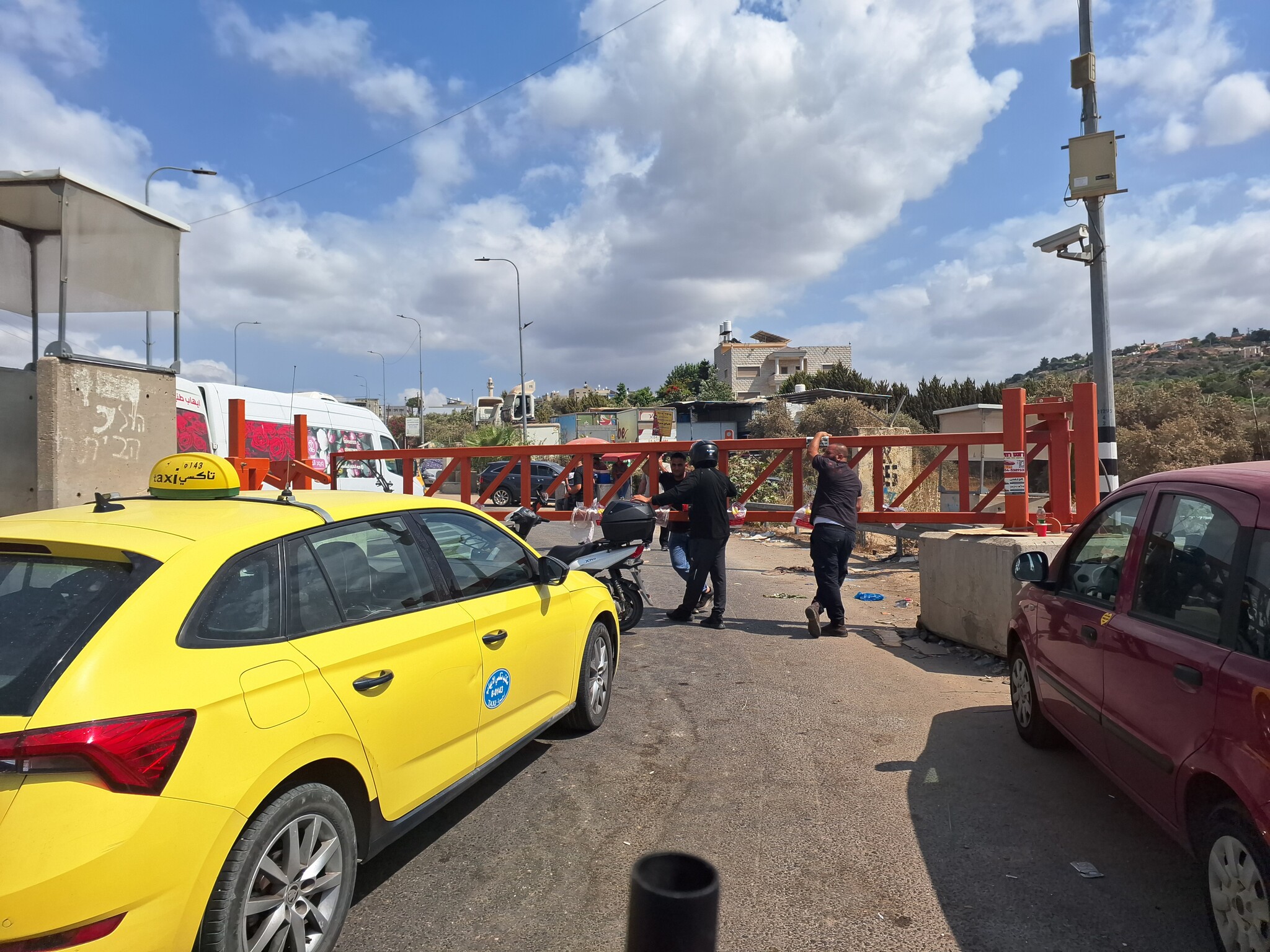 Ronit Dahan-RamatiAug-31-2026Nabi Elias. The gate is closed
-
