
‘Anabta, Ar-Ras, Beit Iba, Irtah, Wed 5.11.08, Morning
7:00 Irtah
Very many laborers in the area where people wait for transport. Some workers – not many – are still near the entrance to the area. Families of prisoners are also entering.
7:20 Ar Ras – Routine
7:40 Anabta – Routine
8:00 Beit Iba
When we arrived the checkpoint was quiet and normal. No lines. Random inspections of people entering. Those leaving undergo all the inspections.
After a while we go over to the area of the taxi drivers. We with them and talk.
About 8:45 the checkpoint stops working. We go near the area where the soldiers stop people from coming closer and the soldier explains that a suspicious item was found at the checkpoint, it’s being examined, and it isn’t clear how long the checkpoint will remain closed. They’re waiting from the army bomb disposal person. After a few minutes the place fills with people waiting to go through, as well as military vehicles, and soldiers of various ranks.
The youth suspected of carrying the item is brought over to the side of the checkpoint. He’s handcuffed. Surrounded by soldiers and officers. We draw closer to the place he’s being interrogated. For some reason, no one stops us from standing and listening to the interrogation. The “bomb” looks like a spray can of paint (like a bottle of deodorant), and near it a few wires. We try to talk to the youth. He tells us what village he comes from. He’s a vegetable merchant, on the way to Tulkarm. Not frightened. About half an hour after the start of the incident the checkpoint resumes normal operation.
The bomb disposal person arrives. The robot is removed from its vehicle. The item is placed in a concrete cube and the robot makes its acquaintance. At this stage we left. No explosion was heard.
We asked for the phone number of relatives in order to follow up what happens to the suspect for the rest of the day.
We told Ra’aya the story, and later it was learned that he was released to go home.
'Anabta CP
See all reports for this place-
'Anabta CP
The checkpoint is located south of the village of 'Anabta, at the intersection of Road 60 (leading to Nablus at the entrance to Area A), with Road (57, 557, 5576) facing west towards the Einav settlement and the checkpoint at the exit from the West Bank - Figs checkpoint. Until 2010 we used to watch the intersection and report the long columns created due to a slow inspection of the vehicles in both directions.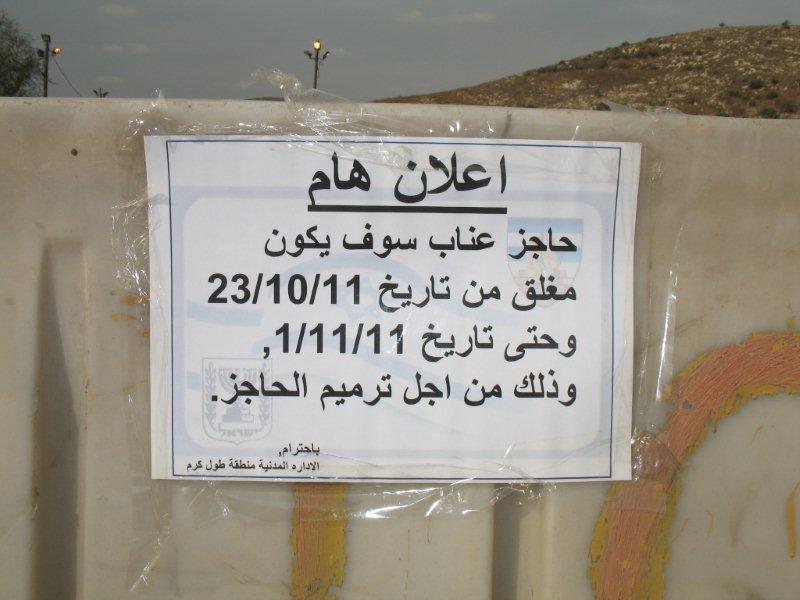 Oct-28-2011Anabta checkpoint 24.10.11
-
A-Ras (The Children Checkpoint)
See all reports for this place-
A-Ras (The Children Checkpoint)
On Tulkarm-Qalqiliya road (574), east of Hirbet Jubara. tia checkpoint is dedicated to residents traveling to and from Tulkarm, so they should not cross apartheid road 557 (only permissible for settlers).
-
Beit Iba
See all reports for this place-
A perimeter checkpoint west of the city of Nablus. Operated from 2001 to 2009 as one of the four permanent checkpoints closing on Nablus: Beit Furik and Awarta to the east and Hawara to the south. A pedestrian-only checkpoint, where MachsomWatch volunteers were present daily for several hours in the morning and afternoon to document the thousands of Palestinians waiting for hours in long queues with no shelter in the heat or rain, to leave the district city for anywhere else in the West Bank. From March 2009, as part of the easing of the Palestinian movement in the West Bank, it was abolished, without a trace, and without any adverse change in the security situation.
 Jun-4-2014Beit-Iba checkpoint 22.04.04
-
Irtah (Sha'ar Efrayim)
See all reports for this place-
The checkpoint is for Palestinians only. It is the main barrier to the passage of workers from the northern West Bank to Israel. Workers with a permit to work in Israel and also for trade (with appropriate permissions), medicine, and visiting prisoners. One can cross the checkpoint only on foot. The checkpoint is located north of Road 557 and south of Tulkarm. Operated by a civil security company, opening hours: between 4:00 and 19:00 on weekdays. As members of Machsom Watch, we began our shifts to this location in 2007. We arrived before it opened at 4 in the morning and report since, on the harsh conditions and the long and crowded queues of workers. The workers who pass by continue their journey by transportation to work throughout Israel. In the first period of its activity, about 3,000 and then 5,000 people passed through this checkpoint every day. Due to the small number of checking points and arbitrary delays for long periods of time in the "rooms", workers feared losing their transportation. Hence workers leave their homes at 2:30 at night to be among the first. Today, 15,000 pass and the transition is faster. Workers are still leaving their homes very early to get past the checkpoint at 7 p.m. In an adjacent compound, there is a terminal for the transfer of goods on a commercial scale, using the back-to-back method.
-
