
‘Anabta, Ar-Ras, Jit, Jubara (Kafriat), Qalqiliya, Sun 7.12.08, Afternoon
Summary
The Universal Declaration of Human Rights was adopted and proclaimed in 1948 by the General Assembly of the United Nations. It was sixty years ago this week, on December 10, that Member States proclaimed "this Universal Declaration of Human Rights as a common standard of achievement for all people and all nations." There are a number of Articles that pertain to what we, in MachsomWatch are about, and not only Article 13, "everyone has the right to freedom of movement…." And, on the eve of a Muslim feast, Eid al Adha, Feast of the Sacrifice, one wonders if it's too much to ask of the army of occupation to behave "in a spirit of brotherhood." Surprisingly, in what we witnessed at Al Funduq, their seeming calmness and reasonableness was an unexpected surprise.
12:20 Habla
The gate is already tightly closed, no soldiers in sight, although it's only five minutes past closing time. We sit with some of the Palestinians, midst the beauty of the carefully tended plant nursery, for our guests to learn, at first hand, something about the ugliness of daily life under occupation.
13:15 Qalqiliya
Free flowing traffic in both directions, in and out of the city, but all vehicles checked, although the many cars with Israeli (yellow) license plates are not asked for permits, nor checked against the usual list: freedom of movement to visit family over Eid Al Adha (Feast of the Sacrifice)! The soldiers shout at pedestrians who wish to walk straight through the checkpoint: "Go around," and a horse and cart do so without being yelled at.
13:40 Azzun
At both access points to Azzun, stand Hummers. We ask the soldiers at the one further east why today. They answer that "we're always around, you just don't see us." They indicate that on Friday, "there was a demonstration (by Azzun inhabitants), and the road was closed." They know nothing about what's going on, if anything, further up the road by Al-Funduq where it's been announced that vast numbers of settlers are coming to pray to observe the death of one of their own a year ago.
13: 55 Junction Al-Funduq-Imanuel-Ariel
A policeman (blue) and two soldiers, with their Hummer parked across the roadway, block passage for anybody wanting to travel further east, and no cars pass in the other direction either. But, having turned the car around and seen the sight of some cars moving through Al Funduq, we stop and ask if we can go on. The policeman indicates, "yes," but one of the soldiers says, "no." He lets us proceed nevertheless, telling us, "I have nothing to say to you" (about what is going on). Fine. We can see for ourselves.
14:00 Al-Funduq
Most of Al-Funduq, usually a busy village, is shuttered and silent, and it's not hard to find a place to park the car outside one of the closed up shops. A line of cars, Palestinian and some Israeli, stand and wait. It's quiet. Groups of young men stand around as we make our way to where another Hummer stands, placed across the roadway at the far end of the village. From here, there's a view down to the valley below and the many hills of the settlement of Qedumim beyond. Again, a Hummer is parked across the roadway, and a line of vehicles waits behind it. A lot of men — not a woman in sight — in the village: Border Police, soldiers and locals. The only activity comes from the butcher and his helpers, busy dealing with a large carcass hanging in the street and sheep bleating pitifully, waiting, ready for the slaughter ahead. Everyone is friendly, including army and police, there is a sense of stillness in the air, but no sense of foreboding. We're told that the settlers are praying, but by the time we get to the site of where a settler had been killed a year ago, there's only a pile of stones on the side of the road. A man with a black (religious, not a settler) skullcap talks to the Border Police by the Hummer. Not clear if he's a rabbi, but he's certainly not army. Just then, a lone settler approaches on foot from the Qedumim direction. He and the other man carry another large stone to add to the pile. Nothing more, and we ask if and when the road will be open. Within fifteen minutes, it is, we make our way back to the car, as the traffic — settlers sitting in their cars, Palestinians in theirs — begins to move. As we get back to our waiting car, a group of three "press" come by, and agree that it's been extremely calm. Nothing to report! Not an activist in sight… no untoward incidents. It seems that the army and police have decided that the settlers had their way too many times in recent days.
As we wend our way beyond the village, a strange sight: a convoy of jeeps, some blue police, some regular army, winds its way through a ploughed Palestinian field. In front of all the jeeps snakes a group of settlers, going back to their settlement homes – but not along the main road where traffic now flows freely.
Shvut Ami
The outpost is deserted, but there is still activity on the hill on the other side of the road.
Jit
Hummers are placed at the entry to the village of Jit (indicating that the road had been closed there a few minutes earlier), and there's another Hummer at Jit Junction.
15:50 Anabta
Free flowing traffic in both directions. Hard to believe there's no (usual) endless line coming out of Tulkarm. In spite of all this, we're told, for the first time, to stand where it's usually forbidden, on the side of the road opposite the lookout tower.
We had been told horror stories, by a taxi driver at Beit Iba, of goings on at the checkpoint yesterday, Shabbat, but the soldiers know nothing of the rampage of the Enav settlers (similar to problems created by settlers at Huwwara, also on the Sabbath)!
16:15 Jubara
There is a long line of cars (Israeli license plates, meaning Palestinian Israelis) waiting to get through back into Israel proper. Probably they have been shopping in Tulkarm. We move, not too happily, into the settlers' line where there is nobody. We tell the reservists that we want to go to A-Ras, they tell us to wait at the gate leading up to the village. There, a soldier comes to take our IDs, goes over to the central checking area, returns a few minutes later as he and another soldier lift up the new "arm" (barricade), and the traffic light turns green for our benefit. For whom else? Abu Ghatem – maybe! The next problem is that the soldiers fiddle with the key. It's the wrong one. Clearly, not in use much! They return with the correct key and open the gate, in friendly fashion.
Gate 753
Not so gracious at the Separation Barrier where a family squats on the ground waiting and waiting. It looks as if they've been there a while. A reservist asks what we're doing here and answers, snidely, "I've heard of MachsomWatch." He insists, all over again, at seeing our IDs, compares each one with the faces in front of him and, again, has uncalled for remarks to offer, and suggests that, since we're MachsomWatch, we know perfectly well why the family, parents and children, wait and wait. They are still in the same, sad position when we return from A-Ras.
16:40 A-Ras
Before we're all out of the car, the soldier in the crow's nest calls out that "You have orders to return," and indeed these are the words we overhear on the phone as we observe another soldier clambering up to the roof of a taxi to examine the insides of a large cardboard box perched there. We make our way back, no spirit of brotherhood in this part of the Occupied Palestinian Territories.
'Anabta CP
See all reports for this place-
'Anabta CP
The checkpoint is located south of the village of 'Anabta, at the intersection of Road 60 (leading to Nablus at the entrance to Area A), with Road (57, 557, 5576) facing west towards the Einav settlement and the checkpoint at the exit from the West Bank - Figs checkpoint. Until 2010 we used to watch the intersection and report the long columns created due to a slow inspection of the vehicles in both directions.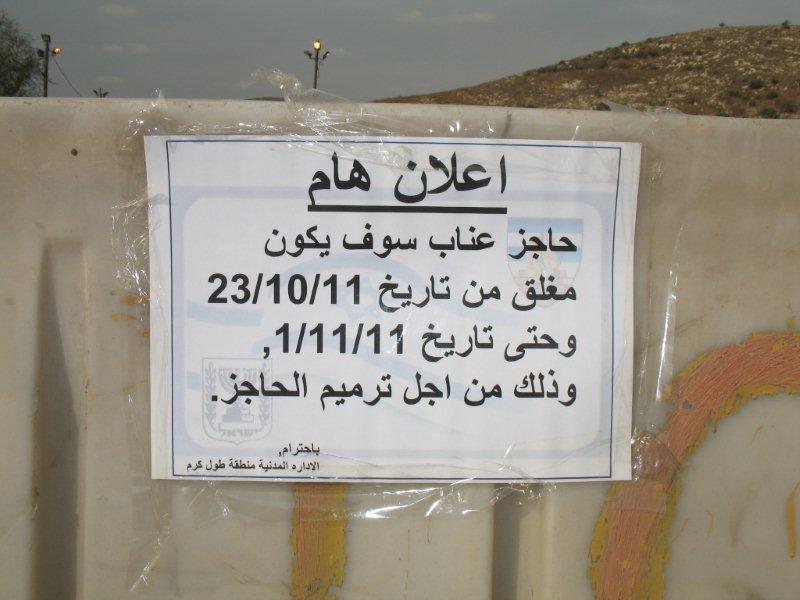 Oct-28-2011Anabta checkpoint 24.10.11
-
A-Ras (The Children Checkpoint)
See all reports for this place-
A-Ras (The Children Checkpoint)
On Tulkarm-Qalqiliya road (574), east of Hirbet Jubara. tia checkpoint is dedicated to residents traveling to and from Tulkarm, so they should not cross apartheid road 557 (only permissible for settlers).
-
Jit Junction
See all reports for this place-
The checkpoint is located on Route 60 near at the junction with Route 55, near the village of Jit. There was a checkpoint for vehicles passing between the north and south of the West Bank, which was abolished towards 2010. Since then, surprise checkpoints have been set up there from time to time with a police or Border Police vehicle, and vehicles and their passengers are inspected.
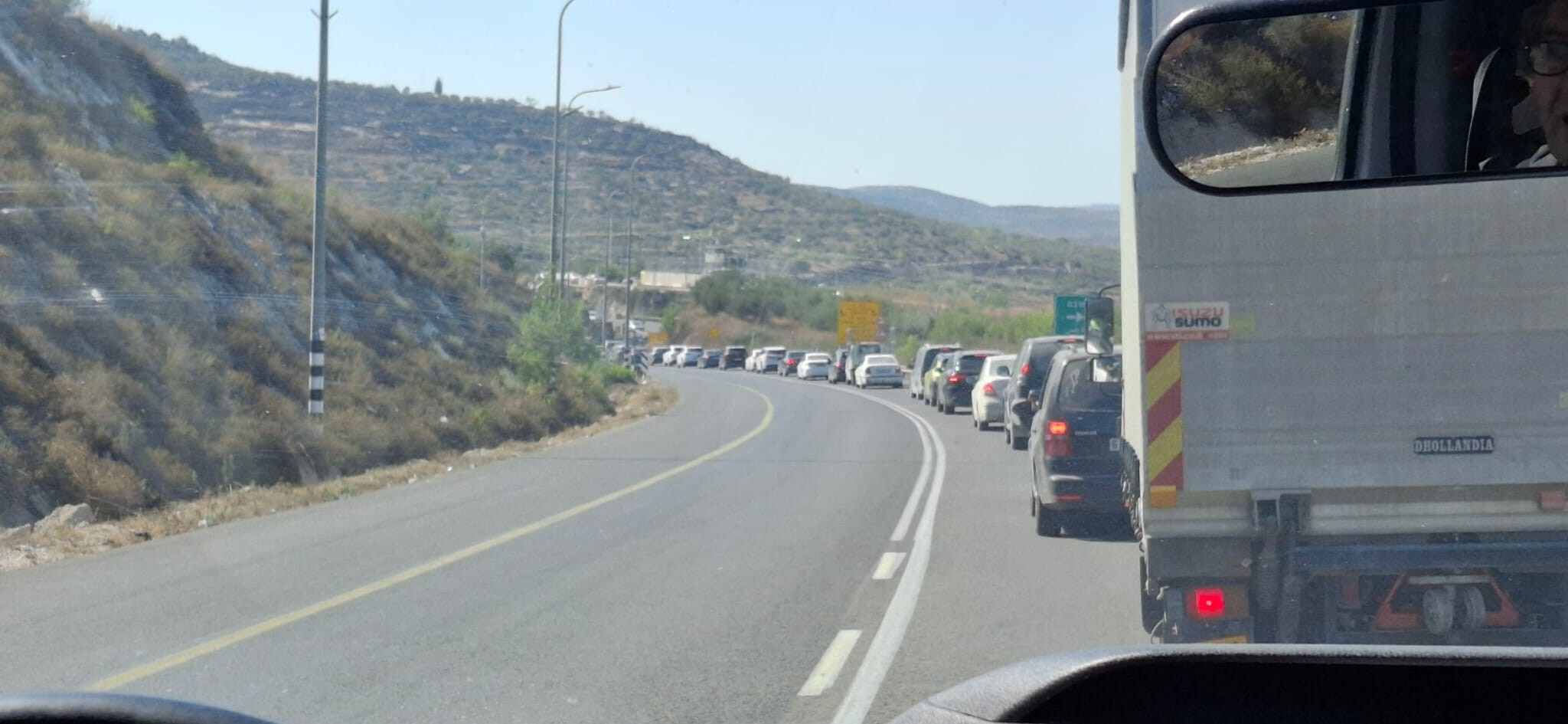 Anat PolakJul-17-2025Yitzhar Road, Jit Junction: traffic jam
-
Jubara (Kafriat)
See all reports for this place-
The Jabra checkpoint was on Road 557, south of Tulkarm, on the side of the Figs Pass, which is located within the Palestinian Authority (a few kilometers east of the Green Line), and serves as an entry barrier from the territories to Israel. The checkpoint to the village of Jubara, which until 2013 was in the seam area, blocked and surrounded by a fence, was intended for the passage of the family members of the house next to the checkpoint, and also for the MachsomWatch volunteers (with special permission only), on their way to checkpoint 753. on the other side of the village. The soldiers supervising the "fig crossing" also supervised the crossing at this checkpoint, in our shifts we often waited a long time until the key was found and the gate opened. The checkpoint was abolished and became part of the separation fence that was moved west following the High Court.
-
Qalqiliya checkpoint
See all reports for this place-
Qalqilya is surrounded on all sides by the separation barrier. The only exit from the city is in the east of the city on the road that leaves the city in an easterly direction. This is where the checkpoint was located. When the checkpoint was active until 2009 our shifts watched long queues of cars being inspected at the only exit from the city to the West Bank. The checkpoint was canceled, but there is a military presence at the entrance to the city.
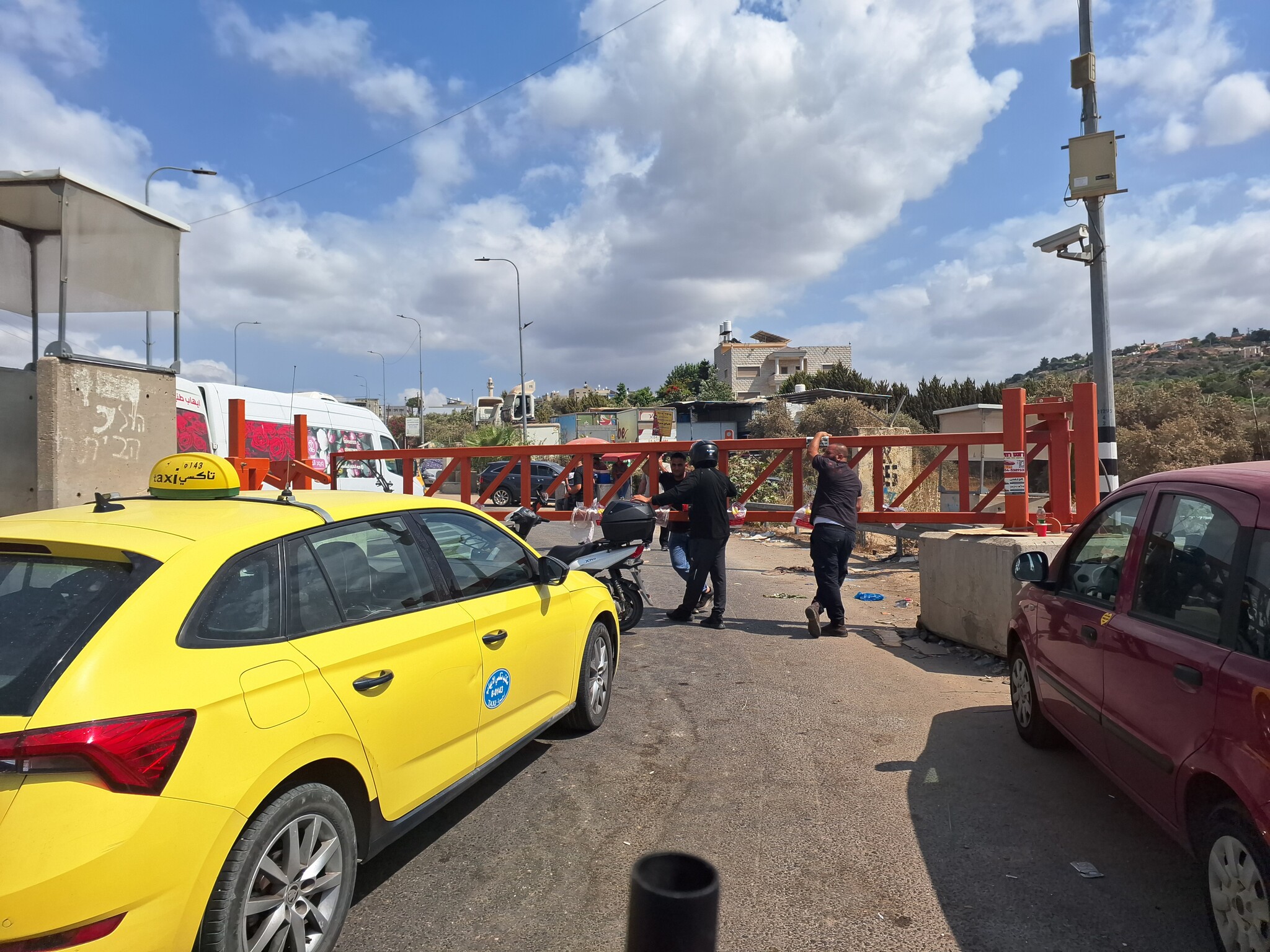 Ronit Dahan-RamatiAug-31-2026Nabi Elias. The gate is closed
-
