
‘Anabta, ‘Azzun, Beit Iba, Irtah (Sha’ar Efrayim)
Dawn shift, Irtach – tour in the west bank,
05:00
Wintry weather. The exit is full of workers and taxis. We arrive at the entrance gate; also here there are still a lot of workers descending upon the gate; from our standpoint, it is hard to see the line because it is hidden behind the cement barriers of the construction. In a few minutes, a military command car comes and 4 well-armed soldiers in black knit hats approach us and ask who we are and inform us that this is a military area. We answer that this is the standard place where we have been standing for many years and that there is no reason that they should not allow us to stand here. The officer who is negotiating with us is not sure of himself and they keep going back to their vehicle to speak on the phone to their commanding officer about the problem and then come back to us. Of course, an argument develops which is greater than the actual issue. In the end, they stand there the whole time that we are present and try to get us to move, without success. On the other hand, during the few minutes when they leave us alone, the Palestinians standing on the other side of the fence shout out to us their daily complaints about the checkpoint. Even though it is before 06:00, they claim that they are going to be late to work because of the conditions at the checkpoint, and that there is often a loss of a day's work. We listen and we can't do anything except agree with them and explain that this is the reason we are there, to observe and record, although we can't do much to help. Meanwhile, 2-3 personnel from the checkpoint command who are working here and are already known to us ask the Palestinians to call an ambulance because there is a wounded person at the checkpoint who needs to be taken to hospital. To our questions, they answer that he has a back pain. At the end of the procedure, when he is carried out on a stretcher to the ambulance, it seems as though he had undergone something very painful. We don't know what happened.
A group of soldiers tell us that they are waiting here until the police come to deal with us. We said there was no need. Everyone looks after theiint will be ready in another month to 6 weeks. The foundation is already complete and they are waiting for the metal workers to finish their work. All this is over when we decide to move to the exit area. The soldiers retreat, the police do not come, the Palestinians advance in the entrance line while being shouted at by the person responsible for the gate which opens and closes alternately.
At the entrance, a number of people complain to us about the difficult conditions at the checkpoint. There is nothing to add; this passageway, whose purpose is to enable 7000 people to go through every Sunday, has about 9 lanes rather than the possible 16, and yet they are proud of their ability to get 2000 people through in an hour! True, they manage this, but at a very high price.
06:10
We leave the checkpoint and travel on road #57 towards Beit Iba, J'it, ‘Azun, and back home. It is early and there is little traffic on the roads. All that one can see are the new neighborhoods being built at Kedumim, the roads which have filled the area to serve the IDF guard towers and the new road which is being built toward Lower Shufa, where there is a yellow gate and Israeli flags in the air, and soldiers directing taxis away from Shufa. Near road #57 a new road is also being built forthe Palestinians towns being built. We also passed ‘Antaba and were happy to see the checkpoint is open and there are no soldiers.
At‘Azzun, a command car with soldiers stands in place for another day of work. The gate is open. One young soldier says about this morning: "You are here for 10 years and you haven't changed anything." This echoes in our minds all morning and causes painful thoughts. We haven't changed anything. But we were here, we saw, we reported, we passed it on, we let the world know;
in the past and in the present
'Anabta CP
See all reports for this place-
'Anabta CP
The checkpoint is located south of the village of 'Anabta, at the intersection of Road 60 (leading to Nablus at the entrance to Area A), with Road (57, 557, 5576) facing west towards the Einav settlement and the checkpoint at the exit from the West Bank - Figs checkpoint. Until 2010 we used to watch the intersection and report the long columns created due to a slow inspection of the vehicles in both directions.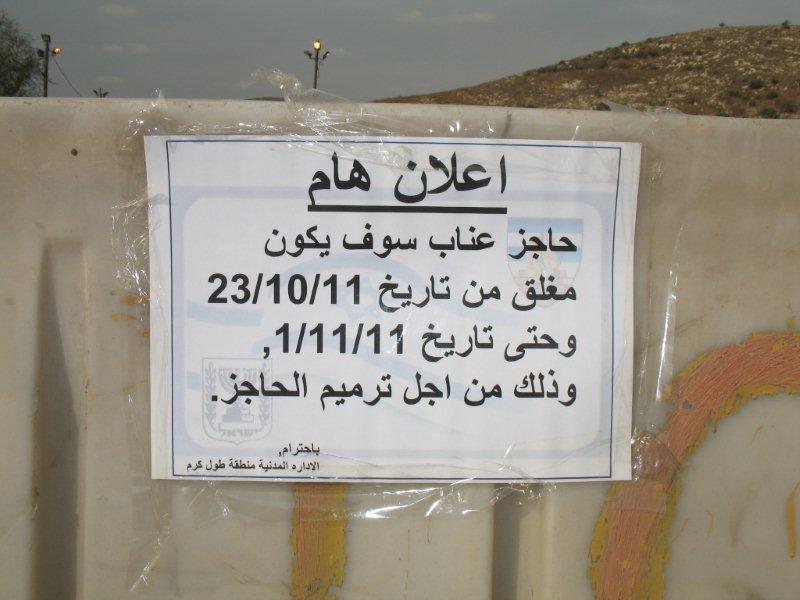 Oct-28-2011Anabta checkpoint 24.10.11
-
'Azzun
See all reports for this place-
Azoun (updated February 2019)
A Palestinian town situated in Area B (under civil Palestinian control and Israeli security control),
on road 5 between Nablus and Qalqiliya, east of Nabi Elias village. The inhabitants are allowed to construct and improve infrastructures. The Separation Fence has confiscated lands belonging to the town's people. In 2018 olive tree groves owned by one of its inhabitants were confiscated for the sake of paving a road to bypass Nabi Elias. Azoun population numbers 13,000, its economic state dire. Its infrastructures are poor, neglect and poverty rampant. In the meantime, the town council has completed paving an internal road for the inhabitants' welfare.
Because of its proximity to the Jewish settler-colony of Karnei Shomron and its outposts, the town suffers the intense presence of the Israeli army, especially at nighttime: soldiers enter homes, arrest suspects, trash the house and sometimes ruin it, as they do in numerous places in the West Bank. At times a checkpoint closes the entrance to the town, so no one can come in or get out.
-
Beit Iba
See all reports for this place-
A perimeter checkpoint west of the city of Nablus. Operated from 2001 to 2009 as one of the four permanent checkpoints closing on Nablus: Beit Furik and Awarta to the east and Hawara to the south. A pedestrian-only checkpoint, where MachsomWatch volunteers were present daily for several hours in the morning and afternoon to document the thousands of Palestinians waiting for hours in long queues with no shelter in the heat or rain, to leave the district city for anywhere else in the West Bank. From March 2009, as part of the easing of the Palestinian movement in the West Bank, it was abolished, without a trace, and without any adverse change in the security situation.
 Jun-4-2014Beit-Iba checkpoint 22.04.04
-
Irtah (Sha'ar Efrayim)
See all reports for this place-
The checkpoint is for Palestinians only. It is the main barrier to the passage of workers from the northern West Bank to Israel. Workers with a permit to work in Israel and also for trade (with appropriate permissions), medicine, and visiting prisoners. One can cross the checkpoint only on foot. The checkpoint is located north of Road 557 and south of Tulkarm. Operated by a civil security company, opening hours: between 4:00 and 19:00 on weekdays. As members of Machsom Watch, we began our shifts to this location in 2007. We arrived before it opened at 4 in the morning and report since, on the harsh conditions and the long and crowded queues of workers. The workers who pass by continue their journey by transportation to work throughout Israel. In the first period of its activity, about 3,000 and then 5,000 people passed through this checkpoint every day. Due to the small number of checking points and arbitrary delays for long periods of time in the "rooms", workers feared losing their transportation. Hence workers leave their homes at 2:30 at night to be among the first. Today, 15,000 pass and the transition is faster. Workers are still leaving their homes very early to get past the checkpoint at 7 p.m. In an adjacent compound, there is a terminal for the transfer of goods on a commercial scale, using the back-to-back method.
-
