
‘Anabta, ‘Azzun, Irtah, Jubara (Kafriat), Mon 3.11.08, Morning
7.20 Irtah. Most of the workers have already passed. Families of prisoners start to pass through to the jails in Israel.
8.00 Jubara. Not much movement but the checking is very pedantic. Even so there is no line.
The road from Ar-Ras and Azzun through Jayush was quiet.
8.50
Azzun is closed and we tried to go through another way. On this road,
next to the factory where they cut stones we saw many army vehicles
which had stopped a Palestinian police car and was questioning the
occupants. We waited and the soldiers tried to send us off. We did not
really go so near because we did not see that our interference would be
of any help and so just waited to see. More army vehicles arrived.
Captains of higher rank so that there were about 20 soldiers. At 9.20
they were freed.
We went on the second road and this took 20 minutes instead of 5 on road 55.
9.45 Qalqiliya. No lines. Hardly any checking.
11.30
Anabta. This has not been a pleasant checkpoint for quite some time
and here one sees the power of the soldiers who act as they want to.
At Beit Iba the taxi drivers complained that the soldiers at Anabta act with a lack of respect and it
especially hurts them when they see how they act with the young women (
the students in the taxis) and the soldiers laugh at them and look at
them. They also say that the soldiers also ask for "small" bribes,
falafel, etc. A driver said that yesterday, 2.11.2008, people waited
two hours in line.
When
we arrived there was a long line at the exit from Tulkarm, at least 25
cars. I came closed to photograph taking care not to photograph the
soldiers who were not very welcoming. They asked what I was
photographing and when I said the line the commander said to his
soldiers "Stop checking. She wants a long line." And so they stopped
for 15 minutes. Then they began to check the long line and all the cars
went through without being checked. I phoned the centre and asked to
make a complaint with the naïve hope that maybe if we complain each day
about this company maybe it will be changed.
11.50
Because there was no line there was more time to check each car, to
make people get out of the taxis and to check the IDs opposite the
computer. Try to understand the logic of the security situation.
'Anabta CP
See all reports for this place-
'Anabta CP
The checkpoint is located south of the village of 'Anabta, at the intersection of Road 60 (leading to Nablus at the entrance to Area A), with Road (57, 557, 5576) facing west towards the Einav settlement and the checkpoint at the exit from the West Bank - Figs checkpoint. Until 2010 we used to watch the intersection and report the long columns created due to a slow inspection of the vehicles in both directions.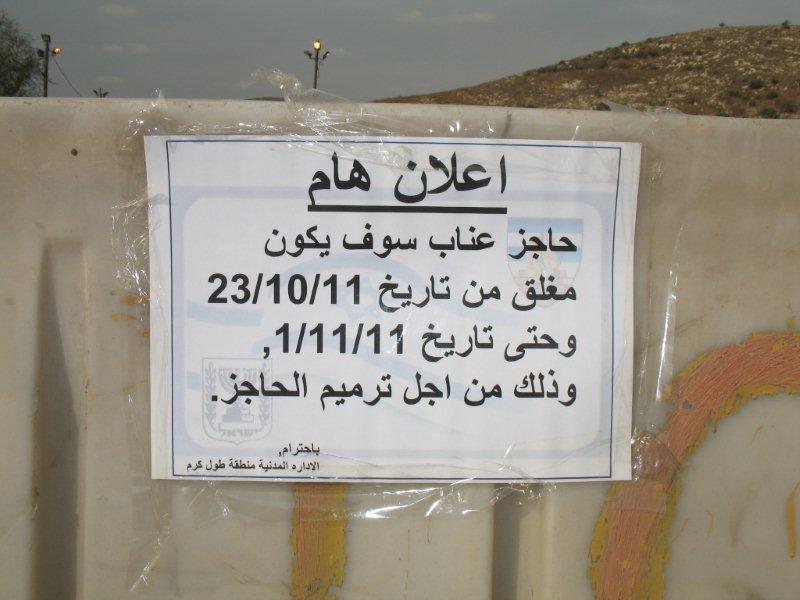 Oct-28-2011Anabta checkpoint 24.10.11
-
'Azzun
See all reports for this place-
Azoun (updated February 2019)
A Palestinian town situated in Area B (under civil Palestinian control and Israeli security control),
on road 5 between Nablus and Qalqiliya, east of Nabi Elias village. The inhabitants are allowed to construct and improve infrastructures. The Separation Fence has confiscated lands belonging to the town's people. In 2018 olive tree groves owned by one of its inhabitants were confiscated for the sake of paving a road to bypass Nabi Elias. Azoun population numbers 13,000, its economic state dire. Its infrastructures are poor, neglect and poverty rampant. In the meantime, the town council has completed paving an internal road for the inhabitants' welfare.
Because of its proximity to the Jewish settler-colony of Karnei Shomron and its outposts, the town suffers the intense presence of the Israeli army, especially at nighttime: soldiers enter homes, arrest suspects, trash the house and sometimes ruin it, as they do in numerous places in the West Bank. At times a checkpoint closes the entrance to the town, so no one can come in or get out.
-
Irtah (Sha'ar Efrayim)
See all reports for this place-
The checkpoint is for Palestinians only. It is the main barrier to the passage of workers from the northern West Bank to Israel. Workers with a permit to work in Israel and also for trade (with appropriate permissions), medicine, and visiting prisoners. One can cross the checkpoint only on foot. The checkpoint is located north of Road 557 and south of Tulkarm. Operated by a civil security company, opening hours: between 4:00 and 19:00 on weekdays. As members of Machsom Watch, we began our shifts to this location in 2007. We arrived before it opened at 4 in the morning and report since, on the harsh conditions and the long and crowded queues of workers. The workers who pass by continue their journey by transportation to work throughout Israel. In the first period of its activity, about 3,000 and then 5,000 people passed through this checkpoint every day. Due to the small number of checking points and arbitrary delays for long periods of time in the "rooms", workers feared losing their transportation. Hence workers leave their homes at 2:30 at night to be among the first. Today, 15,000 pass and the transition is faster. Workers are still leaving their homes very early to get past the checkpoint at 7 p.m. In an adjacent compound, there is a terminal for the transfer of goods on a commercial scale, using the back-to-back method.
-
Jubara (Kafriat)
See all reports for this place-
The Jabra checkpoint was on Road 557, south of Tulkarm, on the side of the Figs Pass, which is located within the Palestinian Authority (a few kilometers east of the Green Line), and serves as an entry barrier from the territories to Israel. The checkpoint to the village of Jubara, which until 2013 was in the seam area, blocked and surrounded by a fence, was intended for the passage of the family members of the house next to the checkpoint, and also for the MachsomWatch volunteers (with special permission only), on their way to checkpoint 753. on the other side of the village. The soldiers supervising the "fig crossing" also supervised the crossing at this checkpoint, in our shifts we often waited a long time until the key was found and the gate opened. The checkpoint was abolished and became part of the separation fence that was moved west following the High Court.
-
