
‘Anabta, Beit Iba, Deir Sharaf, Habla, Irtah (Sha’ar Efrayim), Jit, Jubara (Kafriat), Shave Shomron, Wed 18.8.10, Afternoon
Summary
Our starting point is the Green Line, Route 6. East of it we are well
aware of notions about the land being "disputed," "colonized" or
"separated." What is obvious on our tour are the combination of
apartheid, military occupation and colonization in a manner that must be
unique in the world! The upshot of the process of land acquisition and
demographic engineering is a sorry spectacle on the one hand, a human
tragedy on the other.
13:40 Habla
We arrive early at Gate 1393, firmly closed in the intense heat, as a
dozen or more men sit on the bench, waiting, in the boiling hot ex
container (from Zim shipping line, we wonder). The army arrives after
13:45, and then only two soldiers step from the Hummer as it hurries off
into the hot dust of the Separation Barrier.
13:55 — the gates have still not opened, and the soldier, on our
complaining, says he cannot "open the gate on my own," that he is
awaiting another three…
When they do come, another five minutes wait, as they work in
excruciating slowness, while horse, donkey cart, tractor, bicycle and
about 20 male workers take their place to get through the Separation
Barrier. Just one woman — a woman we know from Ras Atiya, since, once
long ago, we were able to cross the Separation Barrier checkpoint there,
(now no more) and join her in her home, to eat watermelon. Today, she
still has her same job in Israel, she still pays 50 NIS a month for her
work permit, good until the end of this year, but now she can no longer
get near her village without coming through this gate and then taking a
taxi from the other side all the way to Ras Atiya. She is but one
example of the continuous political and economic control over the
Palestinian people by the Occupier.
On our way deeper into the Seam Zone, we take a small tour
alongside Alfe Menashe, the settlement which proudly boasts
advertisements for new housing on the road leading up to it, close to
the sadness and poverty of the Bedouin community a few meters away. Just
before the barred entryway to the settlement is a lookout which
portrays only too well how the contours of the land have been gouged out
to create the Separation Barrier, a roadway below and the "Wall" — as
high as the wall in Jerusalem, as a soldier once boasted to us — above.
The way the Separation Barrier curves as it does is clearly to
demarcate the growing settlement and its expansionist plans to swallow
up what remains of the Seam Zone.
Route 55
Nothing to report, a hidden military jeep off on the side of the
road at Al Funduk, and no signs of life, for now, at the outpost of
Shvut Ami near Qedumim.
Jit and the road to Beit Iba and Nablus
Nothing going on at the junction itself, but a surprising scene as cars,
taxis and even a Taneeb bus, are seen, coming down from the road to
Sarra. We decide to "explore." The road is wide open and where, once, in
the dim, distant past, four, five or more years ago, was a checkpoint
and trucks delivered water to the villages beyond, today the road is
wide open (and the villages, we know now have piped water, as does, and
did the settlement of Qedumim). The roadway is in good shape, and, near
its crest is a gorgeous view to the north and west, whereas just east of
us is Nablus, close by with smart looking new residential buildings
near where we turn around. At a junction, a brand new junction, well
laid out and engineered is a big sign that this road is made with the
help of US AID. Had we continued straight on, we would have been in the
center of Nablus. Instead, we drive down the steep asphalted (still
black) road, the live trees at its side made more silvery than ever with
the roadwork and summer dust, straight into the middle of what was once
the Beit Iba checkpoint. All is quiet, little traffic in the few hours
remaining before the end of Ramadan, the old kiosks all tightly closed
up: the whole setting, with the deserted quarry behind, looks like
something from the back set of a Hollywood movie. The closed Huwwash
Brothers' carpentry workshop sports an impressive looking new iron gate,
a new shopping parade, still not open, has been created near Deir
Sharaf, and there are now some places selling inticately designed clay
pots alongside the road. At the mini market, we learn that the new road
we have just "explored" has been open only about four days.
Shavei Shomron
The newly paved Route 60 to Jenin, also courtesy of US AID, is now open
to traffic, and there's a checkpoint as for many years, at the crest of
the hill, outside the military base entryway to Shavei Shomron. Quite a
bit of traffic here. We note a large IDF tank parked not afar away
(empty), a "stretch" Hummer in front of us, barring the way up the
barricaded hillside, and as we make our way to turn back down the hill, a
gaggle of soldiers surrounds us. We learn from the commander that the
roadway is open although "they" are still working beyond the checkpoint
("there's nothing of interest there for Israeli Jews") that permits to
go to Homesh (the disengaged settlement may be reached: really?) At this
point, the commander from the "stretch" Hummer tries to ask more
aggressive questions and is shooed away and silenced by the commander
stationed at Shavei Shomron.
Anabta
Traffic slows down as it crosses the intricate access point to Tulkarm, but there's not a soldier in sight.
Jubara
A polite military policewoman speeds our way on to:
16:00 Irtah
Many people hurrying, good naturedly, to the terminal building where,
unbelievably, all eight counters are open to service the few returning
workers on this horribly hot day. A man, carrying a standing fan,
struggles to get through the narrow turnstile to the hall inside,
saying, good naturedly, "Well, it would be better to have air
conditioning, but meanwhile…" And only a few more hours to "iftar."
'Anabta CP
See all reports for this place-
'Anabta CP
The checkpoint is located south of the village of 'Anabta, at the intersection of Road 60 (leading to Nablus at the entrance to Area A), with Road (57, 557, 5576) facing west towards the Einav settlement and the checkpoint at the exit from the West Bank - Figs checkpoint. Until 2010 we used to watch the intersection and report the long columns created due to a slow inspection of the vehicles in both directions.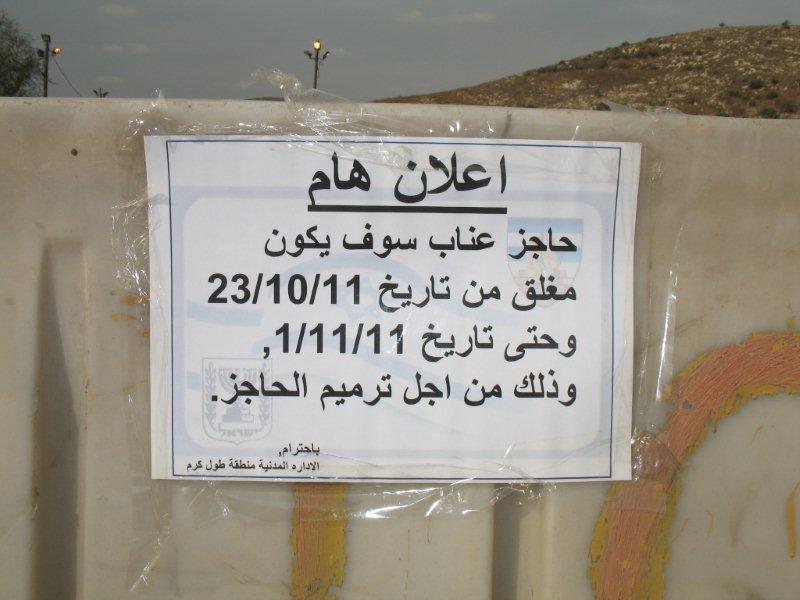 Oct-28-2011Anabta checkpoint 24.10.11
-
Beit Iba
See all reports for this place-
A perimeter checkpoint west of the city of Nablus. Operated from 2001 to 2009 as one of the four permanent checkpoints closing on Nablus: Beit Furik and Awarta to the east and Hawara to the south. A pedestrian-only checkpoint, where MachsomWatch volunteers were present daily for several hours in the morning and afternoon to document the thousands of Palestinians waiting for hours in long queues with no shelter in the heat or rain, to leave the district city for anywhere else in the West Bank. From March 2009, as part of the easing of the Palestinian movement in the West Bank, it was abolished, without a trace, and without any adverse change in the security situation.
 Jun-4-2014Beit-Iba checkpoint 22.04.04
-
Deir Sharaf checkpoint
See all reports for this place-
Deir Sharaf checkpoint is located west of Nablus and south of the settlement of Shavei Shomron, at the entrance to the village of Deir Sharaf on the road leading to Nablus. The checkpoint was activated in early March 2009 after the Beit Iba checkpoint was closed. Palestinians are allowed through the checkpoint , but not for Israelis. Unlike the checkpoints leading to Qalqilya and Tulkarm, crossing of Israeli Palestinians is only allowed on Saturdays.
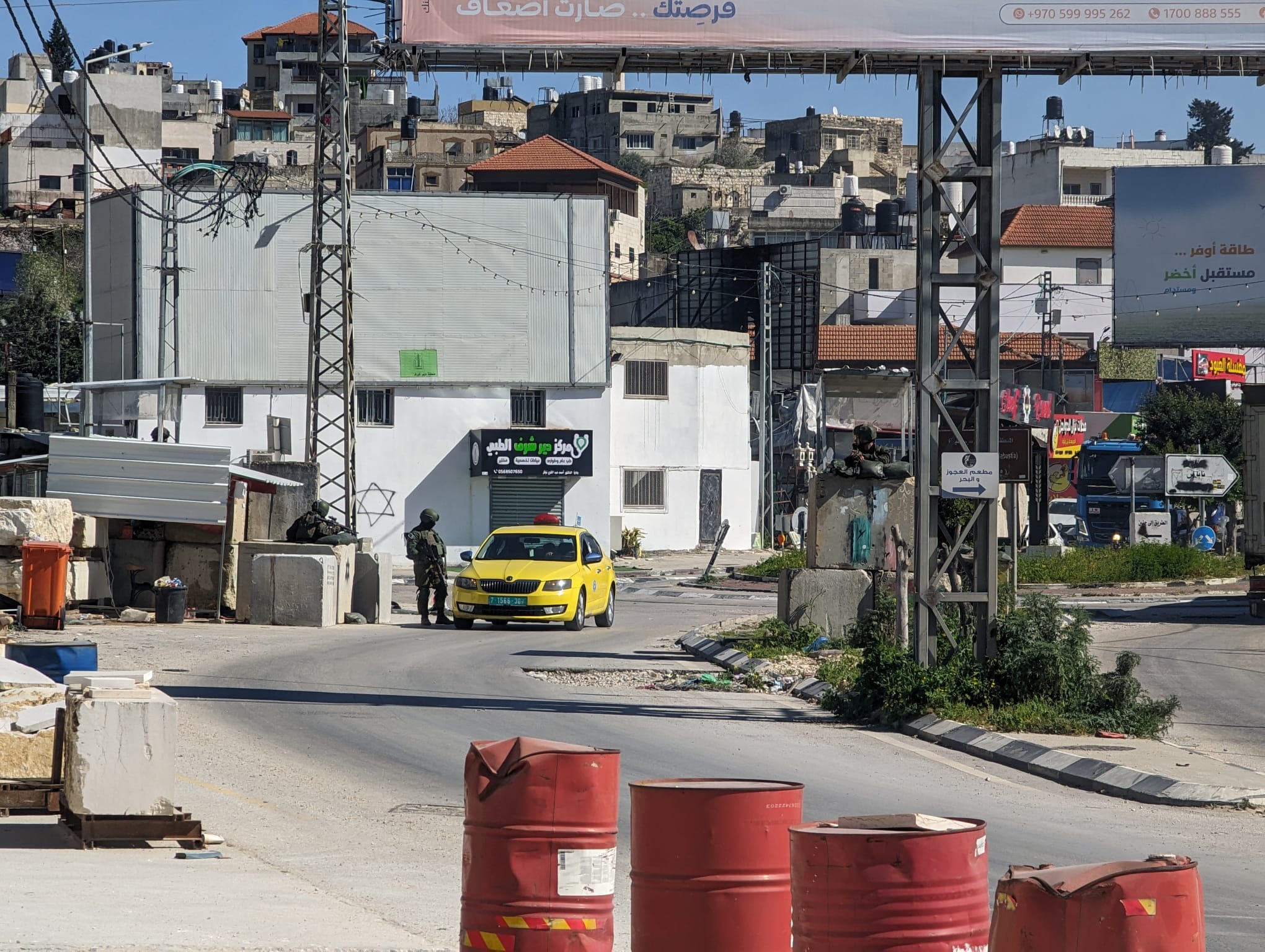 Nina SebaFeb-28-2024Deir Sharaf - the entrance to the village
-
Habla
See all reports for this place-
Habla CP (1393)
The Habla checkpoint (1393) was established on the lands of the residents of Qalqilya, on the short road that
connected it for centuries to the nearby town of Habla. The separation barrier intersects this road twice and cut off the residents of Qalqilya from their lands in the seam zone.(between the fence and the green line).
There is a passage under Road 55 that connects Qalqilya to the sabotage This agricultural barrier is used by the farmers and nursery owners established along Road 55 from the Green Line and on both sides of the kurkar road leading to the checkpoint.
This agricultural checkpoint serves the residents of Arab a-Ramadin al-Janoubi (detached from the West Bank), who pass through it to the West Bank and back to their homes. The opening hours (3 times a day) of this agricultural checkpoint are longer than usual, about an hour (recently shortened to 45 minutes), and are coordinated with the transportation hours of a-Ramadin children studying in the occupied in the West Bank.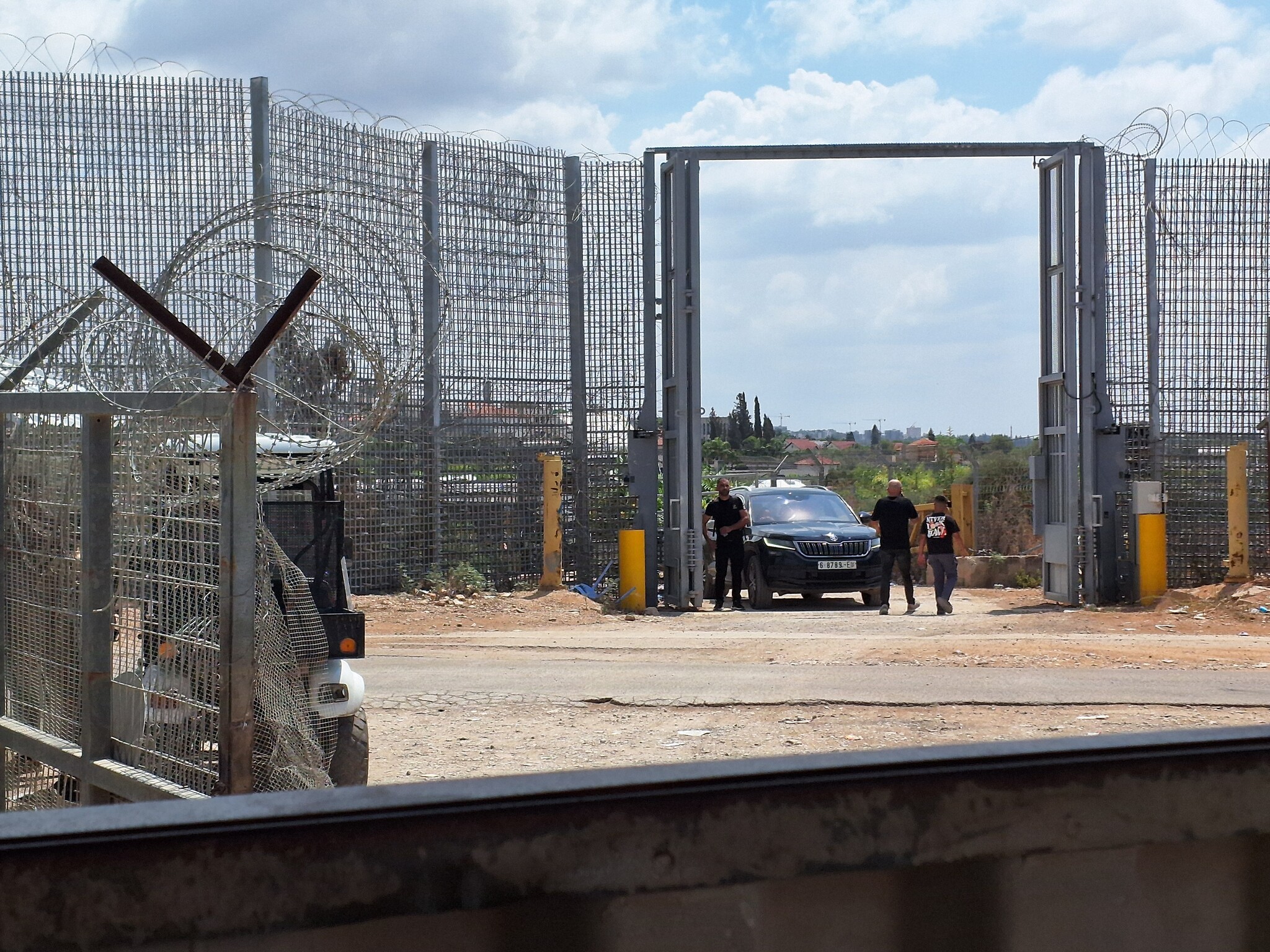 Ronit Dahan-RamatiAug-31-2026Habla. The gate is open
-
Irtah (Sha'ar Efrayim)
See all reports for this place-
The checkpoint is for Palestinians only. It is the main barrier to the passage of workers from the northern West Bank to Israel. Workers with a permit to work in Israel and also for trade (with appropriate permissions), medicine, and visiting prisoners. One can cross the checkpoint only on foot. The checkpoint is located north of Road 557 and south of Tulkarm. Operated by a civil security company, opening hours: between 4:00 and 19:00 on weekdays. As members of Machsom Watch, we began our shifts to this location in 2007. We arrived before it opened at 4 in the morning and report since, on the harsh conditions and the long and crowded queues of workers. The workers who pass by continue their journey by transportation to work throughout Israel. In the first period of its activity, about 3,000 and then 5,000 people passed through this checkpoint every day. Due to the small number of checking points and arbitrary delays for long periods of time in the "rooms", workers feared losing their transportation. Hence workers leave their homes at 2:30 at night to be among the first. Today, 15,000 pass and the transition is faster. Workers are still leaving their homes very early to get past the checkpoint at 7 p.m. In an adjacent compound, there is a terminal for the transfer of goods on a commercial scale, using the back-to-back method.
-
Jit Junction
See all reports for this place-
The checkpoint is located on Route 60 near at the junction with Route 55, near the village of Jit. There was a checkpoint for vehicles passing between the north and south of the West Bank, which was abolished towards 2010. Since then, surprise checkpoints have been set up there from time to time with a police or Border Police vehicle, and vehicles and their passengers are inspected.
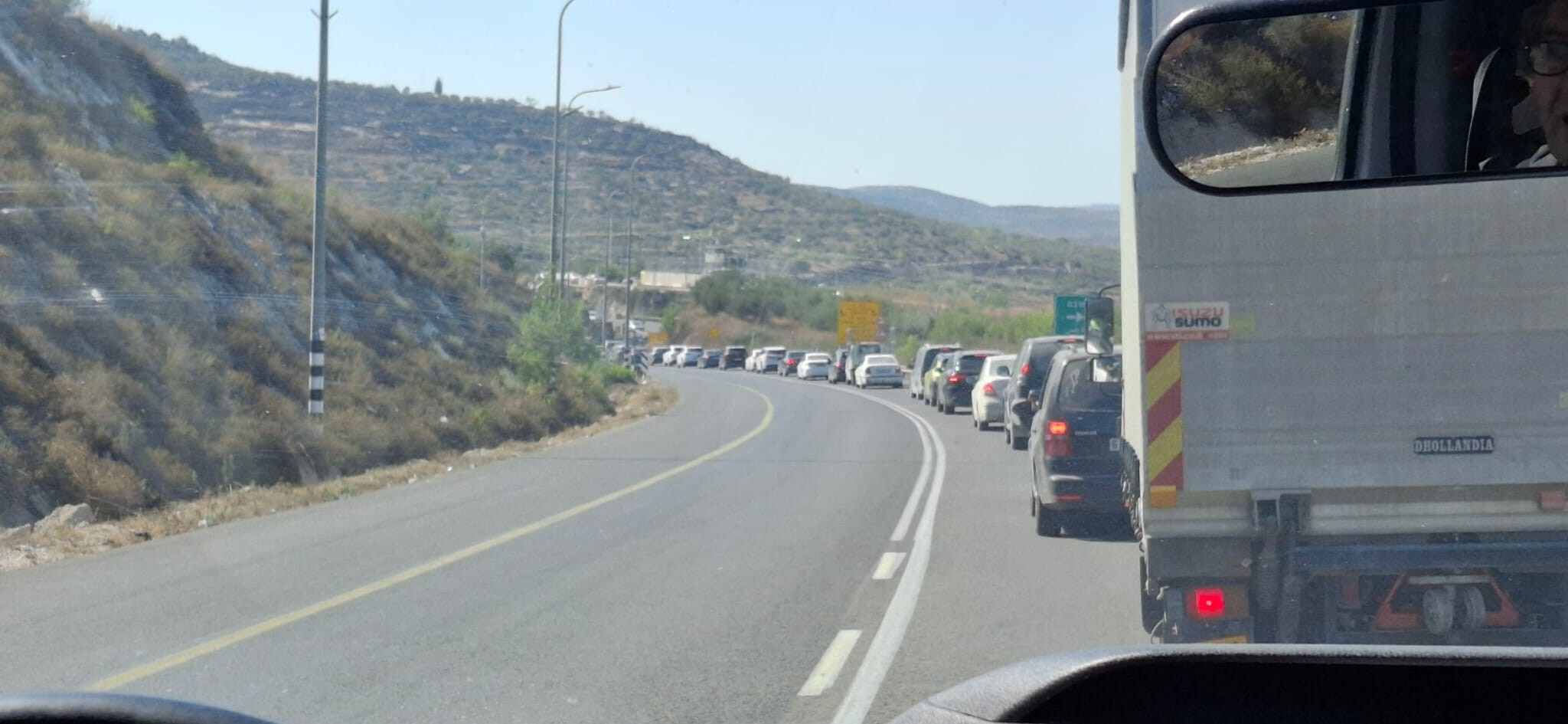 Anat PolakJul-17-2025Yitzhar Road, Jit Junction: traffic jam
-
Jubara (Kafriat)
See all reports for this place-
The Jabra checkpoint was on Road 557, south of Tulkarm, on the side of the Figs Pass, which is located within the Palestinian Authority (a few kilometers east of the Green Line), and serves as an entry barrier from the territories to Israel. The checkpoint to the village of Jubara, which until 2013 was in the seam area, blocked and surrounded by a fence, was intended for the passage of the family members of the house next to the checkpoint, and also for the MachsomWatch volunteers (with special permission only), on their way to checkpoint 753. on the other side of the village. The soldiers supervising the "fig crossing" also supervised the crossing at this checkpoint, in our shifts we often waited a long time until the key was found and the gate opened. The checkpoint was abolished and became part of the separation fence that was moved west following the High Court.
-
Shave Shomron Checkpoint
See all reports for this place-
The checkpoint is on Route 60 (the main road to the northern West Bank), opposite settlement. Has been blocked to Palestinians since disengagement from Gaza and northern Samaria.
-
