
‘Anabta, Beit Iba, Deir Sharaf, Habla, Irtah (Sha’ar Efrayim), Jubara (Kafriat), Sun 10.7.11, Afternoon
Summary
We are quite accustomed to being known as, or calling ourselves, “activists.” Yet, recently, we were referred to as “dissidents,” a term which surely describes who and what we are. We are dissidents as we dissent from the established policy of the government. We are dissenters who object to the political orthodoxy of the majority in Israel, and we protest and, yes, act according to now established traditions of our ten year old grassroots organization. We are also recusants or nonconformists who refuse to conform to established standards of conduct for Israelis where many, if not most, believe the eyes of others. Above all, perhaps, we demystify the faith on which much of Israel functions, by refusing to rely on external authority and relying, instead, on our own internal authority, believing with our own eyes, “bearing witness,” thereby maintaining the freedom of expression and protest on which this country must rely.
Below, what we bore witness to, today:
Habla
13:03 – the gates are open — actually on each side of the Separation Barrier only one of the two gates is open. The pedestrian gate, newly installed only a few months ago, is padlocked. It is hot, and a soldier even asks if we require water! The inevitable military policewoman is talking to a man in a pony cart, together with a small child, and it looks as if there is an altercation, but no, we are wrong, there is nothing like that going on – this as he passes us from the middle of the Separation Barrier.
13:07 – an army jeep arrives and seems to deliver but one lunch to the one soldier who is obviously orthodox… Besides him, there are three soldiers in the concrete shelter on the Separation Barrier another one in the concrete shelter on the other side and one or two inside: a full complement, more than is called for on this hot summer day in the Seam Zone.
A man arrives on our side, together with an older woman, and he keeps repeating, ad infinitum, that some of the army are good, some are bad.
Not borne witness to, but heard, that now foodstuff for animals, sheep and horses is not allowed across the Separation Barrier, a ruling which is, evidently, quite legitimate to the newly promoted Matak (DCO officer). Another nail into the institutionalization of the Occupation, and, as usual, it is not pretty and makes us wonder at what lies ahead….
13:15 – as we leave the agricultural gate, one of the nursery owners, already known to us, asks if we’d like water, which we already have – in bottles. But he takes us into the hut, provided for the Palestinians by the Mennonites and the Catholic Relief Services in the beginnings of the Second Intifada, so many years ago, and asks us to drink from the spring water. We feel very privileged as we sip the cool, almost sweet water from the hose and fear that this, too, will be cut off by the Occupier all too soon.
Route 55
Nothing unusual to report, just a lot of traffic, Palestinian and Israeli.
Beit Iba and Deir Sharaf
There is a sign of the start of affluence. The Huwwash Brothers, with their glass imported from China and reaching Nablus via Ashdod, via the back-to-back at Irtah, and the continuing beautiful carpentry work commissioned, by wealthy Palestinians, in either Israel or Palestine.
Anabta, Jubara and Irtah
Traffic moves freely at Anabta, no visible soldiers and no coffee man at the junction.
At Jubara, Abu Ghatem’s house is festooned with colored streamers: another wedding? Just as important are the white boulders round his property, or part of it, and there is work, but not at this time of day, going on, still, recreating the Separation Barrier. Lots of workers’ “caravans” in the parking lot, built so many years ago – to house no such vehicles at all.
16:20 Irtah
Many workers returning home, no turnstiles or barriers on the way back, at least near us, just a bit of maneuvering needed if a TV or a large agricultural piece of equipment needs to be ushered through the many turnstiles beyond our sight. In spite of the heat, the men have time to joke with us, “Sure everything is wonderful in the mornings,” or, “how are you girls, today?” and for once, in a life of working on behalf of women’s rights, don’t feel offended. The congenial nature, the good mood of Palestinians, generally, is something that we should be in awe of. It is a sound and a sight wondrous to behold.
'Anabta CP
See all reports for this place-
'Anabta CP
The checkpoint is located south of the village of 'Anabta, at the intersection of Road 60 (leading to Nablus at the entrance to Area A), with Road (57, 557, 5576) facing west towards the Einav settlement and the checkpoint at the exit from the West Bank - Figs checkpoint. Until 2010 we used to watch the intersection and report the long columns created due to a slow inspection of the vehicles in both directions.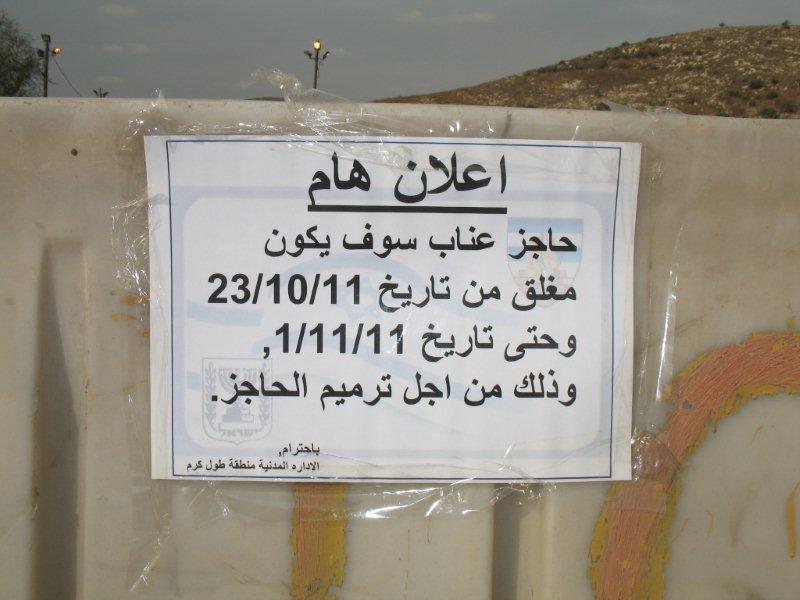 Oct-28-2011Anabta checkpoint 24.10.11
-
Beit Iba
See all reports for this place-
A perimeter checkpoint west of the city of Nablus. Operated from 2001 to 2009 as one of the four permanent checkpoints closing on Nablus: Beit Furik and Awarta to the east and Hawara to the south. A pedestrian-only checkpoint, where MachsomWatch volunteers were present daily for several hours in the morning and afternoon to document the thousands of Palestinians waiting for hours in long queues with no shelter in the heat or rain, to leave the district city for anywhere else in the West Bank. From March 2009, as part of the easing of the Palestinian movement in the West Bank, it was abolished, without a trace, and without any adverse change in the security situation.
 Jun-4-2014Beit-Iba checkpoint 22.04.04
-
Deir Sharaf checkpoint
See all reports for this place-
Deir Sharaf checkpoint is located west of Nablus and south of the settlement of Shavei Shomron, at the entrance to the village of Deir Sharaf on the road leading to Nablus. The checkpoint was activated in early March 2009 after the Beit Iba checkpoint was closed. Palestinians are allowed through the checkpoint , but not for Israelis. Unlike the checkpoints leading to Qalqilya and Tulkarm, crossing of Israeli Palestinians is only allowed on Saturdays.
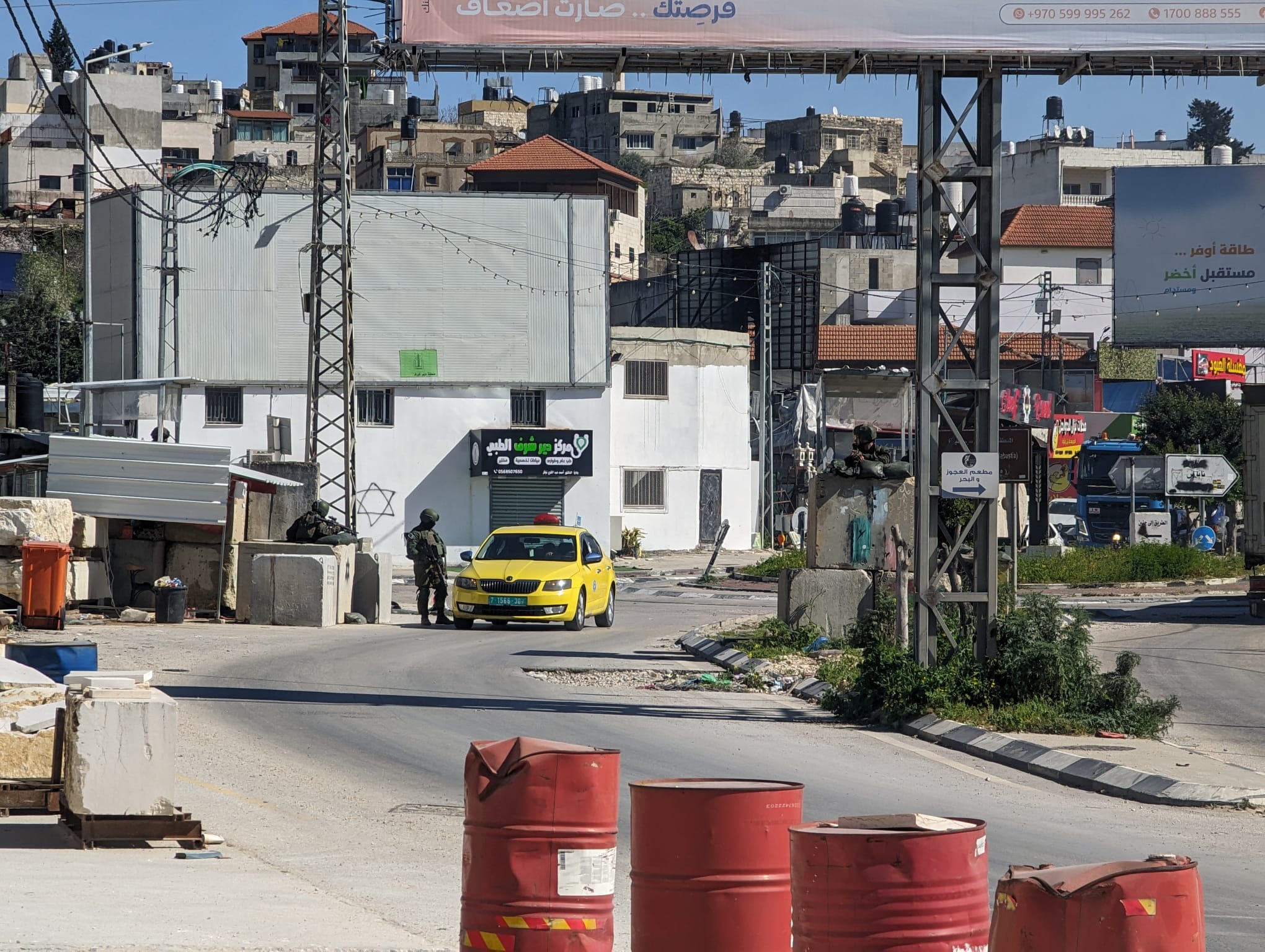 Nina SebaFeb-28-2024Deir Sharaf - the entrance to the village
-
Habla
See all reports for this place-
Habla CP (1393)
The Habla checkpoint (1393) was established on the lands of the residents of Qalqilya, on the short road that
connected it for centuries to the nearby town of Habla. The separation barrier intersects this road twice and cut off the residents of Qalqilya from their lands in the seam zone.(between the fence and the green line).
There is a passage under Road 55 that connects Qalqilya to the sabotage This agricultural barrier is used by the farmers and nursery owners established along Road 55 from the Green Line and on both sides of the kurkar road leading to the checkpoint.
This agricultural checkpoint serves the residents of Arab a-Ramadin al-Janoubi (detached from the West Bank), who pass through it to the West Bank and back to their homes. The opening hours (3 times a day) of this agricultural checkpoint are longer than usual, about an hour (recently shortened to 45 minutes), and are coordinated with the transportation hours of a-Ramadin children studying in the occupied in the West Bank.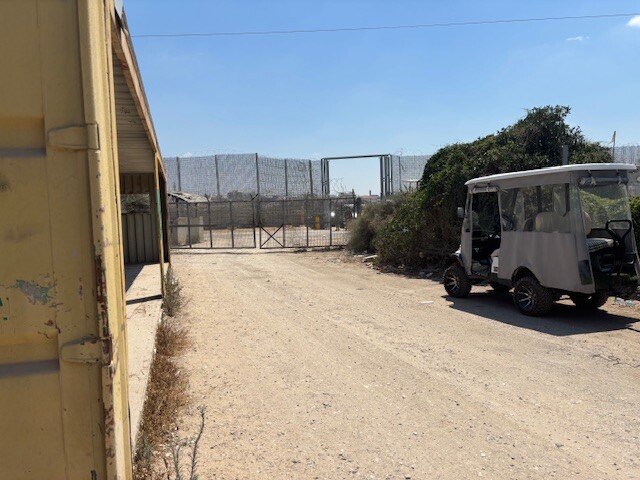 Nina SebaAug-18-2025Habla: The gate is in the process of closing
-
Irtah (Sha'ar Efrayim)
See all reports for this place-
The checkpoint is for Palestinians only. It is the main barrier to the passage of workers from the northern West Bank to Israel. Workers with a permit to work in Israel and also for trade (with appropriate permissions), medicine, and visiting prisoners. One can cross the checkpoint only on foot. The checkpoint is located north of Road 557 and south of Tulkarm. Operated by a civil security company, opening hours: between 4:00 and 19:00 on weekdays. As members of Machsom Watch, we began our shifts to this location in 2007. We arrived before it opened at 4 in the morning and report since, on the harsh conditions and the long and crowded queues of workers. The workers who pass by continue their journey by transportation to work throughout Israel. In the first period of its activity, about 3,000 and then 5,000 people passed through this checkpoint every day. Due to the small number of checking points and arbitrary delays for long periods of time in the "rooms", workers feared losing their transportation. Hence workers leave their homes at 2:30 at night to be among the first. Today, 15,000 pass and the transition is faster. Workers are still leaving their homes very early to get past the checkpoint at 7 p.m. In an adjacent compound, there is a terminal for the transfer of goods on a commercial scale, using the back-to-back method.
-
Jubara (Kafriat)
See all reports for this place-
The Jabra checkpoint was on Road 557, south of Tulkarm, on the side of the Figs Pass, which is located within the Palestinian Authority (a few kilometers east of the Green Line), and serves as an entry barrier from the territories to Israel. The checkpoint to the village of Jubara, which until 2013 was in the seam area, blocked and surrounded by a fence, was intended for the passage of the family members of the house next to the checkpoint, and also for the MachsomWatch volunteers (with special permission only), on their way to checkpoint 753. on the other side of the village. The soldiers supervising the "fig crossing" also supervised the crossing at this checkpoint, in our shifts we often waited a long time until the key was found and the gate opened. The checkpoint was abolished and became part of the separation fence that was moved west following the High Court.
-