
‘Anabta, Beit Iba, Eliyahu Crossing, Habla, Irtah (Sha’ar Efrayim), Jubara (Kafriat), Te’enim Crossing, Thu 8.7.10, Afternoon
13:00 Agricultural Gate Habla
According to past experience we took care to arrive at the time of the gate's opening. But the gate was locked. From a conversation with the people who were waiting in the shed (which was recently put up at the side of the road) it turned out that two weeks ago the times had been changed – now the gate is open from 14:00 to 15:00 and from 17:00 to 18:00. Although the change is for the better, it is very difficult to make a living when the time is measured so tightly. They would like the gate to be open during the entire day, from six in the morning to six in the evening. When we asked why they don't organize themselves, they reply: "We tried. But we didn't succeed". The corrugated iron shed does nothing towards relieving the July heat which, as is it's habit, weighs heavily in Palestine. It is therefore ununderstandable why the labourers arrived so early, if the new opening times are known to them.
Didn't they succeed in finding work? Is it possible that when the livelihood is unavailable, time loses its importance? Is it possible that compared to the daily hardships, sitting around idly in the heat of the day, doesn't make any difference? 13:25 Eliyahu CrossingGate 109
We arrived from road no. 55. The cars drive in both directions without hindrance. We pass Azzun – the road is free. 14:00 Al Funduq (in the garage)We arrived at Al Funduq to search for those who participated in the film "Area C" (the film was made by MachsomWatch activists). We wished to invite the participants for the screening of the film which will take place at the Tel Aviv cinematheque on the 30th of July. One must obtain for them in time the necessary authorizations and to arrange for transportation.
Abed (the brother of one of the participants) wishes to know whether one needs a "magnetic", how many people there will be at the cinametheque, what one has to do there. Apprehension and hesitation can be read in his eyes.A second garage worker tells us that he is prevented from coming. He is prevented from entering Israel for three years. He did indeed sit in prison, but not due to security reasons. At Al Funduq there is no work, he says.
The police arrives only to chase away Israeli drivers who come to repair their vehicle in the occupied territories. Whence shall his help come – he can't make a living in Israel and not where he lives. He asks for help. Karin gives him Silvia's phone number. We drive to see Beit Iba. There is no sign of the CP. 14:45 Anabta CP
The traffic flows. We continue to Irtah. At the turning to Enav – there is police. 15:00 Te'enim PassageKafriat
There is a long queue. An armed girl soldier. When we ask whether the Jubara gate would be opened for us, she answers: "I don't know whether the gate belongs to us." (what she probably means is that the doesn't know whether the gate is under her jurisdiction.) Now the armed girl soldier is busy. If we wait another five minutes she will find out whether there is a key. All around everything is calm, but still the military policeman says severely: "The commander now checks the event". We strain out eyes – lest there was something which we didn't manage to see. But no. It seems that our wish to visit Jubara – this is the event. We are asked to stop, here there and still again. A soldier asks for out IDs and immediately floods us with questions: "where do you come from ? where did you intend going? At what time did you enter road no. 55?" and in a more severe tone: "what are you writing?" (thoughts) "what did you do there? Who are you?" and now with raised voice: "what is this, MachsomWatch?" The soldier notes the ID numbers. He has difficulties deciphering our names. "what's you name?" he asks. We: " Does one takes the ID from everybody who wishes to visit Jubara?" The soldiers: "Every day. Every hour". We: "this was not done before". The soldiers: "there's always a first time!" (with such a determined declaration one can't argue). The ID haven't been returned yet.
Four soldiers, at least, try to find out whether is allowed to open the gate. We: "you told us to wait 5 minutes and in the meantime 20 minutes have gone by. We have no more time. Please find out". The armed girl soldier shouts: "we did all this for you. If you don't want it – ok, then leave it!" And indeed we had to waive the visit. We heard that yesterday there were difficulties at the Irtah crossing and we wanted to be there when we returned home. At the last minute we notice a settler bearing an orange poster, in which it says "Congratulation to Machsomwomen on their contribution to the terror organizations". 15:30 IrtahEfrayim Gate A civilian guard allows us to park at the parking lot (following a telephonic clarification). The labourers return without any checking, no checking at all – not a biometric one nor an identification by means of the magnetic card.
It turns out that the afternoon checking was cancelled.
The cancellation makes one wonder – after all the checking procedure was introduced not long ago. It seems that regulations and their cancellation in the occupied territories are a kind of whim. The labourers, as is their wont, greet us cheerfully. But more than one call out to us: "come in the morning. Balagan, balagan, balagan." __._,_._____,_._,___
'Anabta CP
See all reports for this place-
'Anabta CP
The checkpoint is located south of the village of 'Anabta, at the intersection of Road 60 (leading to Nablus at the entrance to Area A), with Road (57, 557, 5576) facing west towards the Einav settlement and the checkpoint at the exit from the West Bank - Figs checkpoint. Until 2010 we used to watch the intersection and report the long columns created due to a slow inspection of the vehicles in both directions.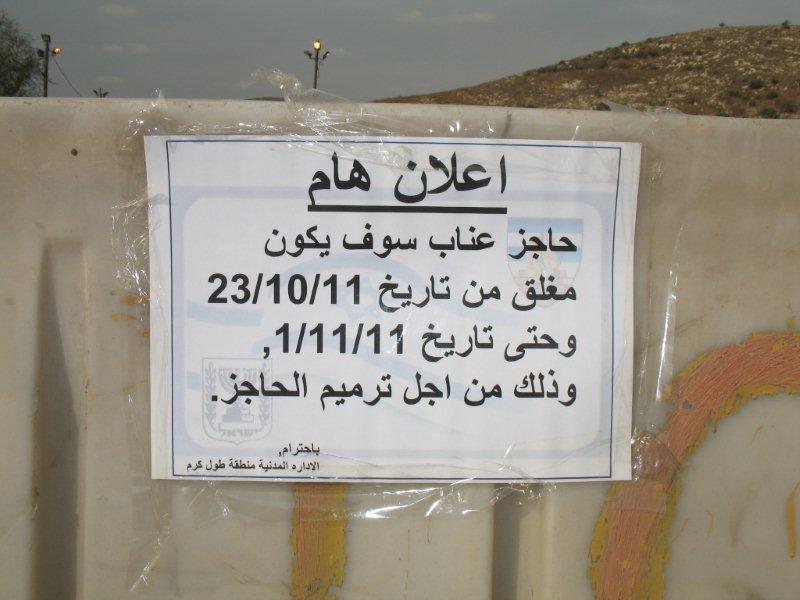 Oct-28-2011Anabta checkpoint 24.10.11
-
Beit Iba
See all reports for this place-
A perimeter checkpoint west of the city of Nablus. Operated from 2001 to 2009 as one of the four permanent checkpoints closing on Nablus: Beit Furik and Awarta to the east and Hawara to the south. A pedestrian-only checkpoint, where MachsomWatch volunteers were present daily for several hours in the morning and afternoon to document the thousands of Palestinians waiting for hours in long queues with no shelter in the heat or rain, to leave the district city for anywhere else in the West Bank. From March 2009, as part of the easing of the Palestinian movement in the West Bank, it was abolished, without a trace, and without any adverse change in the security situation.
 Jun-4-2014Beit-Iba checkpoint 22.04.04
-
Eliyahu CP (109) / Crossing
See all reports for this place-
Eliyahu CP (109) / Crossing This checkpoint, also known as the Fruit Crossing, is one of the main checkpoints between Israel and the West Bank. It is located on Route 55 between Alfei Menashe and the turn to Qalqilya and Zufin, more than 4 km east of the Green Line, in the separation fence, which separates Qalqilya from its lands to the south, thus leaving Alfei Menashe West of the fence - the Seam Zone. This checkpoint, a few kilometers across the Green Line, is intended for "Israeli settlement in the West Bank and the population of the Seam Zone." It is managed by a civil company. Palestinians with a special permit for their lands in the seam area are also allowed to pass through it, on foot, and sometimes by car.
-
Habla
See all reports for this place-
Habla CP (1393)
The Habla checkpoint (1393) was established on the lands of the residents of Qalqilya, on the short road that
connected it for centuries to the nearby town of Habla. The separation barrier intersects this road twice and cut off the residents of Qalqilya from their lands in the seam zone.(between the fence and the green line).
There is a passage under Road 55 that connects Qalqilya to the sabotage This agricultural barrier is used by the farmers and nursery owners established along Road 55 from the Green Line and on both sides of the kurkar road leading to the checkpoint.
This agricultural checkpoint serves the residents of Arab a-Ramadin al-Janoubi (detached from the West Bank), who pass through it to the West Bank and back to their homes. The opening hours (3 times a day) of this agricultural checkpoint are longer than usual, about an hour (recently shortened to 45 minutes), and are coordinated with the transportation hours of a-Ramadin children studying in the occupied in the West Bank.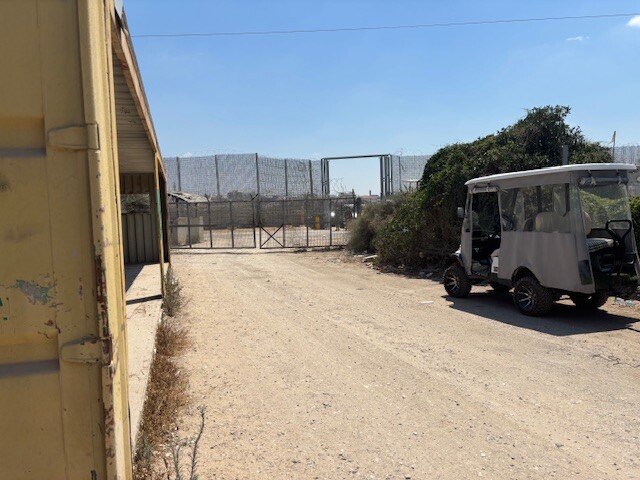 Nina SebaAug-18-2025Habla: The gate is in the process of closing
-
Irtah (Sha'ar Efrayim)
See all reports for this place-
The checkpoint is for Palestinians only. It is the main barrier to the passage of workers from the northern West Bank to Israel. Workers with a permit to work in Israel and also for trade (with appropriate permissions), medicine, and visiting prisoners. One can cross the checkpoint only on foot. The checkpoint is located north of Road 557 and south of Tulkarm. Operated by a civil security company, opening hours: between 4:00 and 19:00 on weekdays. As members of Machsom Watch, we began our shifts to this location in 2007. We arrived before it opened at 4 in the morning and report since, on the harsh conditions and the long and crowded queues of workers. The workers who pass by continue their journey by transportation to work throughout Israel. In the first period of its activity, about 3,000 and then 5,000 people passed through this checkpoint every day. Due to the small number of checking points and arbitrary delays for long periods of time in the "rooms", workers feared losing their transportation. Hence workers leave their homes at 2:30 at night to be among the first. Today, 15,000 pass and the transition is faster. Workers are still leaving their homes very early to get past the checkpoint at 7 p.m. In an adjacent compound, there is a terminal for the transfer of goods on a commercial scale, using the back-to-back method.
-
Jubara (Kafriat)
See all reports for this place-
The Jabra checkpoint was on Road 557, south of Tulkarm, on the side of the Figs Pass, which is located within the Palestinian Authority (a few kilometers east of the Green Line), and serves as an entry barrier from the territories to Israel. The checkpoint to the village of Jubara, which until 2013 was in the seam area, blocked and surrounded by a fence, was intended for the passage of the family members of the house next to the checkpoint, and also for the MachsomWatch volunteers (with special permission only), on their way to checkpoint 753. on the other side of the village. The soldiers supervising the "fig crossing" also supervised the crossing at this checkpoint, in our shifts we often waited a long time until the key was found and the gate opened. The checkpoint was abolished and became part of the separation fence that was moved west following the High Court.
-
Te'enim Crossing
See all reports for this place-
Te'enim Crossing The Figs checkpoint, located on Road 557, east of the Green Line and the Ephraim Checkpoint (Road 444), is a vehicle crossing, open 24/7 all year round. It serves the Israeli population, including those authorized to enter the Palestinian Authority. The passage of foreigners holding international passports recognized by the State of Israel is approved. In exceptional cases will the passage of a Palestinian be allowed here.
-