
‘Anabta, Deir Sharaf, Eliyahu Crossing, Habla, Jubara (Kafriat), Sun 23.10.11, Afternoon
Summary
The turmoil created by the “Arab spring” revolutions may have affected people here, not so its politicians who haven't changed the strategic equation and continue with occupation and settlement building in a language that is, frankly, just stuck in the past. The celebrations on both sides of the divide in the prisoner swap between Israel and Hamas last week freed more than 1,000 prisoners, including Gilad Shalit, and came about through the vox populi, not the vox dei. And what about the situation in the OPT as observed today: more of the same, none of the good, plenty of the bad and the ugly.
12:30 Habla
A magnificent lesson on what goes on for the long time inhabitants of Qalqiliya and today’s dire life in the Seam Zone, complete with map. The effect of the “girls” (that’s us, MachsomWatch women) on the overall perception Palestinians today have of Israelis – all for the edification of a newcomer. We are called something like “angels of mercy,” but that’s mainly thanks to the women who work with Menuei Shabak and Menuei Mishtara: “they work as if pouring water over hot coals.”
13:10 Gate 1392
We arrive late because of the above session. Six people wait on our side of the Separation Barrier, and it’s clear that this is one of those extra slow days which seem to typify guarding this checkpoint. Nothing moves, and then we begin to understand that the five Palestinians who are called at any one time to be checked inside the concrete house come in as a group and exit also as a group.
13:15 – a Hummer arrives, followed by a jeep as the Hummer soon drives off into the distance. The soldiers’ shift, twenty minutes late, is now complete, but this does nothing to speed the checking.
13:23 – the elementary schoolchildren’s bus has been waiting for nearly half an hour, and it waits some more as the commander, a reservist, confers in the middle of the Separation Barrier with another soldier (also a reservist). Two soldiers, plus the usual woman Military Police enter the bus.
Eliahu Gateway/Gate 109
For us no problem as we are made to cross the obstacle course to get to blue Police and Border Police who sit, waiting for what, on the ground. But at Gate 109, on the far side of the so-called gateway, stand two Palestinian buses, with nobody inside. Palestinians are certainly being checked in the newly expanded and improved checking facility there. In the mornings, Gate 109 continues to be a terrible place for Palestinians who have permits to go to the Seam Zone. Often, if they arrive at 7:00, they don’t get out until 9:30, and the kinds of demeaning behaviors they are subjected to remind us of the worst days at Huwarra or Beit Iba, being forced to undress, subjected to uncouth behaviors of women soldiers, etc. All this seems to have started here at Gate 109 since its privatization.
Route 55
It’s quiet today, little traffic, as if everybody, including in the Occupied Palestinian Territories, had had enough of the endless festivals in Israel proper.
Deir Sharaf
Another disastrous year for the olive harvest.
14:50 Anabta
The checkpoint is closed, a row of concrete boulders stands across the narrowest part of the access point. Parallel to the boulders is an army jeep. The soldiers never get out. They watch the endless stream of semi-trailers, cars, trucks, etc., approach the checkpoint, and then watch them maneuver, with difficulty, to turn around. We see one car valiantly clamber up the steep IDF-made mound having found a way to circumvent this latest obstacle in the daily life of a Palestinian. Later, during our watch, a few brave cars, all without four-wheel drive, make their way down this huge mound, into the dust-filled dirt path to make their way to where they want or need to go. Of course, no signs announcing that the checkpoint is closed today as there are roadworks beyond, or so we are told. No, let them come up to the concrete boulders, and let them do what they will. Not a concern for the army of occupation.
We have time to study the junction itself and the signs on it. One, in particular, takes our fancy, or at least draws attention to itself. In bright, glowing colors, on the background of a photo of the beautiful Roman ruins at Sebastia, near Nablus, (which we are forbidden to visit, in spite of their fame and beauty) the “next festival of Samaria in Sebastia” is announced for Sukkot (the just passed Jewish festival) on 17.10.11. Once again, the settlers are more equal than all others.
15:15 Jubara
A soldier there asks where we’ve been shopping, but the name of Habla means not a thing to him, nor does that of MachsomWatch!
'Anabta CP
See all reports for this place-
'Anabta CP
The checkpoint is located south of the village of 'Anabta, at the intersection of Road 60 (leading to Nablus at the entrance to Area A), with Road (57, 557, 5576) facing west towards the Einav settlement and the checkpoint at the exit from the West Bank - Figs checkpoint. Until 2010 we used to watch the intersection and report the long columns created due to a slow inspection of the vehicles in both directions.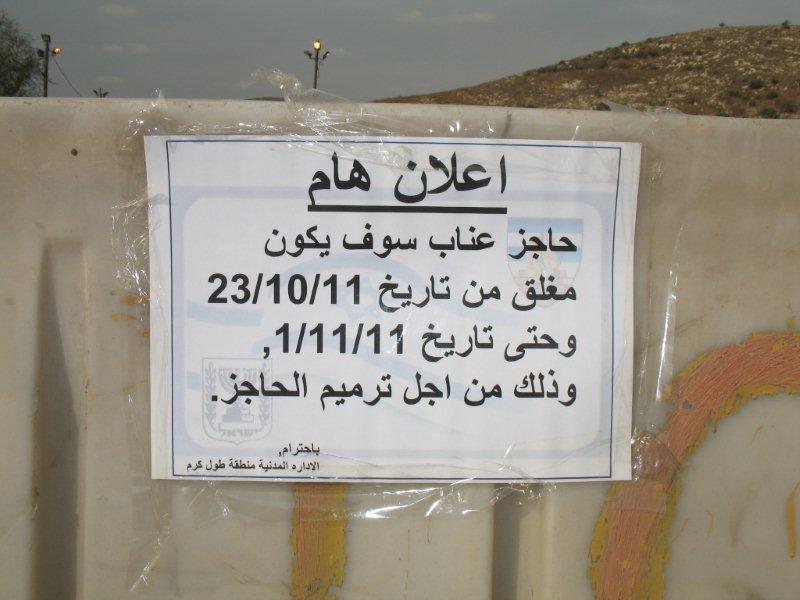 Oct-28-2011Anabta checkpoint 24.10.11
-
Deir Sharaf checkpoint
See all reports for this place-
Deir Sharaf checkpoint is located west of Nablus and south of the settlement of Shavei Shomron, at the entrance to the village of Deir Sharaf on the road leading to Nablus. The checkpoint was activated in early March 2009 after the Beit Iba checkpoint was closed. Palestinians are allowed through the checkpoint , but not for Israelis. Unlike the checkpoints leading to Qalqilya and Tulkarm, crossing of Israeli Palestinians is only allowed on Saturdays.
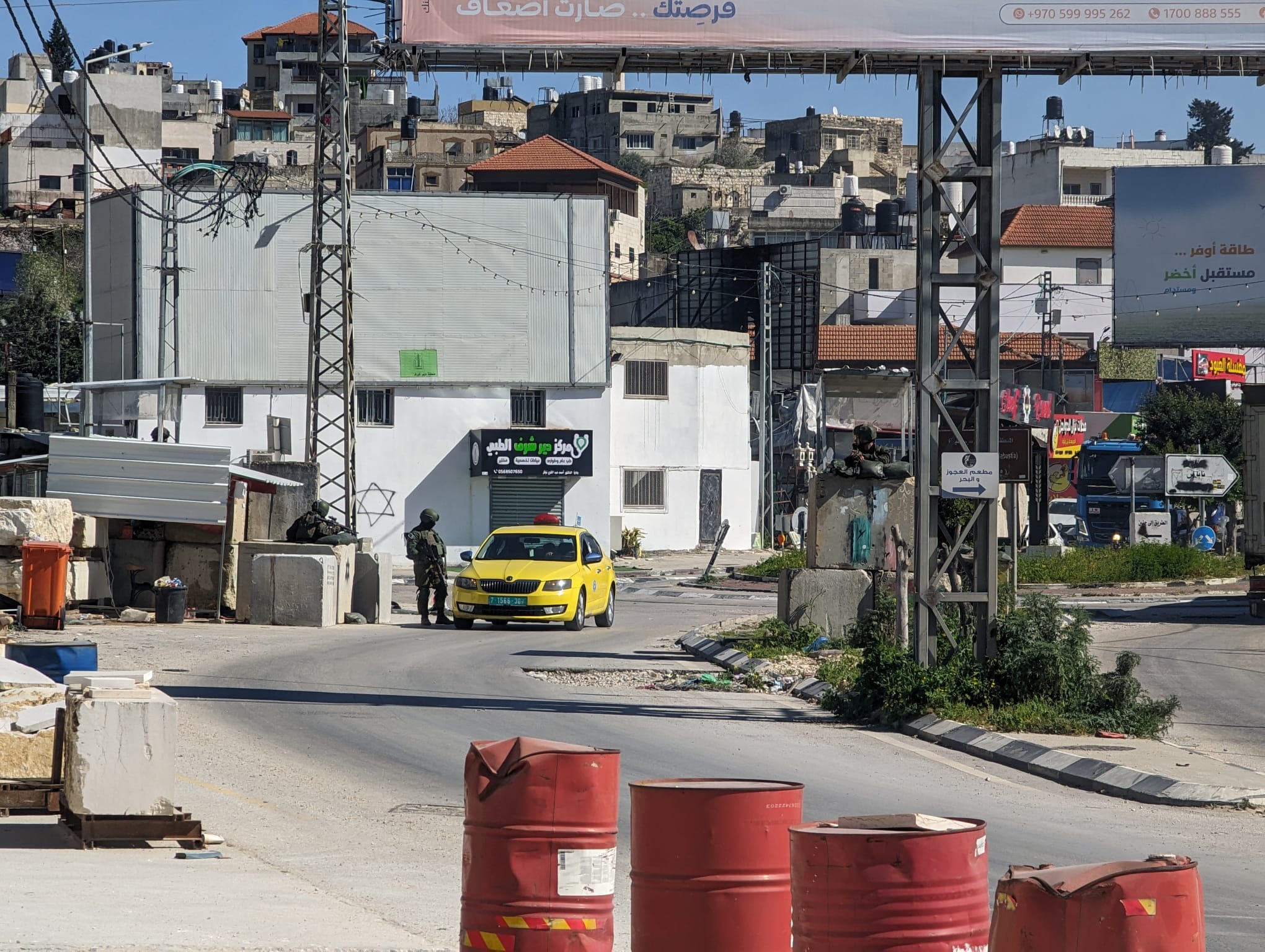 Nina SebaFeb-28-2024Deir Sharaf - the entrance to the village
-
Eliyahu CP (109) / Crossing
See all reports for this place-
Eliyahu CP (109) / Crossing This checkpoint, also known as the Fruit Crossing, is one of the main checkpoints between Israel and the West Bank. It is located on Route 55 between Alfei Menashe and the turn to Qalqilya and Zufin, more than 4 km east of the Green Line, in the separation fence, which separates Qalqilya from its lands to the south, thus leaving Alfei Menashe West of the fence - the Seam Zone. This checkpoint, a few kilometers across the Green Line, is intended for "Israeli settlement in the West Bank and the population of the Seam Zone." It is managed by a civil company. Palestinians with a special permit for their lands in the seam area are also allowed to pass through it, on foot, and sometimes by car.
-
Habla
See all reports for this place-
Habla CP (1393)
The Habla checkpoint (1393) was established on the lands of the residents of Qalqilya, on the short road that
connected it for centuries to the nearby town of Habla. The separation barrier intersects this road twice and cut off the residents of Qalqilya from their lands in the seam zone.(between the fence and the green line).
There is a passage under Road 55 that connects Qalqilya to the sabotage This agricultural barrier is used by the farmers and nursery owners established along Road 55 from the Green Line and on both sides of the kurkar road leading to the checkpoint.
This agricultural checkpoint serves the residents of Arab a-Ramadin al-Janoubi (detached from the West Bank), who pass through it to the West Bank and back to their homes. The opening hours (3 times a day) of this agricultural checkpoint are longer than usual, about an hour (recently shortened to 45 minutes), and are coordinated with the transportation hours of a-Ramadin children studying in the occupied in the West Bank.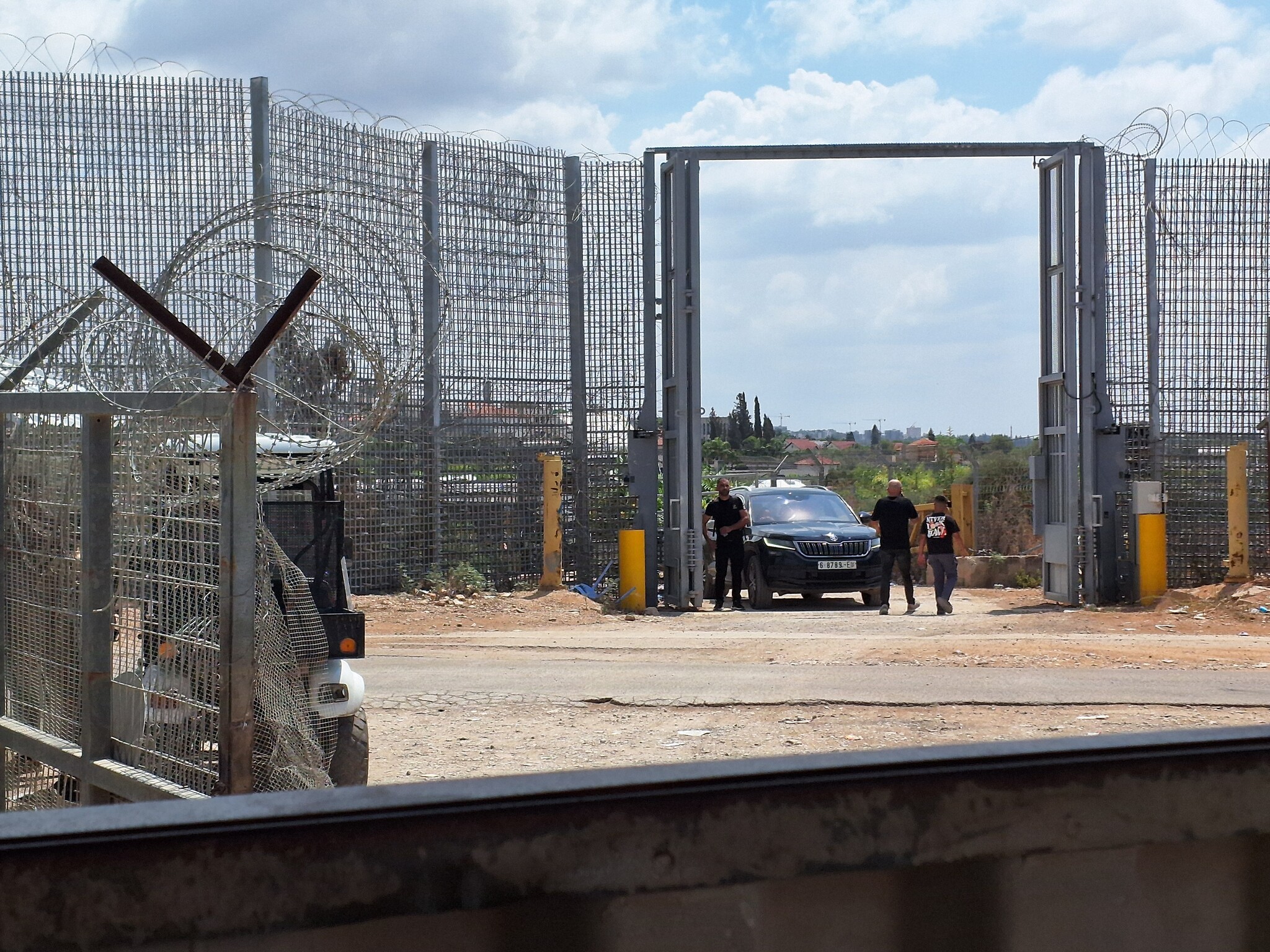 Ronit Dahan-RamatiAug-31-2026Habla. The gate is open
-
Jubara (Kafriat)
See all reports for this place-
The Jabra checkpoint was on Road 557, south of Tulkarm, on the side of the Figs Pass, which is located within the Palestinian Authority (a few kilometers east of the Green Line), and serves as an entry barrier from the territories to Israel. The checkpoint to the village of Jubara, which until 2013 was in the seam area, blocked and surrounded by a fence, was intended for the passage of the family members of the house next to the checkpoint, and also for the MachsomWatch volunteers (with special permission only), on their way to checkpoint 753. on the other side of the village. The soldiers supervising the "fig crossing" also supervised the crossing at this checkpoint, in our shifts we often waited a long time until the key was found and the gate opened. The checkpoint was abolished and became part of the separation fence that was moved west following the High Court.
-
