
‘Anabta, Deir Sharaf, Eliyahu Crossing, Habla, Jubara (Kafriat), Sun 30.10.11, Afternoon
Summary
A day after the autumn social protest demonstration calling for “fairer treatment” of Israelis, our shift goes, as usual to the Seam Zone and into Palestine. True, MachsomWatch deals with violation of Palestinian human rights, but week in, week out, we see, even if we don’t monitor and report, the victims of Israel’s growing ethnocentrism, its Palestinian citizens, whose civic rights are sorely abused at the “gateways” to the OPT, at Jubara, Eliahu Crossing or Shomron Crossing in the central area: the confrontational or sullen and surly checking by the army or private security personnel reflect the worsening situation for a large percentage of Israel’s population, part of the continuing denial that all relates and is connected to the Occupation. Over the years of monitoring, it’s often struck us that harassment coupled with humiliation have been and still are the most powerful weapons of occupation, and sometimes MachsomWatch is subjected to the same – one way to keep our antenna attuned to the far greater sufferings endured by Palestinians.
13:00 Habla
There are soldiers, more than half a dozen hanging around the Separation Barrier, showing no interest in opening any of the many gates that make up this checkpoint. Bicycles, young men without bicycles, older men with horse carts – all wait patiently as nothing happens.
13:15 – the seven soldiers present clamber aboard the stationary jeep which speeds off into the distance – and then there were none except one standing guard(?) in the concrete position just by the gate on our side. As is usual, the long-suffering Palestinians wait some more. We call the DCO office. Just then, from our side of the Separation Barrier, a jeep comes up to the locked gate, which is opened for it. We have to wonder if we’re not all actors in some strange theatrical farce. The jeep bears the commander who sets about opening all the gates. No, not all, for, during this shift, the far gate remains closed all the time and must be opened each time a vehicle or a human being wish to enter….
13:20 – on our side, a Palestinian asks the commander if he may go across, or go to the concrete house for his credentials to be checked. “Not yet” is the laconic answer. The full complement of soldiers is now present, and the painter, an inhabitant of Habla, whom we know well, asks if he may carry across the Separation Barrier something (we can’t hear what) that is not permitted. “No way” is the straight answer he receives. “All I did was to ask” he adds.
13:25 – the by now well known cry of “Five at a time” is called out by the commander. The bus with the elementary schoolchildren makes its way across, carrying them home. Again they have waited since before 13:00. We ask why it’s so slow today. “That’s just the way it is” is his rude response. As to why the checkpoint is opened 20 minutes late, instead of at 13:00, he responds in an equally offensive manner, “The army has its reason” or some such ridiculous saying.
13:27 – the DCO calls to see if the checkpoint is open by now but that’s it, no chance for us to add anything else.
13:30 – the commander calls over to a soldier at the far side of the Separation Barrier to open the gate there, and it’s again closed at the whim of the commander.
13:35 – two men arrive on our side of the Barrier, and the three soldiers, including the commander, let them wait as they huddle in the center and talk and talk some more. It sure looks as if they pretend nobody is there. And that, in fact, is the case, for after all to this army of occupation, the Palestinians are “nobody.”
13:45 – the larger green school bus waits on the far side of the Separation Barrier. When the gate is opened, its baggage doors are opened wide, and the soldiers painstakingly examine the inside of the bus.
13:50 – a waiting Palestinian lifts back part of the half opened gate on our side, to help the large bus get through, and is scolded, with a finger, by a soldier. As usual, the girls in the bus wave wildly as they pass by us.
13:55 – the woman from Ras Atiya who works in Israel proper arrives, bearing a huge, heavy sack and other packages. She is cheerful, as always, stops to chat, then struggles to go to the concrete house to be checked. Surprise, surprise, the commander offers to help and takes the heavy sack from her.
Deir Sharaf
Large infrastructure works on the road from Deir Sharaf to Beit Iba, and a longish traffic jam in which nobody honks or gets excited. We must be in Palestine!
16:00 Anabta
The checkpoint is closed, large piles of whitish stones on the sides of the road, not a soldier in sight, but nobody working either. On the concrete barrier across the roadway a sign, in Arabic, indicating that the checkpoint is closed from 23.10.11 until 1.11.11. Many vehicles, as last week, approach the checkpoint, few can see the small typed sign, and many make their way through the dirt path up to Ramin and from thence to Tulkarm.
16:10 Jubara
The female Military Police officer who inspects our IDs, while the soldiers burrow through the trunk of the car, refuses to let our foreign visitors into Israel proper as they are not carrying their visas with them, then indicates that she is the commander of this Crossing. Frequently, MachsomWatch visitors do not carry passports with them, and this is the first time that this has caused an incident, an ugly incident that shows the IDF in all its ugliness. There is a standoff, we are told to park our car far away from the checkpoint, refuse to do so, and although our lawyer is called, in the end we make our way back to the Eliahu Crossing, which, contrary to our expectations of the new private security company, checks neither IDs nor asks any questions but instead bids us goodspeed on our way home. Otherwise, there’s a strong taste of the Occupation which may well linger long after we return.
.
'Anabta CP
See all reports for this place-
'Anabta CP
The checkpoint is located south of the village of 'Anabta, at the intersection of Road 60 (leading to Nablus at the entrance to Area A), with Road (57, 557, 5576) facing west towards the Einav settlement and the checkpoint at the exit from the West Bank - Figs checkpoint. Until 2010 we used to watch the intersection and report the long columns created due to a slow inspection of the vehicles in both directions.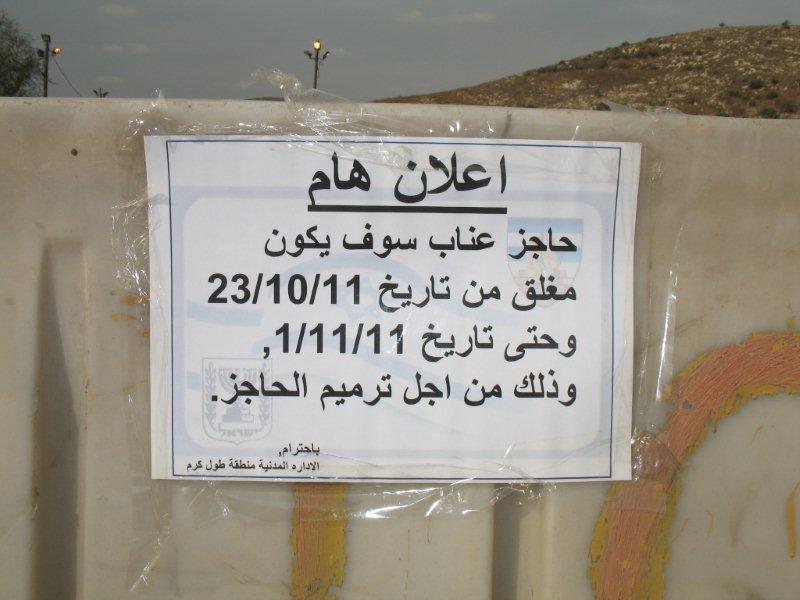 Oct-28-2011Anabta checkpoint 24.10.11
-
Deir Sharaf checkpoint
See all reports for this place-
Deir Sharaf checkpoint is located west of Nablus and south of the settlement of Shavei Shomron, at the entrance to the village of Deir Sharaf on the road leading to Nablus. The checkpoint was activated in early March 2009 after the Beit Iba checkpoint was closed. Palestinians are allowed through the checkpoint , but not for Israelis. Unlike the checkpoints leading to Qalqilya and Tulkarm, crossing of Israeli Palestinians is only allowed on Saturdays.
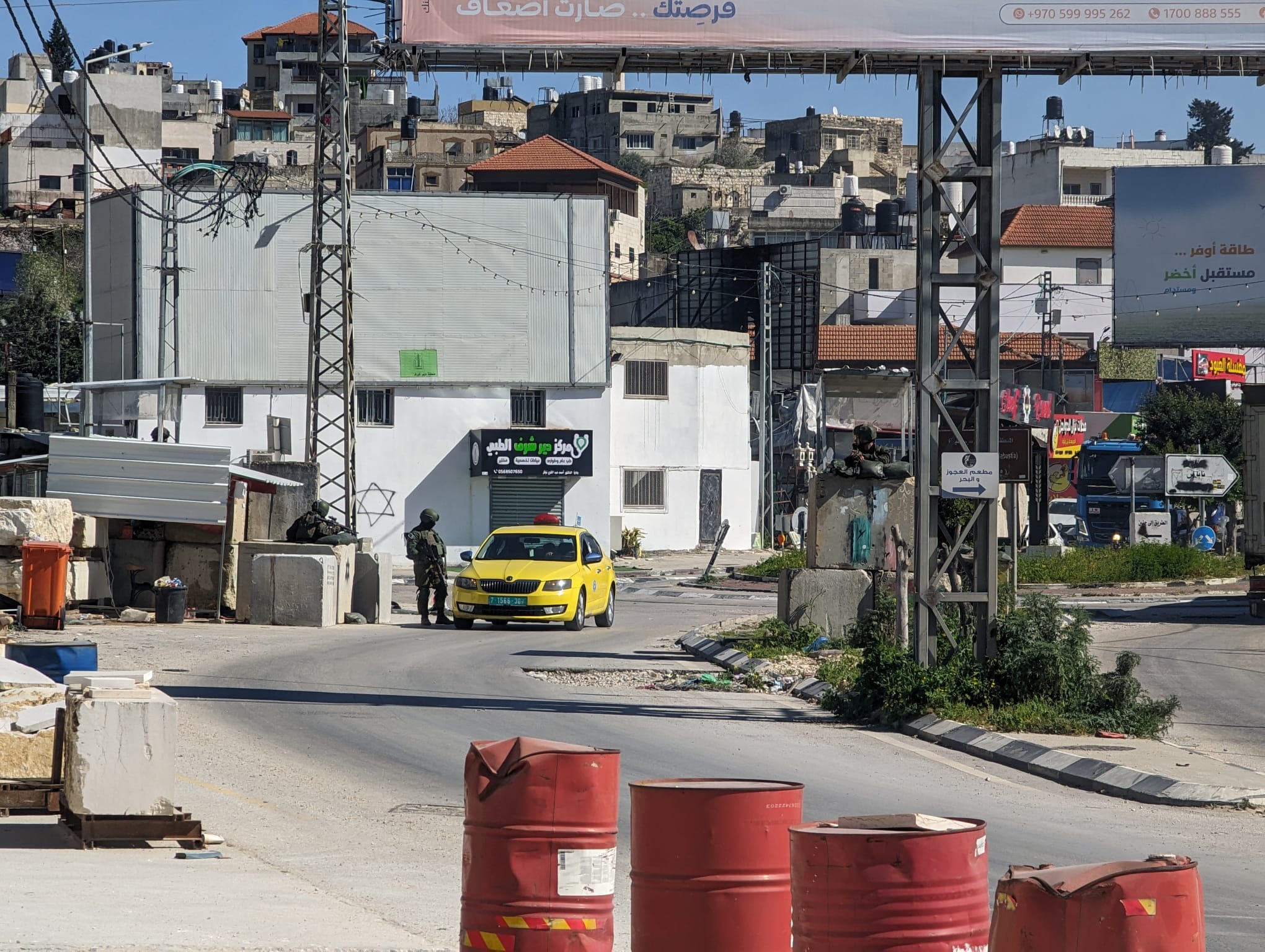 Nina SebaFeb-28-2024Deir Sharaf - the entrance to the village
-
Eliyahu CP (109) / Crossing
See all reports for this place-
Eliyahu CP (109) / Crossing This checkpoint, also known as the Fruit Crossing, is one of the main checkpoints between Israel and the West Bank. It is located on Route 55 between Alfei Menashe and the turn to Qalqilya and Zufin, more than 4 km east of the Green Line, in the separation fence, which separates Qalqilya from its lands to the south, thus leaving Alfei Menashe West of the fence - the Seam Zone. This checkpoint, a few kilometers across the Green Line, is intended for "Israeli settlement in the West Bank and the population of the Seam Zone." It is managed by a civil company. Palestinians with a special permit for their lands in the seam area are also allowed to pass through it, on foot, and sometimes by car.
-
Habla
See all reports for this place-
Habla CP (1393)
The Habla checkpoint (1393) was established on the lands of the residents of Qalqilya, on the short road that
connected it for centuries to the nearby town of Habla. The separation barrier intersects this road twice and cut off the residents of Qalqilya from their lands in the seam zone.(between the fence and the green line).
There is a passage under Road 55 that connects Qalqilya to the sabotage This agricultural barrier is used by the farmers and nursery owners established along Road 55 from the Green Line and on both sides of the kurkar road leading to the checkpoint.
This agricultural checkpoint serves the residents of Arab a-Ramadin al-Janoubi (detached from the West Bank), who pass through it to the West Bank and back to their homes. The opening hours (3 times a day) of this agricultural checkpoint are longer than usual, about an hour (recently shortened to 45 minutes), and are coordinated with the transportation hours of a-Ramadin children studying in the occupied in the West Bank.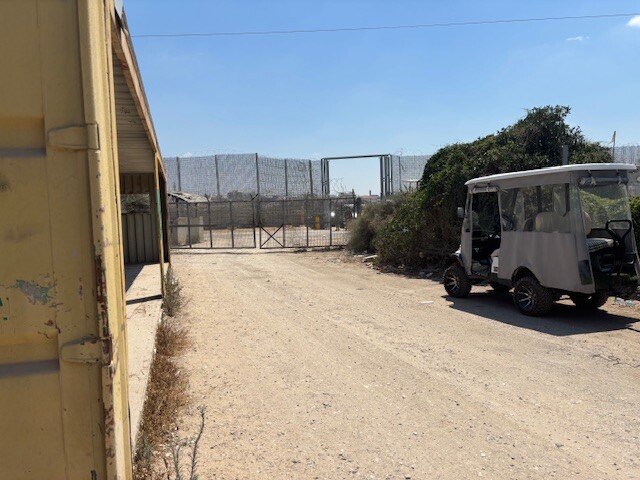 Nina SebaAug-18-2025Habla: The gate is in the process of closing
-
Jubara (Kafriat)
See all reports for this place-
The Jabra checkpoint was on Road 557, south of Tulkarm, on the side of the Figs Pass, which is located within the Palestinian Authority (a few kilometers east of the Green Line), and serves as an entry barrier from the territories to Israel. The checkpoint to the village of Jubara, which until 2013 was in the seam area, blocked and surrounded by a fence, was intended for the passage of the family members of the house next to the checkpoint, and also for the MachsomWatch volunteers (with special permission only), on their way to checkpoint 753. on the other side of the village. The soldiers supervising the "fig crossing" also supervised the crossing at this checkpoint, in our shifts we often waited a long time until the key was found and the gate opened. The checkpoint was abolished and became part of the separation fence that was moved west following the High Court.
-