
‘Anabta, Deir Sharaf, Eyal, Irtah (Sha’ar Efrayim), Qalqiliya, Sun 17.5.09, Afternoon
Summary
Today's Haaretz enlightens the Israeli public (and others) about what's going on in the Occupied Palestinian Territories: "New residents account for one-third of West Bank settlement growth." The newspaper says nothing, of course, about freedom of movement for the Palestinians, nor does it mention the 1500 settlers who were given permission to march to the evacuated settlement of Homesh last week, on Lag ba'Omer, 12.05.09. The settlers had full IDF backing and support. All we knew (or learned) is that there were garish fluorescent Hebrew signs in Deir Sharaf last week at the junction with Route 60, pointing in the direction of Homesh – but the women of MachsomWatch have no "freedom of movement" to go beyond the new checkpoint: settlers only. Beyond that, we MachsomWatchers are supposed to "bear witness," to speak or write about facts from direct knowledge. We are supposed to be "eyewitnesses," a role that is impossible to carry out at the so-called terminals.
11:55 Gate 1392-3 Habla
Young men from Qalqiliya can't use this gate since they have no permit: one just wants to receive, from the other side, a very un-agricultural looking envelope. Another young man is not allowed to cross with two plastic bags. Sure, says the soldier, he can cross, but not with the bags. They contain clothes and, horror of horrors, a charger for a mobile phone, "proving" to this army of Occupation that he is up to no good, wanting to "stay here" (meaning Israel, which these agricultural lands are not)! So what, as long as the Occupation is making life more miserable for people, what more can one ask.
12:05 — a pickup truck carrying pale green evergreens. The soldier asks where is the man's nursery. He waves behind him (there are more than a few in this Seam Zone)! The man's ID is taken, he waits for "approval."
12:10 — the tracker tractor arrives and ploughs its way along the separation barrier road, and there's more of the usual traffic – horses and carts, another truck with young saplings. Life goes on….
At the greengrocer whom we frequent, we find there are no local eggs: a new rule, he tells us. Eggs are not allowed to cross the separation barrier (maybe a similarity to Gaza where only 30-40 commercial items are allowed into Gaza, compared to 4000 since the closure). The greengrocer is quick to point out that it's not the fault of the soldiers stationed at the gate but of the "higher ups."
Along route 55:
Note 1: new Hebrew signs outside the colonies of Qarnei Shomron, on the road leading across country, south, to Ariel, and at Qedumim: "Seminar on the story of every Jew in Judea and Samaria." But we can't tell whether this is an informal gathering on this subject or whether these colonies already have "teacher training colleges" expounding so-called facts.
Note 2: On the south side of Qedumim, a new house is being built (on the day that Netanyahu is probably telling Obama that no such thing is happening in the West Bank)! On the opposite hill, the Israeli flag still flies, and there is some kind of underground or imitation Bedouin style existence, in Hebrew, certainly taking place
13:10 Deir Sharaf
A lot of fast moving Palestinian vehicles, mainly private cars and taxis, on their way to Nablus. From Nablus, every second or third vehicle is made to stop by the two soldiers standing at the bedraggled flag bedecked position on the north side of the roadway. IDs, we can see from our far away vantage point, are taken by one soldier and perused, or called in: who knows? Three minutes of wasted time in a journey for the many passengers inside. Two Israeli SUVs are sent back: they cannot go further today, as it's Sunday, not a day where Palestinian Israelis are allowed into Nablus.
13:30 Anabta
Single file Indian style is the norm here today. Happily, there aren't many vehicles on this extremely hot day. The work seems to be progressing slowly, oh so slowly, at this about to be bigger and better checkpoint. Meanwhile, the inconveniences for drivers from Tulkarm or those wishing to go to the city are part and parcel of Occupation. One side has to wait as the vehicles in the opposite direction make their meandering way along the in process checkpoint. Happily, never more than six or seven in either direction.
13:45 Irtah (Sha'ar Efrayim)
We stand outside the wire fence and listen to Palestinians, standing inside one of the series of turnstiles needing to be negotiated, even before human, or so-called humans, are met inside the building (access to us forbidden). Several men call out to us that they have been here for several (three) hours, trying to get inside to receive a renewal to their magnetic cards at the DCL office in the "terminal" building. Nothing has moved, nothing happens, and it's very, very hot.
We make phone calls and try to facilitate this horrible process. A loudspeaker shatters the stifling heat, a disembodied male voice, soldier or private security guard, who knows? The voice goes on and on in 1984 style: "There is no DCO here today, I don't know what to say to you…. the DCO is not here…." Finally, after five minutes of such earsplitting cacophony, he announces that "only entry to Israel" can be accepted. A couple of young men now break loose from the others waiting, still, for permission to enter the building to try to get new magnetic cards. "They will be let in… now it's full" is the response we get from a call to the DCL office. We relay this news to the waiting men.
A second phone call to the DCL office is responded to after thirty minutes, by which time we're at the "terminal" of Eyal outside Qalqiliya. "We let in 80 people a day. That's it." So, what are we, as monitors and observers of the scene, to make of this set of data which conflicts with that received, also from the DCL, a short while ago? Of course, it's all part of Occupation, but what kind of comfort is that to us, and even more important, to the Palestinians trying to eke out a living by trying to come to work, legally, in Israel?
What is in no doubt is that we are not monitoring anything, instead we are reporting hearsay and realize that this is what the Palestinians have to live with – day in , day out.
15:00 Eyal
The buses waiting for workers to emerge from the terminal wait patiently in the boiling sun as the filth around seems to become ever more permanent. Conversations with taxi drivers, waiting for rides, or conversations with a woman waiting for who knows what after treatment at Beilinson Hospital, tender us with what kind of information? It is not clear. What is certain is that we gather little from direct knowledge and a lot from hearsay.
'Anabta CP
See all reports for this place-
'Anabta CP
The checkpoint is located south of the village of 'Anabta, at the intersection of Road 60 (leading to Nablus at the entrance to Area A), with Road (57, 557, 5576) facing west towards the Einav settlement and the checkpoint at the exit from the West Bank - Figs checkpoint. Until 2010 we used to watch the intersection and report the long columns created due to a slow inspection of the vehicles in both directions.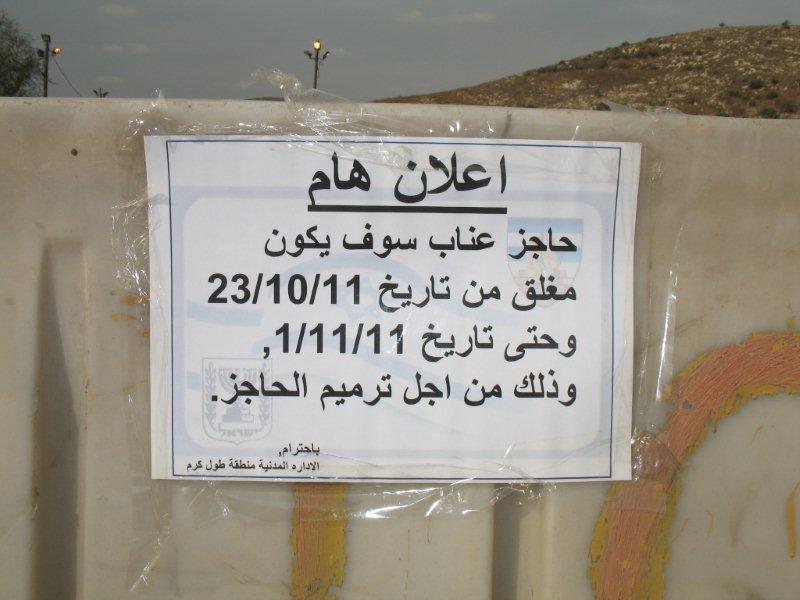 Oct-28-2011Anabta checkpoint 24.10.11
-
Deir Sharaf checkpoint
See all reports for this place-
Deir Sharaf checkpoint is located west of Nablus and south of the settlement of Shavei Shomron, at the entrance to the village of Deir Sharaf on the road leading to Nablus. The checkpoint was activated in early March 2009 after the Beit Iba checkpoint was closed. Palestinians are allowed through the checkpoint , but not for Israelis. Unlike the checkpoints leading to Qalqilya and Tulkarm, crossing of Israeli Palestinians is only allowed on Saturdays.
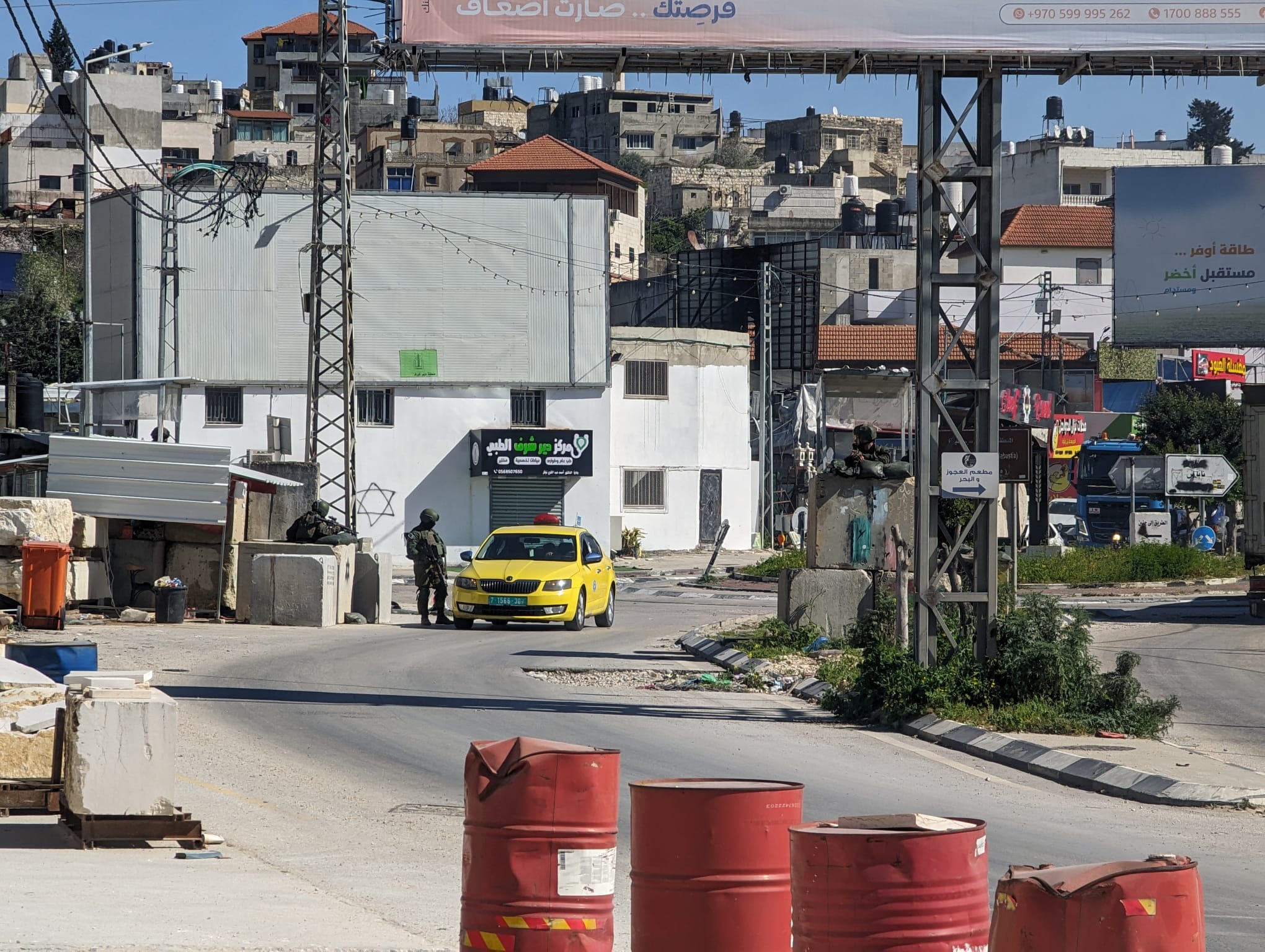 Nina SebaFeb-28-2024Deir Sharaf - the entrance to the village
-
Eyal Checkpoint / Crossing
See all reports for this place-
Eyal Checkpoint is intended for pedestrians and Palestinians only. This is the main barrier for workers to cross from the center of the West Bank. Workers with a work permit to enter Israel can pass through it for trade, medicine, and visiting prisoners. The checkpoint was built on the Green Line north of Qalqilya in the separation barrier that surrounds the city. The checkpoint began operating in 2004 by the military. Opening hours on weekdays from 04:00 to 19:00. We started holding shifts there in 2007. We arrived at the checkpoint before it opened at 4 in the morning. We reported on the difficult conditions and the long and cramped queues of workers who must continue their journey by commuting to work throughout Israel. At the end of June 2009, the checkpoint was operated by a civil security company, The transit time has been gradually shortened, today it is faster, but the Palestinians still have to arrive very early to make it to the transportation. Usually, about 15,000 people pass through.
-
Irtah (Sha'ar Efrayim)
See all reports for this place-
The checkpoint is for Palestinians only. It is the main barrier to the passage of workers from the northern West Bank to Israel. Workers with a permit to work in Israel and also for trade (with appropriate permissions), medicine, and visiting prisoners. One can cross the checkpoint only on foot. The checkpoint is located north of Road 557 and south of Tulkarm. Operated by a civil security company, opening hours: between 4:00 and 19:00 on weekdays. As members of Machsom Watch, we began our shifts to this location in 2007. We arrived before it opened at 4 in the morning and report since, on the harsh conditions and the long and crowded queues of workers. The workers who pass by continue their journey by transportation to work throughout Israel. In the first period of its activity, about 3,000 and then 5,000 people passed through this checkpoint every day. Due to the small number of checking points and arbitrary delays for long periods of time in the "rooms", workers feared losing their transportation. Hence workers leave their homes at 2:30 at night to be among the first. Today, 15,000 pass and the transition is faster. Workers are still leaving their homes very early to get past the checkpoint at 7 p.m. In an adjacent compound, there is a terminal for the transfer of goods on a commercial scale, using the back-to-back method.
-
Qalqiliya checkpoint
See all reports for this place-
Qalqilya is surrounded on all sides by the separation barrier. The only exit from the city is in the east of the city on the road that leaves the city in an easterly direction. This is where the checkpoint was located. When the checkpoint was active until 2009 our shifts watched long queues of cars being inspected at the only exit from the city to the West Bank. The checkpoint was canceled, but there is a military presence at the entrance to the city.
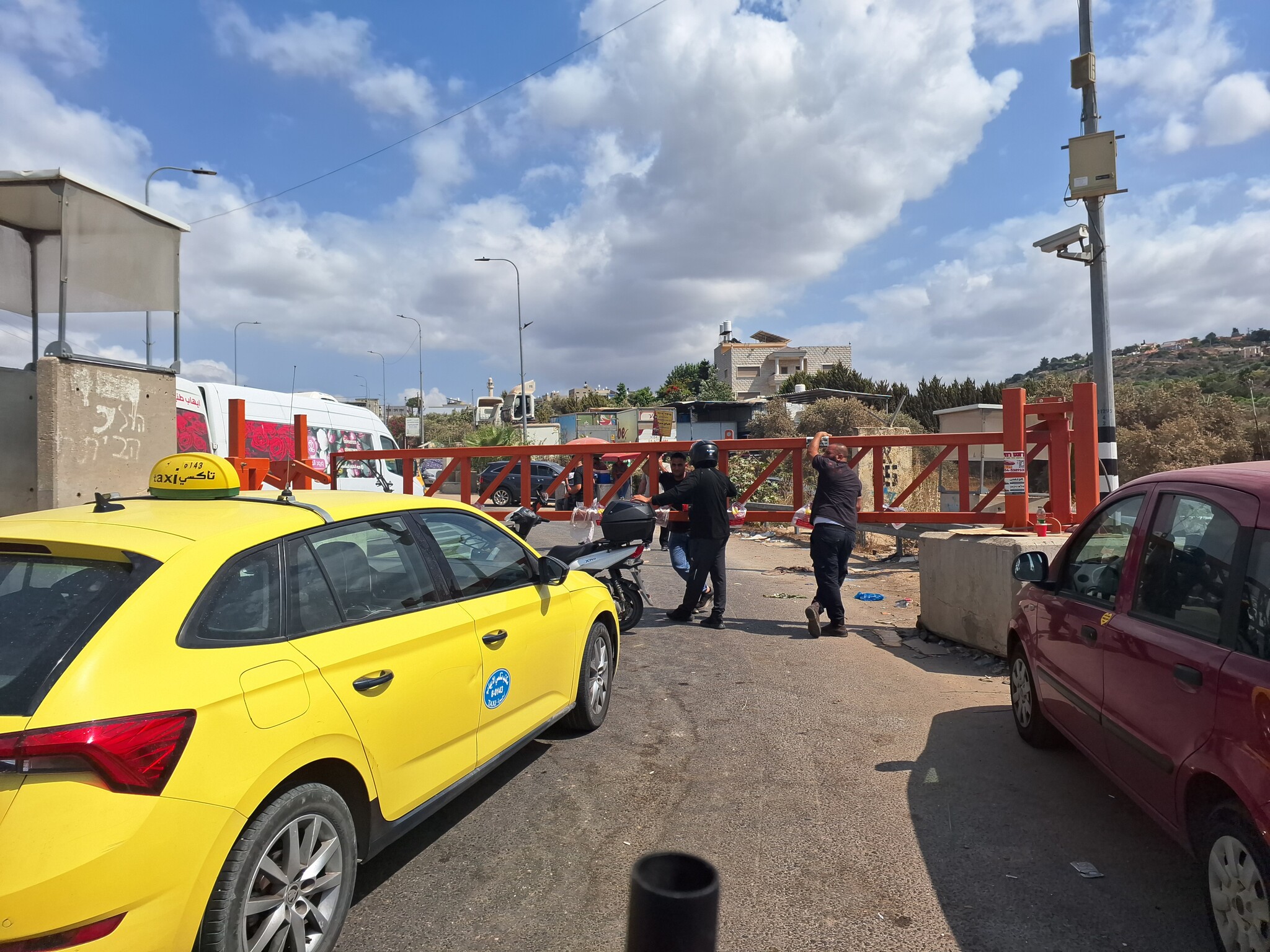 Ronit Dahan-RamatiAug-31-2026Nabi Elias. The gate is closed
-
