
‘Anabta, Deir Sharaf, Habla, Irtah (Sha’ar Efrayim), Jubara (Kafriat), Shave Shomron, Sun 31.10.10, Afternoon
Summary
Each week, OCHA (Office for the Coordination of Humanitarian Affairs – Occupied Palestinian Territories) issues a Protection of Civilians report — the facts, nothing but the facts — dry yet perturbing reading. Much of it we already know from our monitoring, but the detail, the numbers are particularly ugly when they stare into your face. “Settler violence continues unabated during the olive harvest,” 17 as opposed to 11 incidents the week before; search and arrest operations, 80; ten stop work orders in Area C. And so it goes. Occupation as the seasons roll round again and again. Settlers stealing olives, attacking Palestinians but no mention of the roll of the Civil Administration that does, or does not, permit Palestinians to get to their groves or prevents a day of olive picking for no reason at all: three out of four days, indicated on issued permits for Deir Sharaf residents to pick olives below the settlement of Shavei Shomron. The humiliation and harassment of the Occupation continue, season in, season out.
13:00-13:40 Habla Gate 1392
The gates open on time, and today they’re open wide, the usual array of donkey and horse drawn carts, big trucks, tractors, etc., waiting their turn on either side of the Separation Barrier as the soldiers – reservists –take their sweet time and often manage to find themselves in the middle of the Separation Barrier, doing nothing but talking to each other. The local greengrocer’s oldest son talks to a soldier, who clearly knows him, in fluent Hebrew, but a few minutes later, the former has to ask, sheepishly, “Is it ok to enter?” There’s nobody else in front of him, there’s no reason for him not to go on to the Separation Barrier, but long acquaintance with the ways of Occupation have made the young Palestinian wary, even of a soldier who appears to enjoy a casual conversation with him.
A Hummer arrives, revving its way nosily from where we stand to make a fancy turn about in the middle of the Separation Barrier, and then, it appears, delivers food and drink. The soldiers now stand and check Palestinians, or wave on vehicular traffic, or direct pedestrians to the concrete hut for checking with cold drinks (and, of course, guns in hand). Meanwhile, perched atop the other military vehicle already standing at the agricultural gate, are three soldiers, prettily arrayed on the hood, eating their lunch…..
13:30 — a white pickup, with no military markings at all, arrives and from it appears a captain, who shakes hands with all the soldiers, as we hear one of them saying, “It’s the Matak (officer from the Civil Administration’s DCO office). Having greeted all the soldiers, K., such is his name, comes over to us and chats. He agrees that the morning pressure is terrible at Gate 1392, pointing out that it’s especially bad on a Sunday morning. (MachsomWatch should be there then). Later, we hear from the nursery owner that this captain, unlike many of his peers in the DCO, spends a lot of time in the field and tries to understand what is going on, or, as K. told us, checks on the reservists who may not know what they should be doing.
As we leave, music belches out of the Hummer, where the soldiers who’ve finished eating seem ready to take a siesta….
14:55 Shavei Shomron
We don’t succeed in getting to the checkpoint on Route 60. There is a long line of Palestinian vehicles. In other words, a checkpoint, a working checkpoint, is alive and well once again in this part of the world. But one has to ask why. A checkpoint leading northwards to Jenin, past numerous Palestinian villages and, yes, of course, the disengaged settlement of Homesh beyond. Trouble afoot there? Who knows….
15:30 Anabta, not much traffic which flows freely
15:45 Jubara. After we’ve been asked where we live, “Shavei Shomron”? asks a soldier, and having received a firm negative, he calls over the commander, a young woman second lieutenant. Yes, a first. Never seen a woman in such a position in the IDF in all other years of monitoring with MachsomWatch. She, too, wants to know where we live and where we’ve been. Then opens the gate, and on we go to…
16:00 Irtah
Streams and steams of returning Palestinians cross the eternally too small turnstile, disappear into the bowels of the terminal, only to re-emerge quickly, on their way home. The cheeriness of the Palestinians, their warm greetings never cease to amaze us.
New signs, or new to us, adorn the terminal building and the fence at the Separation Barrier. Surely these signs are dedicated to MachsomWatchers: “Security facility. Photography prohibited.” So, a terminal building is made to sound like a prison… which makes us wonder if the “Welcome to Israel” signs are still posted inside, as they were when the building first opened.
'Anabta CP
See all reports for this place-
'Anabta CP
The checkpoint is located south of the village of 'Anabta, at the intersection of Road 60 (leading to Nablus at the entrance to Area A), with Road (57, 557, 5576) facing west towards the Einav settlement and the checkpoint at the exit from the West Bank - Figs checkpoint. Until 2010 we used to watch the intersection and report the long columns created due to a slow inspection of the vehicles in both directions.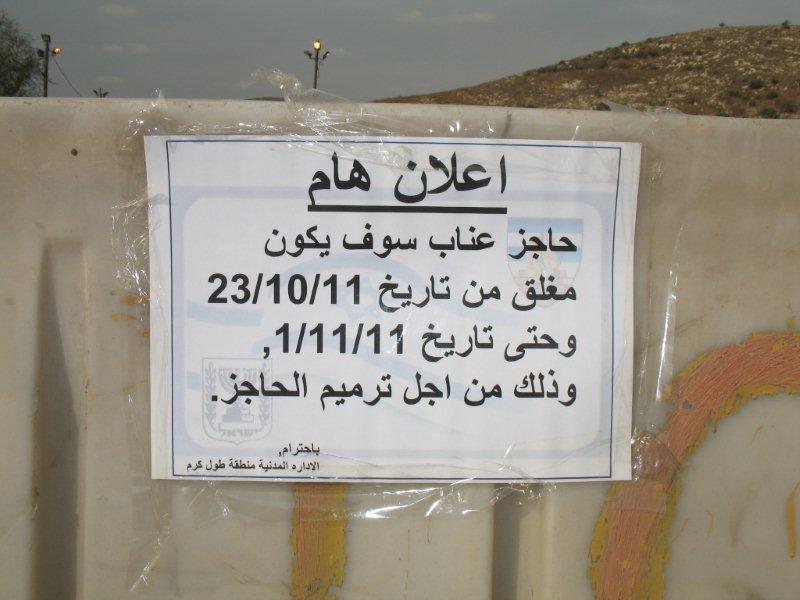 Oct-28-2011Anabta checkpoint 24.10.11
-
Deir Sharaf checkpoint
See all reports for this place-
Deir Sharaf checkpoint is located west of Nablus and south of the settlement of Shavei Shomron, at the entrance to the village of Deir Sharaf on the road leading to Nablus. The checkpoint was activated in early March 2009 after the Beit Iba checkpoint was closed. Palestinians are allowed through the checkpoint , but not for Israelis. Unlike the checkpoints leading to Qalqilya and Tulkarm, crossing of Israeli Palestinians is only allowed on Saturdays.
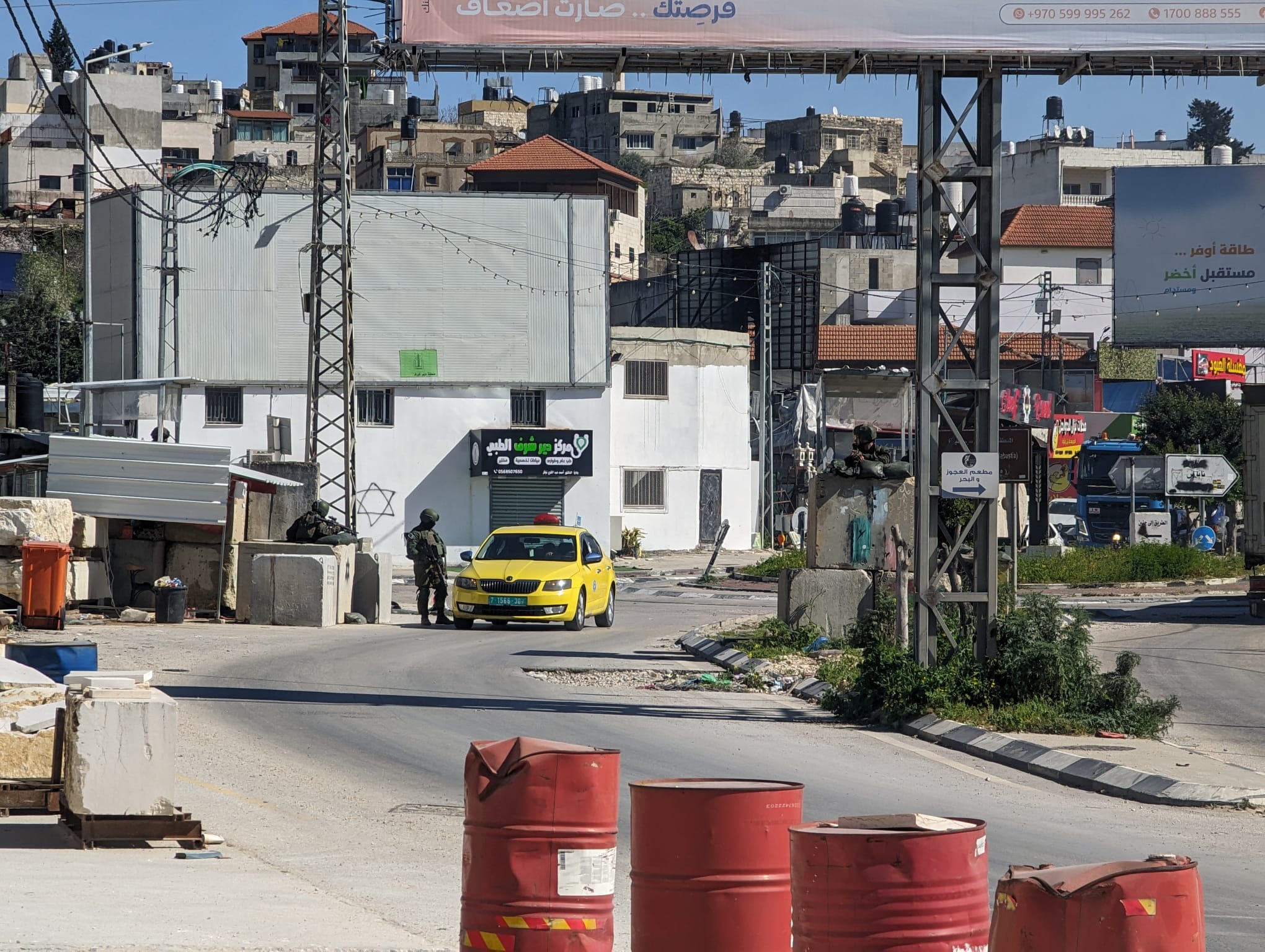 Nina SebaFeb-28-2024Deir Sharaf - the entrance to the village
-
Habla
See all reports for this place-
Habla CP (1393)
The Habla checkpoint (1393) was established on the lands of the residents of Qalqilya, on the short road that
connected it for centuries to the nearby town of Habla. The separation barrier intersects this road twice and cut off the residents of Qalqilya from their lands in the seam zone.(between the fence and the green line).
There is a passage under Road 55 that connects Qalqilya to the sabotage This agricultural barrier is used by the farmers and nursery owners established along Road 55 from the Green Line and on both sides of the kurkar road leading to the checkpoint.
This agricultural checkpoint serves the residents of Arab a-Ramadin al-Janoubi (detached from the West Bank), who pass through it to the West Bank and back to their homes. The opening hours (3 times a day) of this agricultural checkpoint are longer than usual, about an hour (recently shortened to 45 minutes), and are coordinated with the transportation hours of a-Ramadin children studying in the occupied in the West Bank.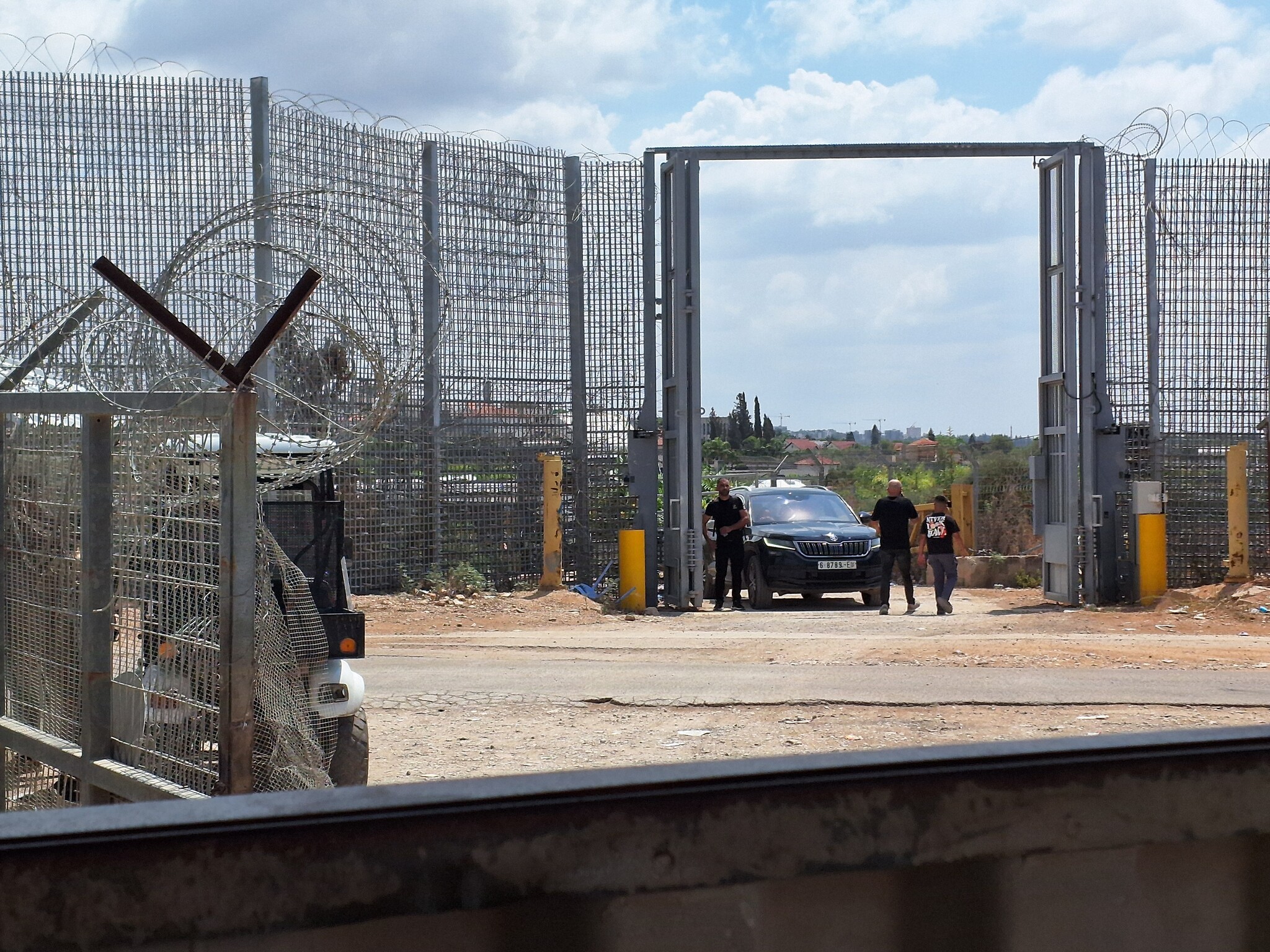 Ronit Dahan-RamatiAug-31-2026Habla. The gate is open
-
Irtah (Sha'ar Efrayim)
See all reports for this place-
The checkpoint is for Palestinians only. It is the main barrier to the passage of workers from the northern West Bank to Israel. Workers with a permit to work in Israel and also for trade (with appropriate permissions), medicine, and visiting prisoners. One can cross the checkpoint only on foot. The checkpoint is located north of Road 557 and south of Tulkarm. Operated by a civil security company, opening hours: between 4:00 and 19:00 on weekdays. As members of Machsom Watch, we began our shifts to this location in 2007. We arrived before it opened at 4 in the morning and report since, on the harsh conditions and the long and crowded queues of workers. The workers who pass by continue their journey by transportation to work throughout Israel. In the first period of its activity, about 3,000 and then 5,000 people passed through this checkpoint every day. Due to the small number of checking points and arbitrary delays for long periods of time in the "rooms", workers feared losing their transportation. Hence workers leave their homes at 2:30 at night to be among the first. Today, 15,000 pass and the transition is faster. Workers are still leaving their homes very early to get past the checkpoint at 7 p.m. In an adjacent compound, there is a terminal for the transfer of goods on a commercial scale, using the back-to-back method.
-
Jubara (Kafriat)
See all reports for this place-
The Jabra checkpoint was on Road 557, south of Tulkarm, on the side of the Figs Pass, which is located within the Palestinian Authority (a few kilometers east of the Green Line), and serves as an entry barrier from the territories to Israel. The checkpoint to the village of Jubara, which until 2013 was in the seam area, blocked and surrounded by a fence, was intended for the passage of the family members of the house next to the checkpoint, and also for the MachsomWatch volunteers (with special permission only), on their way to checkpoint 753. on the other side of the village. The soldiers supervising the "fig crossing" also supervised the crossing at this checkpoint, in our shifts we often waited a long time until the key was found and the gate opened. The checkpoint was abolished and became part of the separation fence that was moved west following the High Court.
-
Shave Shomron Checkpoint
See all reports for this place-
The checkpoint is on Route 60 (the main road to the northern West Bank), opposite settlement. Has been blocked to Palestinians since disengagement from Gaza and northern Samaria.
-
