
‘Anabta, Eliyahu Crossing, Habla, Jubara (Kafriat), Te’enim Crossing, Sun 12.9.10, Morning
Habla 06:45 – the main gate is still closed, maybe we were too early. 06:50 – the first 5 people leave the inspection. Behind the inner gate there are about 50 people waiting; less than usual. Every 5 minutes, another 5 people go through; we are thrown out of the main gate area and stand behind it.
Eliyahu crossing
07:30 There are no workers in the big cage. Israel has declared a "closure".
Jayyus
– 5 07:35tractors and a donkey with its rider are waiting. This is an opportunity to talk and ask questions. The Swiss ecumenical priest whom we have met in the past is there. One of the farmers tells us how permits are given to each family allowing a certain number to go out and work on their land. The teacher, Bassam, will leave tomorrow to go to work in his school but there won't be anyone to take his place on his land since no one else in his family received a permit. There are saws on the carts pulled behind the tractors. The ration of water allowed is so small that it is impossible to irrigate the citrus trees. They need the water for the vegetables, so they have to cut down the citrus.
Falamya
08:10 – A truck full of garbage is pulled by a tractor, but is not allowed through. It seems that its owner has a permit, but only to Jayyus, where the gate will close in another 5 minutes. The military policewoman surprises us with her desire to help and suggests telephoning the officer in charge to ask for a special one time gesture to let him through. However, it then turns out that his permit is not for a tractor. The soldier claims that they don't usually check this detail, but the military police do. Meanwhile, after he has given up the possibility of passing through, he called his son, who has a permit to Falamya, asking him to come from the village and take the tractor in. The son enters with the tractor and the garbage, and the father stays behind. I asked the father why he didn't go to Jayyus (as written on the permit). He answered that in Jayyus they don't allow him to go through with the tractor. What harassment for a man who just wants to work on his legal land. The distance between Jayyus and Falamya is altogether 1 kilometer. Why do they need different permits? And why, in the same family, they received 2 permits for 2 different gates? And then we met the family of Mahmud and his friendly wife. Only he and his wife are permitted to go onto their land. They returned from a visit to their plot with pails full of guava. Their son waited for them on the other side of the fence to take them in his car to the village. He has 7 children. All of his 4 sons are not permitted to go out to their fields since one of them, when he was a child in 1994, took part in stone throwing. He was brought to trial and punished – but that is not enough. Every time that they go back and ask for an exit permit, they are denied and given strong hints that, if they are willing to cooperate with the GSS, it would help them a lot. This same son, who once sat in jail, needed a work permit for his job in Israel, and received one for a month. But there are no permits for him to work his land.
Jubarra
09:20 – the "Childrens'" gate. We arrived there via the village of Tzur. One woman passed through. One car entered. Quiet. How we got lost and wandered around Tulkarm and ‘Anabta. We tried to go from the Jubarra checkpoint to that at Anabta, according to directions we had received from our new friends in Falamya. We didn't find any other road than the paved one which leads straight into
Tulkarm. There we found a bus driver named Ziad, from Akraba, who happens to be a friend of Nadim's son. He suggested that, for 20 NIS, he would drive a taxi (with a family already in it) in front of us up to the road which leaves Tulkarm in the direction of ‘Anabta. We agreed and, in this way, we passed through the southeastern part of the city, where one Palestinian policeman stood in astonishment with his weapon in the central square and stared at us. We parted from the taxi driver and continued, according to his directions, on the road to the southeast. We passed ‘Anabta, where people also were looking at us in surprise. Only after a rather long trip, longer than what we had expected, we breathed more easily when we saw the checkpoint of ‘Anabta in the distance.
'Anabta
10:00 – No one looked at us there. We didn't see any soldiers at our fast exit. Only then did our driver admit that, during the whole trip in both of the cities, he was very tense until he saw the checkpoint on the other side, where he felt that he had returned "home".
Te’enim crossing
10:05 – 5 cars waiting, we passed through.
'Anabta CP
See all reports for this place-
'Anabta CP
The checkpoint is located south of the village of 'Anabta, at the intersection of Road 60 (leading to Nablus at the entrance to Area A), with Road (57, 557, 5576) facing west towards the Einav settlement and the checkpoint at the exit from the West Bank - Figs checkpoint. Until 2010 we used to watch the intersection and report the long columns created due to a slow inspection of the vehicles in both directions.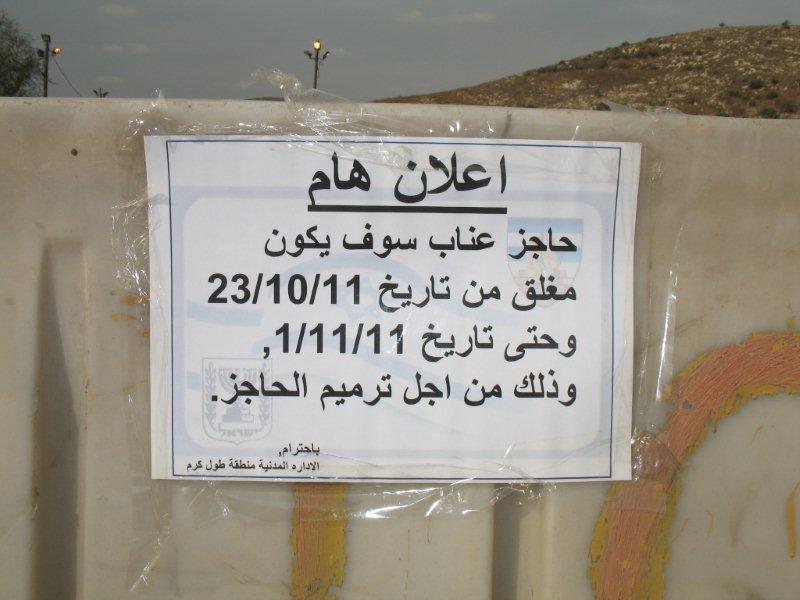 Oct-28-2011Anabta checkpoint 24.10.11
-
Eliyahu CP (109) / Crossing
See all reports for this place-
Eliyahu CP (109) / Crossing This checkpoint, also known as the Fruit Crossing, is one of the main checkpoints between Israel and the West Bank. It is located on Route 55 between Alfei Menashe and the turn to Qalqilya and Zufin, more than 4 km east of the Green Line, in the separation fence, which separates Qalqilya from its lands to the south, thus leaving Alfei Menashe West of the fence - the Seam Zone. This checkpoint, a few kilometers across the Green Line, is intended for "Israeli settlement in the West Bank and the population of the Seam Zone." It is managed by a civil company. Palestinians with a special permit for their lands in the seam area are also allowed to pass through it, on foot, and sometimes by car.
-
Habla
See all reports for this place-
Habla CP (1393)
The Habla checkpoint (1393) was established on the lands of the residents of Qalqilya, on the short road that
connected it for centuries to the nearby town of Habla. The separation barrier intersects this road twice and cut off the residents of Qalqilya from their lands in the seam zone.(between the fence and the green line).
There is a passage under Road 55 that connects Qalqilya to the sabotage This agricultural barrier is used by the farmers and nursery owners established along Road 55 from the Green Line and on both sides of the kurkar road leading to the checkpoint.
This agricultural checkpoint serves the residents of Arab a-Ramadin al-Janoubi (detached from the West Bank), who pass through it to the West Bank and back to their homes. The opening hours (3 times a day) of this agricultural checkpoint are longer than usual, about an hour (recently shortened to 45 minutes), and are coordinated with the transportation hours of a-Ramadin children studying in the occupied in the West Bank.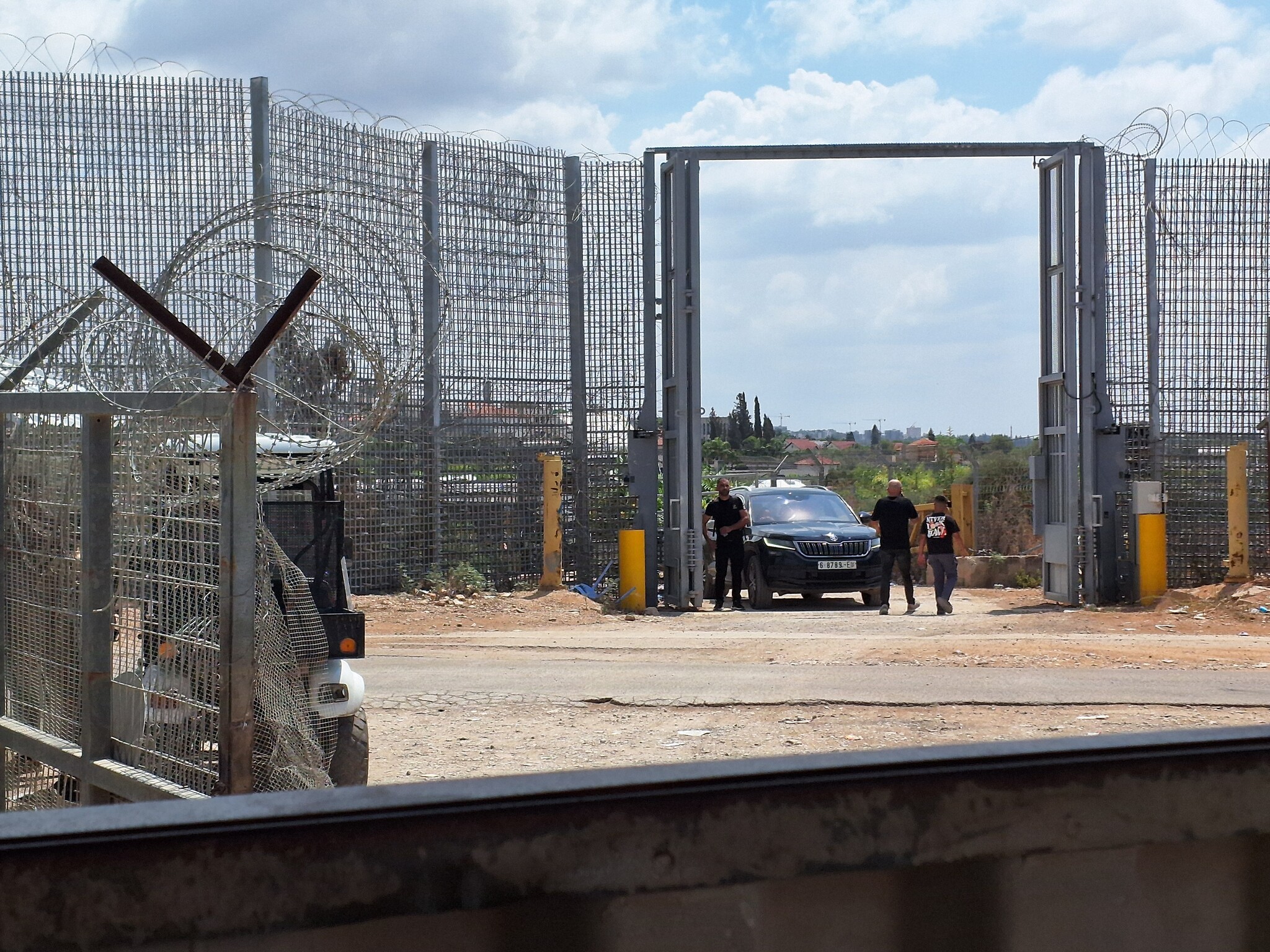 Ronit Dahan-RamatiAug-31-2026Habla. The gate is open
-
Jubara (Kafriat)
See all reports for this place-
The Jabra checkpoint was on Road 557, south of Tulkarm, on the side of the Figs Pass, which is located within the Palestinian Authority (a few kilometers east of the Green Line), and serves as an entry barrier from the territories to Israel. The checkpoint to the village of Jubara, which until 2013 was in the seam area, blocked and surrounded by a fence, was intended for the passage of the family members of the house next to the checkpoint, and also for the MachsomWatch volunteers (with special permission only), on their way to checkpoint 753. on the other side of the village. The soldiers supervising the "fig crossing" also supervised the crossing at this checkpoint, in our shifts we often waited a long time until the key was found and the gate opened. The checkpoint was abolished and became part of the separation fence that was moved west following the High Court.
-
Te'enim Crossing
See all reports for this place-
Te'enim Crossing The Figs checkpoint, located on Road 557, east of the Green Line and the Ephraim Checkpoint (Road 444), is a vehicle crossing, open 24/7 all year round. It serves the Israeli population, including those authorized to enter the Palestinian Authority. The passage of foreigners holding international passports recognized by the State of Israel is approved. In exceptional cases will the passage of a Palestinian be allowed here.
-
