
‘Anabta, Eyal, Jubara (Kafriat), Qalqiliya, Wed 20.2.08, Morning
Eyal Passage 7:00
We heard no complaints; the workers are pleased and say that the passage through is easy.
Lower Jubara 7:15
The gate is locked. We waited for 15 minutes but the soldiers did not find the key. No entry to the village.
Anabta 7:40-8:30
Still no exit from Tulkarm for male residents of Jenin, aged 18-35.
We watched more than 10 people being sent back, which is strange since usually when separation lasts more than a day, the news spread and the restricted residents do not come to the checkpoint at all. We gathered some names for the Association for Civil Rights, for example a student who lives in Ramalla and studies at the University of Bir Zeit, who was sent back because according to his ID he is a resident of Jenin. The student presented a medical certificate to the checkpoint commander, stating that a bullet had hit his shoulder, but he does not have the right document to get him through – a hospital appointment.
The queue of vehicles awaiting passage at the checkpoint is normal for the time and place – about 20 minutes delay.
There is no significant queue at the entrance to Tulkarm, since there is no inspection of ID's. Usually at this checkpoint even cars with Israeli number plates enter without inspection.
Qalqiliya 11:00
Not a very long queue at the exit from the town. No special restrictions on entries and exits for Palestinian vehicles.
As to vehicles with Israeli number plates – according to the explanation we received today, it consists of about 300 people, residents of Qalqliya, who have permits to drive Israeli vehicles. Contrary to what we assumed before, the permit is given to a person and not to a car, although he whose name appears on the list of permit holders, has to present a vehicle permit bearing his own name. It is permitted to a man/woman to drive a car registered under the name of his/her son/daughter but not in a vehicle registered under his/her brother/sister's name.
Assuming that we understand this correctly, this arrangement is meant for Palestinians with an Israeli Identity cards (perhaps due to a marriage to an Israeli partner), who had been vetted by the Military Intelligence.
The restriction may sound almost logical (because of the fear of the entry of vehicles with explosives to Israel) apart from 2 simple facts:
A. One can transfer explosives from an Israeli car to a Palestinian one and vice versa.
B. An Isreali vehicle enters Tulkarm freely.
The checkpoint commander to whom we chatted claimed that we did not have enough information and that we saw the checkpoints 'through a straw' (ie from a narrow point of view). We reiterated that he too was in a similar position and he answered that as a soldier he was obliged to look through' the military straw'.
'Anabta CP
See all reports for this place-
'Anabta CP
The checkpoint is located south of the village of 'Anabta, at the intersection of Road 60 (leading to Nablus at the entrance to Area A), with Road (57, 557, 5576) facing west towards the Einav settlement and the checkpoint at the exit from the West Bank - Figs checkpoint. Until 2010 we used to watch the intersection and report the long columns created due to a slow inspection of the vehicles in both directions.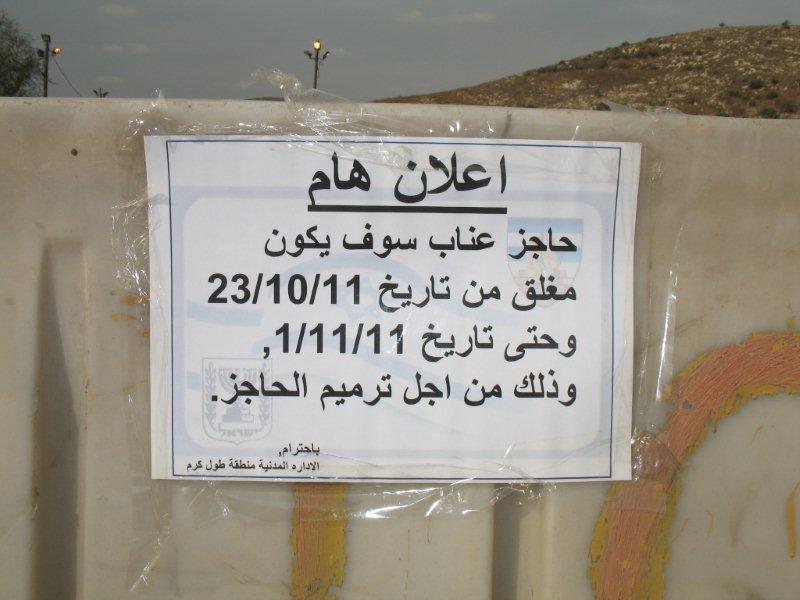 Oct-28-2011Anabta checkpoint 24.10.11
-
Eyal Checkpoint / Crossing
See all reports for this place-
Eyal Checkpoint is intended for pedestrians and Palestinians only. This is the main barrier for workers to cross from the center of the West Bank. Workers with a work permit to enter Israel can pass through it for trade, medicine, and visiting prisoners. The checkpoint was built on the Green Line north of Qalqilya in the separation barrier that surrounds the city. The checkpoint began operating in 2004 by the military. Opening hours on weekdays from 04:00 to 19:00. We started holding shifts there in 2007. We arrived at the checkpoint before it opened at 4 in the morning. We reported on the difficult conditions and the long and cramped queues of workers who must continue their journey by commuting to work throughout Israel. At the end of June 2009, the checkpoint was operated by a civil security company, The transit time has been gradually shortened, today it is faster, but the Palestinians still have to arrive very early to make it to the transportation. Usually, about 15,000 people pass through.
-
Jubara (Kafriat)
See all reports for this place-
The Jabra checkpoint was on Road 557, south of Tulkarm, on the side of the Figs Pass, which is located within the Palestinian Authority (a few kilometers east of the Green Line), and serves as an entry barrier from the territories to Israel. The checkpoint to the village of Jubara, which until 2013 was in the seam area, blocked and surrounded by a fence, was intended for the passage of the family members of the house next to the checkpoint, and also for the MachsomWatch volunteers (with special permission only), on their way to checkpoint 753. on the other side of the village. The soldiers supervising the "fig crossing" also supervised the crossing at this checkpoint, in our shifts we often waited a long time until the key was found and the gate opened. The checkpoint was abolished and became part of the separation fence that was moved west following the High Court.
-
Qalqiliya checkpoint
See all reports for this place-
Qalqilya is surrounded on all sides by the separation barrier. The only exit from the city is in the east of the city on the road that leaves the city in an easterly direction. This is where the checkpoint was located. When the checkpoint was active until 2009 our shifts watched long queues of cars being inspected at the only exit from the city to the West Bank. The checkpoint was canceled, but there is a military presence at the entrance to the city.
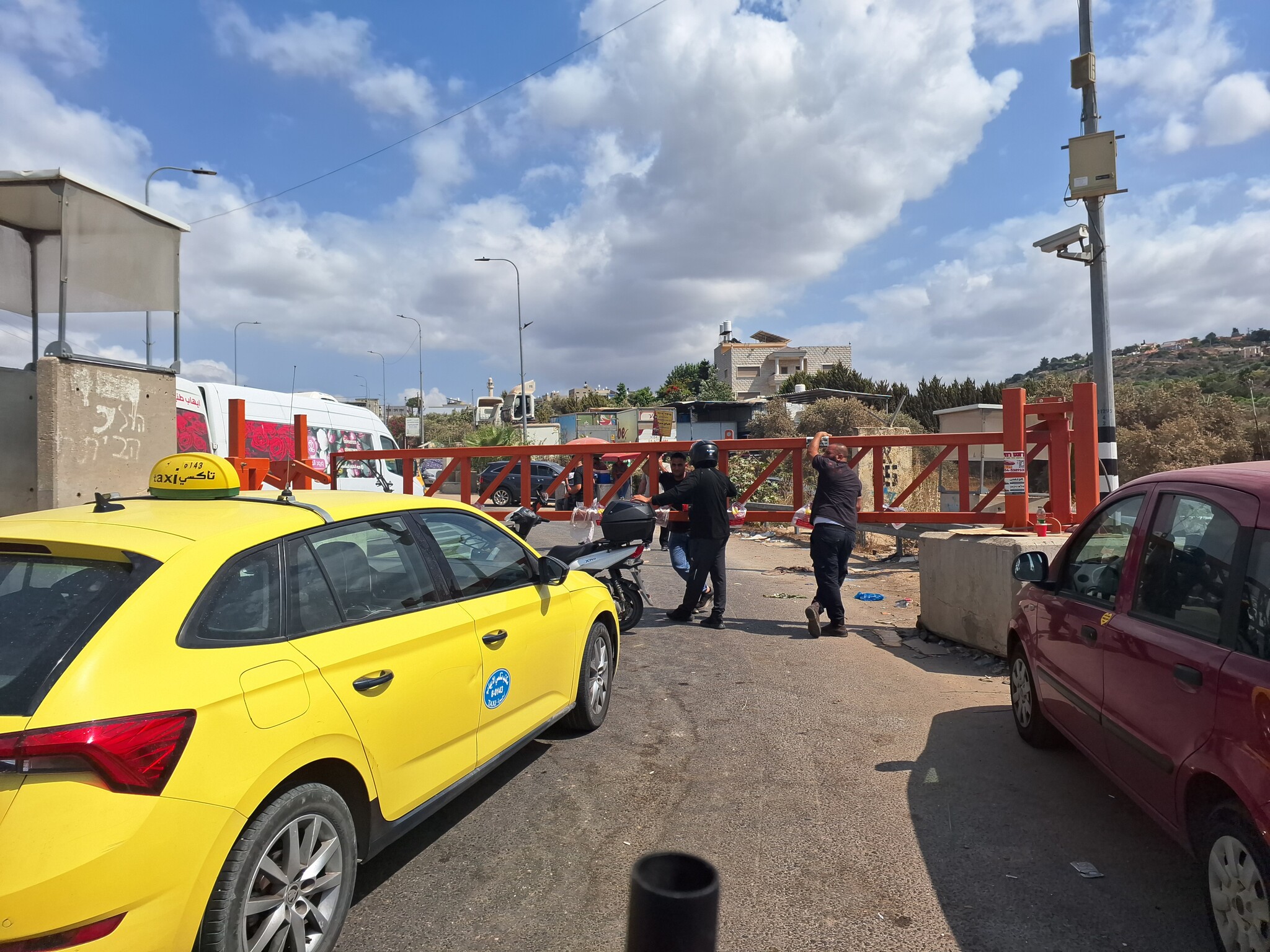 Ronit Dahan-RamatiAug-31-2026Nabi Elias. The gate is closed
-
