
‘Anabta, Falamiya, Habla, Irtah (Sha’ar Efrayim), Tue 19.6.12, Afternoon
12:55
Habla
. Ten youths wait in the shed. One carries a cage of small song birds, canaries, a second with a passiflora seedling that will bear fruit in a month. Both are proud of their purchases; we congratulate them.
13:00
The gate is closed. We don’t see the army. A horse cart and driver join those waiting.
13:12
The army vehicle finally arrives. The crew starts getting organized. Today it’s hot; everyone waits patiently, 13 men and one woman. We notify the humanitarian office that the gate didn’t open on time. We asked the female MP what happened; she said they had trouble with the vehicle.
13:25
The first group from Habla approaches the revolving gate. The gate next to us is still closed.
13:30
Two vehicles with yellow license plates on the patrol road. We’re told they belong to a company repairing the fence. The first five from our side enters the inspection station.
The large gate opens; a truck loaded with saplings is inspected and crosses toward the plant nurseries.
The first group from our side approaches the gate, which is still closed. No one complains. The Occupation routine.
Meanwhile a Palestinian approaches us, asking that we tell his story – a tale of racism. He was born in Habla and lived there with his family until his first wife died of cancer. Twelve years ago he married a woman from Jaljulya and they had three children. His wife isn’t permitted to enter Habla, and he receives permits that are valid for only one year. Each year he must request a renewal of the permit so he can go to Habla to visit his family. He’s worked in Israel since age 20 and speaks fluent Hebrew. It pains him that his name doesn’t appear on the birth certificates of his three children who were born in Israel. His wife is handicapped; his thumb was cut off in a work accident and his family lives below the poverty line.
13:40
Finally, after 40 minutes, the Palestinian driving the horse cart goes through. Two tractors and a car come from the village.
After the young men leave the shed, three bags of second-hand clothing remain. Residents of Habla weren’t allowed to bring them in. Only agricultural produce may enter through this gate. Second-hand clothing endangers Israel’s security!
13:45
We leave the gate and stop at the plant nursery for a short visit.
14:00
Eliyahu gate – Two cars being inspected, the trunk lids open.
14:10
We turn right to Azzun, continue on a dirt road toward Falamya. It’s quiet here; a truck shows up a few minutes later. The driver gets out, goes to the inspection booth, and drives on a few minutes later.
Five bored soldiers in position. They tell us that many people go through at 6 AM.
Streets in Falamya are deserted. It’s afternoon, and hot.
The road north to the village of Sur is wide and has been upgraded.
We turn east toward Funduq and right to Bet Lid. We reach Bet Lid on a lovely, winding road, and continue to Anabta. A soldier in the guard tower; traffic flows in both directions and the coffee seller is still here.
15:25
– the concrete barriers are still here but cars go through freely. A driver who arrives tells us the crossing has been open for a month.
15:40
Jubara (Te’anim). Despite our tags and the flag, we go through without being stopped.
15:45
Irtach. Everyone’s hurrying home. A river of people. They tell us things have improved in the mornings, the crossing goes more quickly. One person adds, with a grin, “All thanks to you.”
A bus enters the interior parking lot. A security man rushes toward the women getting out quickly, tries rudely to stop them. He reports over the walkie-talkie that he was surprised by the bus’s arrival, and that there are also two women here from Machsom Watch. He tells me I’m not allowed to photograph. He tries to control the situation, makes impolite comments to the women, but is given an order over the walkie-talkie and lets them all through, to return home after visiting inmates in Israeli jails.
16:00 We leave.
'Anabta CP
See all reports for this place-
'Anabta CP
The checkpoint is located south of the village of 'Anabta, at the intersection of Road 60 (leading to Nablus at the entrance to Area A), with Road (57, 557, 5576) facing west towards the Einav settlement and the checkpoint at the exit from the West Bank - Figs checkpoint. Until 2010 we used to watch the intersection and report the long columns created due to a slow inspection of the vehicles in both directions.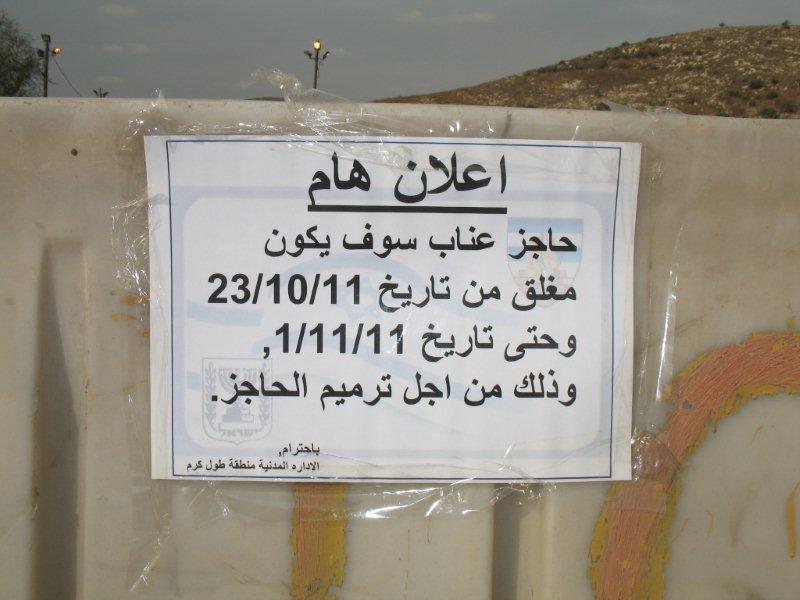 Oct-28-2011Anabta checkpoint 24.10.11
-
Falamiya
See all reports for this placeHabla
See all reports for this place-
Habla CP (1393)
The Habla checkpoint (1393) was established on the lands of the residents of Qalqilya, on the short road that
connected it for centuries to the nearby town of Habla. The separation barrier intersects this road twice and cut off the residents of Qalqilya from their lands in the seam zone.(between the fence and the green line).
There is a passage under Road 55 that connects Qalqilya to the sabotage This agricultural barrier is used by the farmers and nursery owners established along Road 55 from the Green Line and on both sides of the kurkar road leading to the checkpoint.
This agricultural checkpoint serves the residents of Arab a-Ramadin al-Janoubi (detached from the West Bank), who pass through it to the West Bank and back to their homes. The opening hours (3 times a day) of this agricultural checkpoint are longer than usual, about an hour (recently shortened to 45 minutes), and are coordinated with the transportation hours of a-Ramadin children studying in the occupied in the West Bank.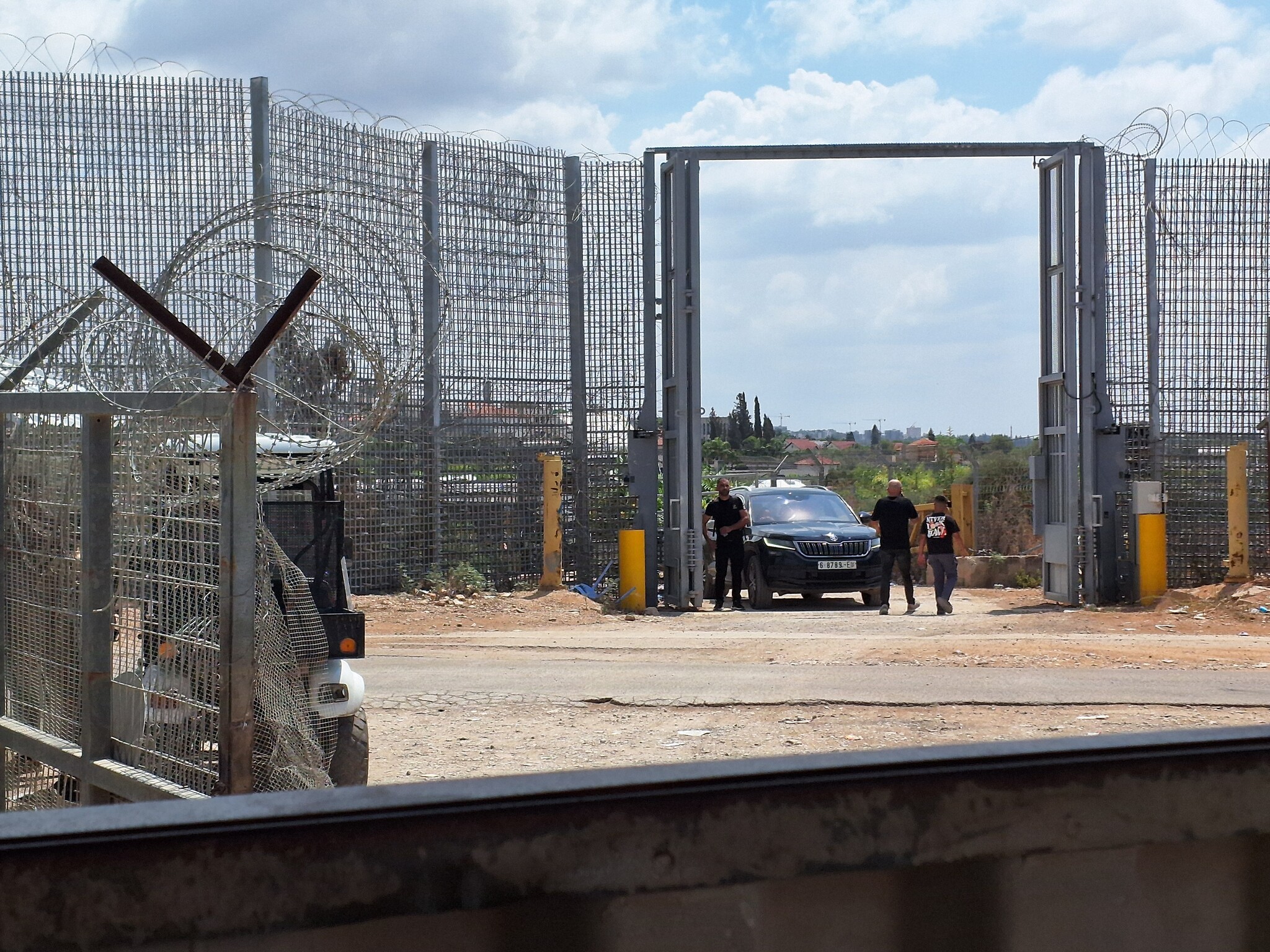 Ronit Dahan-RamatiAug-31-2026Habla. The gate is open
-
Irtah (Sha'ar Efrayim)
See all reports for this place-
The checkpoint is for Palestinians only. It is the main barrier to the passage of workers from the northern West Bank to Israel. Workers with a permit to work in Israel and also for trade (with appropriate permissions), medicine, and visiting prisoners. One can cross the checkpoint only on foot. The checkpoint is located north of Road 557 and south of Tulkarm. Operated by a civil security company, opening hours: between 4:00 and 19:00 on weekdays. As members of Machsom Watch, we began our shifts to this location in 2007. We arrived before it opened at 4 in the morning and report since, on the harsh conditions and the long and crowded queues of workers. The workers who pass by continue their journey by transportation to work throughout Israel. In the first period of its activity, about 3,000 and then 5,000 people passed through this checkpoint every day. Due to the small number of checking points and arbitrary delays for long periods of time in the "rooms", workers feared losing their transportation. Hence workers leave their homes at 2:30 at night to be among the first. Today, 15,000 pass and the transition is faster. Workers are still leaving their homes very early to get past the checkpoint at 7 p.m. In an adjacent compound, there is a terminal for the transfer of goods on a commercial scale, using the back-to-back method.
-
