
‘Anabta, Irtah (Sha’ar Efrayim), Mon 21.12.09, Afternoon
15:10 The barrels checkpoint and the
Anabta checkpoint is deserted.
We saw a girl with beautiful eyes at the Anabta junction, waiting for a ride. We stopped. She was scared at first because she thought we were settlers, but when Nadim asked her where she lived she calmed down. She’s a student at Al-Najah, from Shufa. We gave her a ride to the magnificent village. We met her father next to her house, who gave us home-grown clementines. We saw the American investments in the village, and in response to our question were told that the new school they built is very attractive, but it hasn’t had electricity for a long time because the Israel Electric Company, which supplies electricity to the Palestinian Authority, still hasn’t done so here. Nadim told us that there used to be a direct connection from the village to Tulkarm, but since Avnei Hefetz was established that road is blocked.
Irtah
15:35 – Two booths are open. A stream of people entering and going through quickly. We went to see what was happening on the Palestinian side. People exit the checkpoint quickly and hurry to the taxis or waiting vehicles, to the cries of the peddlers in the little market which has sprung up.
A kind of square pen about 20 meters square has been erected east of the crossing, surrounded by high concrete blocks, with a locked gate. We peeked through a crack between the blocks. Inside were two Palestinian cars on whose license plates was a combination of letters and numbers – unusual numbers. One had two large crosses chalked on it. It’s not clear what the pen is for. (Elinor will send a photo separately)
16:10 Laborers pour from two buses and a line of about 70 people forms, but two additional booths open immediately, besides the two that are already open, so the line advances pretty quickly. While they’re waiting the laborers complain about how hard it is in the morning:
One laborer complains that he gets to the checkpoint at 04:00, but it opens only at 04:30. It’s 06:30 before he gets out, but he’s supposed to be at work by then. He says that other crossings (Eyal) open at 04:00. Is that true?
A second complaint: Sometimes people who go into the rooms for their documents to be inspected have to wait for hours. The long, crowded wait in those rooms is the principal complaint.
A third complaint: A woman reports that in the morning women and men are crowded together.
'Anabta CP
See all reports for this place-
'Anabta CP
The checkpoint is located south of the village of 'Anabta, at the intersection of Road 60 (leading to Nablus at the entrance to Area A), with Road (57, 557, 5576) facing west towards the Einav settlement and the checkpoint at the exit from the West Bank - Figs checkpoint. Until 2010 we used to watch the intersection and report the long columns created due to a slow inspection of the vehicles in both directions.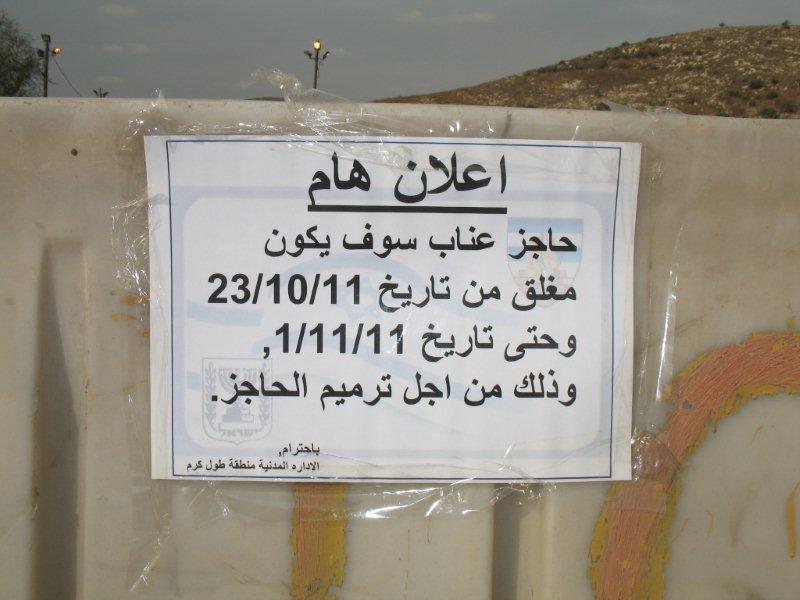 Oct-28-2011Anabta checkpoint 24.10.11
-
Irtah (Sha'ar Efrayim)
See all reports for this place-
The checkpoint is for Palestinians only. It is the main barrier to the passage of workers from the northern West Bank to Israel. Workers with a permit to work in Israel and also for trade (with appropriate permissions), medicine, and visiting prisoners. One can cross the checkpoint only on foot. The checkpoint is located north of Road 557 and south of Tulkarm. Operated by a civil security company, opening hours: between 4:00 and 19:00 on weekdays. As members of Machsom Watch, we began our shifts to this location in 2007. We arrived before it opened at 4 in the morning and report since, on the harsh conditions and the long and crowded queues of workers. The workers who pass by continue their journey by transportation to work throughout Israel. In the first period of its activity, about 3,000 and then 5,000 people passed through this checkpoint every day. Due to the small number of checking points and arbitrary delays for long periods of time in the "rooms", workers feared losing their transportation. Hence workers leave their homes at 2:30 at night to be among the first. Today, 15,000 pass and the transition is faster. Workers are still leaving their homes very early to get past the checkpoint at 7 p.m. In an adjacent compound, there is a terminal for the transfer of goods on a commercial scale, using the back-to-back method.
-
