
‘Anabta, Irtah (Sha’ar Efrayim), Tue 12.1.10, Afternoon
16:00 Anabta
There are no soldiers at the CP.
16:20 Irtah
We arrived and found about 60 people waiting to pass outside of the parking lot (!) The big gate is locked and there is nobody one can turn to. Tom contacted the DCO and the Humanitarian Center to find out if something had happened. It transpired that it is simply because there was "an accumulation of pressure" owing to the returning workmen. We also contacted our Hanna Barak asking that she too should put pressure so that more posts be opened and the passage be sped up.
In the meantime we heard some stories – a Palestinian from Tul Karem told us that he had lived in Miami a very comfortable life until 911. Then they simply confiscated all his papers and "asked" him to leave. Since then he is in Tul Karem.The memories evoked many smiles. On the other hand he also told us a story about a neighbor of his who was taken for interrogation three months ago, during which they broke him one leg and didn't bother to tend it. Since then he isn't taken care of, he has no money for the hospital and he asks for aid (medical? Legal? I didn't understand). The name of the injured person is Abd El Karim Abu Hayam 052-7256742. We gave him a card of Machsom-Watch and suggested that the neighbor contact us and we shall see who can help.
In the meantime more people arrived, we were already 300 outside the parking gate. At about 16:35 the gate was opened and they all ran to the passage. At the passage there are three working stations, the queue now "flows". Whoever stood next to me at the end of the queue found himself on the other side within 7 minutes. Wonderful. Women and children and elderly people who arrive enter without standing in the queue (the workmen immediately make place for them). Although the passage now is really quick there are some who push (the young people!) and the sight is not nice. Every person who lingers to talk to us points out that the real problem is of course in the morning.
17:10 We left.
'Anabta CP
See all reports for this place-
'Anabta CP
The checkpoint is located south of the village of 'Anabta, at the intersection of Road 60 (leading to Nablus at the entrance to Area A), with Road (57, 557, 5576) facing west towards the Einav settlement and the checkpoint at the exit from the West Bank - Figs checkpoint. Until 2010 we used to watch the intersection and report the long columns created due to a slow inspection of the vehicles in both directions.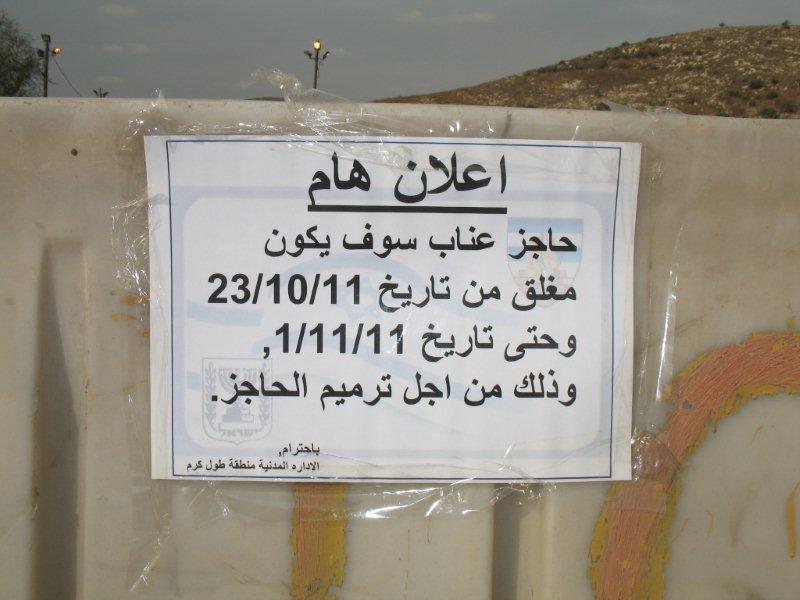 Oct-28-2011Anabta checkpoint 24.10.11
-
Irtah (Sha'ar Efrayim)
See all reports for this place-
The checkpoint is for Palestinians only. It is the main barrier to the passage of workers from the northern West Bank to Israel. Workers with a permit to work in Israel and also for trade (with appropriate permissions), medicine, and visiting prisoners. One can cross the checkpoint only on foot. The checkpoint is located north of Road 557 and south of Tulkarm. Operated by a civil security company, opening hours: between 4:00 and 19:00 on weekdays. As members of Machsom Watch, we began our shifts to this location in 2007. We arrived before it opened at 4 in the morning and report since, on the harsh conditions and the long and crowded queues of workers. The workers who pass by continue their journey by transportation to work throughout Israel. In the first period of its activity, about 3,000 and then 5,000 people passed through this checkpoint every day. Due to the small number of checking points and arbitrary delays for long periods of time in the "rooms", workers feared losing their transportation. Hence workers leave their homes at 2:30 at night to be among the first. Today, 15,000 pass and the transition is faster. Workers are still leaving their homes very early to get past the checkpoint at 7 p.m. In an adjacent compound, there is a terminal for the transfer of goods on a commercial scale, using the back-to-back method.
-
