
‘Anabta, Irtah, Wed 10.12.08, Morning
08:00 Irtach
From the utility structure (what else do you call a built–up space, fenced , covered in metal sheets, where part of the ground is covered in white gravel and brown touf, with a not so young olive tree in the middle?) a man emerges. He lives in Nizlat Issa. He is angry and says that only two counters are operating. He had left home at 02:30 am. He has been at the checkpoint since 03:30 am.
In the parking lot, buses are waiting for the families of prisoners at Megido Prison. People (elderly, women, small children) who have already been inspected are mostly seated in the buses, waiting for additional passengers. A blue slide had been erected, for the childre to play on while waiting, and indeed some children are using it. All in all about 400 visitors are due to go through this morning. One of the men, a member of a prisoner's family, a resident of Nablus, shares with us his experience while waiting for his relatives. His grandaughter is hospitalised in Hadassa Hospital in Jerusalem since the day she was born, a year and half ago. Her father, who needed to renew his permit to stay by her side, would have to wait till sunday, because the DCO in Nablus is closed for the holiday. The grandfather complained that when they return from the visit at the same time as the workers getting back fom their day's work the queues are joined together and again they have to wait for a very long time to go through and catch their tranportation. He asks whether it would be possible to open an extra gate for the families of prisoners returning from their visits so that the exit is quicker. After all – they had been thoroughly checked on their way into Israel, and they go straight to the prison and back from it.
08:12 It's not only the DCO in Nablus which is closed now . From the DCO in Qalqiliya people are being sent over to renew their magnetic tickets for the utility in Irtakh. They took a cab and came here and now they are standing facing the carousel which is revolving only in the opposite direction. (By pushing a button one can change the direction of the revoloving carousel). A security man from the utitlity approaches to see what is going on. Their explanations do not convince him, and he sends them to enter from 'the other side' which will cause them to lose more time and money.
We rang the DCO in Tulkarm. Someone answers that 'nothing can be done. They will not enter from here. It is a waste of their time (ie if they wait here to be let through, it would be useless.) ' Moreover says the man – prisoners' families are leaving through here. Naomi tells him that traffic is very thin at the moment.
08:30 Suddenly a shout is heard from the utility ' Open the carousel!' The carousel is opened and the crowd of magnetic tickets' seekers go through hastily before the carousel is closed again.
08:40 We leave
09:04 Anabta
09:16 We leave.
'Anabta CP
See all reports for this place-
'Anabta CP
The checkpoint is located south of the village of 'Anabta, at the intersection of Road 60 (leading to Nablus at the entrance to Area A), with Road (57, 557, 5576) facing west towards the Einav settlement and the checkpoint at the exit from the West Bank - Figs checkpoint. Until 2010 we used to watch the intersection and report the long columns created due to a slow inspection of the vehicles in both directions.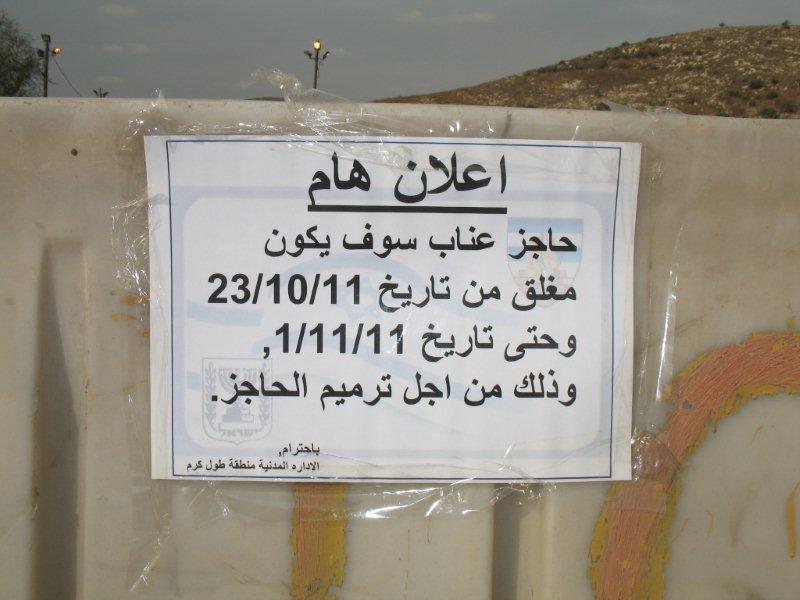 Oct-28-2011Anabta checkpoint 24.10.11
-
Irtah (Sha'ar Efrayim)
See all reports for this place-
The checkpoint is for Palestinians only. It is the main barrier to the passage of workers from the northern West Bank to Israel. Workers with a permit to work in Israel and also for trade (with appropriate permissions), medicine, and visiting prisoners. One can cross the checkpoint only on foot. The checkpoint is located north of Road 557 and south of Tulkarm. Operated by a civil security company, opening hours: between 4:00 and 19:00 on weekdays. As members of Machsom Watch, we began our shifts to this location in 2007. We arrived before it opened at 4 in the morning and report since, on the harsh conditions and the long and crowded queues of workers. The workers who pass by continue their journey by transportation to work throughout Israel. In the first period of its activity, about 3,000 and then 5,000 people passed through this checkpoint every day. Due to the small number of checking points and arbitrary delays for long periods of time in the "rooms", workers feared losing their transportation. Hence workers leave their homes at 2:30 at night to be among the first. Today, 15,000 pass and the transition is faster. Workers are still leaving their homes very early to get past the checkpoint at 7 p.m. In an adjacent compound, there is a terminal for the transfer of goods on a commercial scale, using the back-to-back method.
-
